Why is news traffic falling across the globe?
Over 43 publishers — including leading news platforms in India — among the world’s 50 biggest English news websites witnessed sharp declines in web traffic, as per Press Gazette-Similarweb data
 by
by
Published: May 20, 2026 8:32 AM | 8 min read
 Follow Us

- Digital news publishers are experiencing a significant decline in referral traffic from search and social platforms, primarily due to the impact of artificial intelligence on content discovery and audience behavior.
- Data from April 2026 indicates that only six of the world's 50 largest English-language news websites saw year-on-year traffic growth, with many major publishers, including those in India, reporting substantial declines.
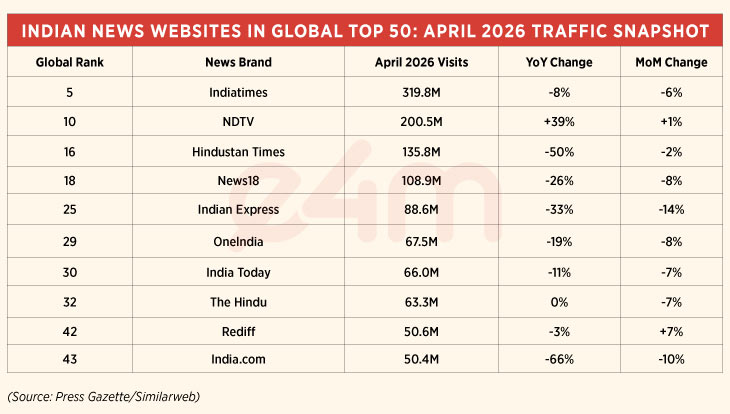
- NDTV emerged as a standout performer among Indian publishers, recording a 39% increase in traffic year-on-year, while others like Hindustan Times and The Indian Express faced sharp declines of 50% and 33%, respectively.
- Experts suggest that the news industry is undergoing a structural reset, with AI-driven changes in user behavior and discovery methods posing both challenges and opportunities for publishers to innovate and strengthen audience relationships.
For nearly two decades, digital news publishing operated on a relatively stable bargain: Google sent traffic, publishers created content, and advertisers funded the ecosystem. That compact is now beginning to unravel.
Across global markets, including India, publishers are witnessing a sharp erosion in referral traffic from both search and social platforms, triggering growing anxiety across newsrooms, media agencies and advertiser ecosystems. At the centre of this disruption is artificial intelligence, which is fundamentally rewriting the mechanics of content discovery, distribution and audience behaviour.
The latest Press Gazette-Similarweb data for April 2026 paints a stark picture. Only six among the world’s 50 largest English-language news websites managed to record Year-on-Year growth, while 44 publishers, including several of India’s biggest digital news brands, saw global visit decline. The slowdown intensified further in April, with 47 out of 50 publishers recording month-on-month traffic declines.
From legacy global media houses to India’s largest publishers, the slowdown no longer appears cyclical. Increasingly, it resembles a structural reset in the economics of digital publishing itself. Global news brands such as Reuters.com (-14%), Forbes (-23%), CNBC.com (-38%) WashingtonPost.com, NPR, BusinessInsider, Telegraph, DailyMail.co.UK (-41%), USAToday.com (-23%), RT.com (-23%), CNN.com (-11%), and Fox News (-10%) were among the worst-hit compared to last year. The publications whose traffic grew during this period include AlJazeera.com (257%), Mirror.co.UK (17%) and NBCnews.com (9%).
Among Indian publishers, NDTV emerged as the standout performer and the only major Indian news platform to register growth on both yearly and monthly bases. The network recorded 200.5 million visits in April, rising 39% year-on-year and 1% month-on-month, making it one of the few publishers globally to buck the broader traffic slowdown.
In contrast, several established Indian publishers reported sharp year-on-year declines. Hindustan Times saw traffic fall 50%, followed by The Indian Express (-33%), News18 (-26%) and Indiatimes (-8%). India.com recorded the steepest decline among Indian publishers, with traffic dropping 66% year-on-year.
Calling it the defining challenge facing publishers today, Nandagopal Rajan, CEO of Indian Express Digital, told exchange4media, “Multiple factors have contributed to the sharp decline in traffic globally over the past year. While Google’s core updates affected visibility across the board, the larger disruption has emerged from the integration of AI into search itself.”
According to Puneet Jain, CEO of HT Digital, “The entire news industry is going through a structural reset in how audiences discover and consume news. Increasing use of AI-generated summaries and answer experiences is changing how users interact with search and information products. That said, web referrals is only one of the channels through which our readers discover us.”
Traffic across the world’s largest publishers is declining at an unprecedented pace as AI-powered search experiences, weakening referral ecosystems and rapidly evolving user behaviour fundamentally alter how audiences consume news online.
The disruption differs from previous platform transitions because it is simultaneously reshaping search visibility, audience acquisition, loyalty economics and monetisation models.
“AI Overviews are generated using publishers’ content, yet traffic to news websites has crashed,” Rajan noted. He added that the more profound structural shift lies in changing user behaviour. “People are no longer clicking on news links as frequently. With AI platforms becoming universally accessible, users increasingly rely on tools like ChatGPT, Gemini and others for refined searches and instant, smarter answers instead of visiting publisher websites directly,” he said, pointing out that AI adoption has fundamentally altered content discovery patterns across the internet ecosystem.
This shift is being viewed as the biggest recalibration of the open web economy since Facebook deprioritised publisher content in 2018. Publishers insist they spent years optimising for discoverability inside platforms they did not control. AI has accelerated that dependency risk overnight.
This is not just a disruption. It is also an opportunity – one to build a more sustainable and higher-quality news relationship with audiences. Strong editorial credibility, responsible use of AI, and innovation in storytelling will be critical differentiators for publishers going forward, Jain noted.
NDTV.com credits its growth to a result of sticking to fundamentals with strong, accurate and responsible journalism and then supplementing it with a strong editorial mix of data-driven insights, easy to understand explainers and user-first experience.
“We have been deliberate about meeting audiences where they are rather than expecting them to come to us,” quips Abhinav Bhatt, Managing Editor of NDTV.com. He explains, “With most people now consuming news on social media and video platforms, we have heavily invested in expanding our digital video output and keeping information simple enough to grasp.”
Also read: Why are news publishers losing web traffic now?
Are Algorithms Alone to Blame?
While publishers acknowledge that AI discovery is accelerating the disruption, many believe the crisis cannot be viewed through the lens of algorithms alone.
Ravanan N, CEO of OneIndia.com believes the industry is underestimating the scale of the structural shift underway.
“Periodic algorithm updates by Google notwithstanding, the ground has shifted permanently, not cyclically,” Ravanan said, adding that three parallel forces are now rewriting the rules of digital publishing.
“First, the referral moat is gone. Google's SGE and AI Overviews now answer queries directly, collapsing the click-through moment that publishers built their entire traffic architecture around. Studies from Ahrefs and SparkToro through late 2025 indicate informational query click-through rates have dropped by as much as 30-40% in categories AI can summarise confidently — finance, health and news. Publishers who over-indexed on SEO volume without owning audience intent are feeling this most acutely.”
“Second, social platforms have algorithmically deprioritised outbound links. Meta's pivot away from news distribution and X’s structural volatility mean referral traffic from social has contracted structurally, not temporarily. The audience still exists. What has broken is the distribution pipe,” he shares.
The third shift, he argues, is uniquely Indian. “Short-form video and vernacular-first apps have created an entirely parallel discovery layer that monetises attention before it ever reaches a publisher’s domain. For Bharat-scale publishers, this represents both the biggest threat and, if approached correctly, the biggest opportunity.”
According to multiple industry studies and publisher estimates, “zero-click” news searches, where users consume information directly within search interfaces without visiting source websites, have surged from roughly 50% to nearly 80% over the past two years.
“More worrying for publishers is the possibility that the open web itself is being gradually disintermediated. Research from Chartbeat and Axios reportedly found Google Search referrals declining by as much as 60% for smaller publishers over the past year, while even larger publishers witnessed drops exceeding 20%. The impact has been particularly severe for explanatory journalism, evergreen content and SEO-heavy publishing models — categories that AI-generated summaries can compress and commoditise most efficiently,” Ravanan explains.
An ad executive said the industry may be entering a “post-referral internet.” “For years, traffic growth masked deeper vulnerabilities in publishing models. The AI era is exposing which publishers truly own consumer relationships and which merely rented audiences from platforms,” the executive observed.
A senior agency executive overseeing digital investments for large advertisers said the implications extend beyond publishing alone. “For years, programmatic advertising relied on abundant scale across the open web. If AI interfaces continue intercepting discovery before users reach publisher environments, the economics of digital advertising itself will inevitably need recalibration,” the executive said.
“Multiplatform footprint should be considered”
Several publishers argued that web traffic alone no longer represents the full extent of audience reach and engagement across platforms such as YouTube, apps and social ecosystems.
Puneet Jain says, “Hindustan Times commands a dominant multi-platform digital footprint, with 8.6 million YouTube subscribers, 8.7 million X followers, 7.5 million Facebook followers, and 3.3 million Instagram followers, making it one of India’s most followed news brands across social media. Its YouTube network spans multiple dedicated channels, extending its reach to the entire world. Further, the Hindustan Times App, which serves original and diversified content in the most engaging manner, is trusted for its quality, which is evident in the fact that it is the highest-rated general news app in India at a rating of 4.6.”
News industry expert Sandeep Amar, founder of Pdlab.in, too believes the decline is disproportionately impacting text-heavy news platforms. According to him, a significant portion of text-based news consumption and discussion has gradually migrated to social platforms such as X and Reddit.
“The larger text-news publishers are losing ground because much of their coverage has become increasingly commoditised, flat reportage with limited point of view, opinion or ideation,” Amar noted. “In contrast, smaller publishers and social-first ecosystems are often offering sharper perspectives, differentiated narratives and more engaging discourse.”
At the same time, Amar pointed out that video-led news consumption continues to remain resilient. “Video news is still delivering strong numbers and, unlike text traffic, it is not witnessing a comparable decline,” he said. “With major global developments such as elections, the Iran conflict and other high-intensity news cycles, overall news consumption remains robust. What is changing is the format and the platform through which audiences are consuming it.”
Experts also noted that the current news cycle in India (May) remains exceptionally strong, driven by multiple developments including state election results and government formation across five states, alongside growing public discourse around potential government austerity measures linked to the West Asia crisis and its broader implications for consumers and the economy.
Read more news about Digital Media, Internet Advertising, Marketing News, Television Media, Radio Media
For more updates, be socially connected with us onInstagram, LinkedIn, Twitter, Facebook, YouTube & Google News
