PKL's next rights deal is tipped for a premium. But who will pay for it?
Estimates put the next 5-yr rights cycle at ₹1,000-1,300 cr as audiences & ad volumes grow, but brands see limited pricing headroom and a concentrated broadcast market could constrain price discovery
 by
by
Published: Sep 7, 2026 9:27 AM | 15 min read
 Follow Us

- The Pro Kabaddi League (PKL) is preparing for its upcoming media rights auction, with estimates for the next five-year cycle ranging from ₹1,000 crore to ₹1,300 crore, compared to the previous cycle's ₹905 crore deal with Star India.
- Despite PKL's growth, including a significant increase in viewership and advertising volumes, the overall non-cricket sports market in India has shrunk, raising concerns about the competitiveness of the media rights auction.
- The previous auction in 2021 resulted in only one bidder, Star India, leading to questions about genuine price discovery; the upcoming auction will be crucial in determining if more bidders will participate.
- Experts suggest that the valuation of PKL's media rights may depend on how the rights are packaged, with potential for broader participation if structured differently, amidst a market dominated by cricket.
Five years ago, the Pro Kabaddi League went to the market for its media rights and came back with just one final bidder. This time, the league is bigger. But is the market?
That is the question confronting PKL as its five-season media-rights agreement covering Seasons 8 to 12 comes to an end. Star India, now part of JioStar, acquired the previous cycle for a reported ₹905 crore, or roughly ₹181 crore per season.
Industry estimates shared with exchange4media now put the next five-year cycle anywhere between roughly ₹1,000 crore and ₹1,300 crore, with one media buyer putting ₹1,200 crore as a realistic base case.
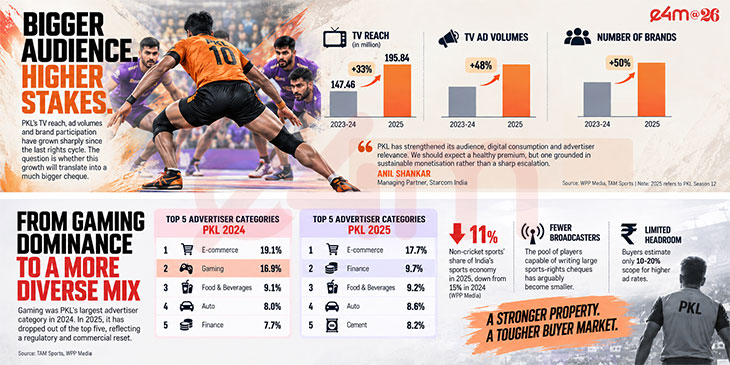
There is evidence to support a premium. PKL's 2025 season reached nearly 196 million viewers on television, according to WPP Media. Separately, data from TAM Sports shows television advertising volumes during PKL 2025 were nearly 48% higher than in the 2023-24 season, while the number of brands advertising in the league increased by more than 50% over the previous season.
But there is another set of numbers that complicates the valuation story. Non-cricket sports accounted for just 11% of India's sports economy in 2025, down from 15% in 2024, according to WPP Media. And the pool of broadcasters capable of writing large sports-rights cheques has arguably become smaller.
That leaves PKL facing a curious equation: a stronger property entering a potentially less competitive buyer market.
The next rights deal, therefore, will test not merely how much PKL has grown, but whether that growth can finally produce the competitive price discovery that was largely missing five years ago.
A 12-season league, but only one open rights auction?
There is an important history behind that question. PKL began in 2014, with Star India as its broadcast partner from the inaugural season. A year later, Star acquired a 74% stake in Mashal Sports, the company that owns and operates the league. Star continued as PKL's media-rights partner through its first seven seasons.
That meant PKL's media rights were not being periodically put to the market through the kind of competitive auction now associated with major sporting properties.
That changed in 2021. Ahead of Season 8, Mashal Sports offered PKL's media rights to domestic and international players through an open tender for the first time in the league's history, covering five seasons from Season 8 to Season 12. Mashal at the time described PKL as the first Indian sports league outside cricket to auction its media rights.
The move followed a disagreement between PKL's 12 franchises and Star over the appropriate value of the rights and the revenue-sharing arrangement. Contemporary reports said franchise owners had pushed for an open auction as they sought better price discovery for a property they believed had grown substantially in value.
But the auction produced an unusual outcome. Despite other companies showing initial interest, Star ultimately emerged as the sole bidder. The consolidated package carried a reserve price of around ₹900 crore, and Star retained the rights for a reported ₹905 crore. Some franchise owners subsequently questioned whether the process had produced genuine price discovery, while Mashal maintained that the rights had been offered through a fair and independently overseen open tender.
That history makes the upcoming cycle particularly significant. PKL may be 12 seasons old, but this is effectively only the second opportunity in its history for an open market to put a price on its media rights.
And the first attempt never produced a bidding contest.
₹905 crore then. ₹1,200 crore now?
Anil Shankar, Managing Partner, Starcom India, estimates the next five-year rights cycle at approximately ₹1,100-1,300 crore, with ₹1,200 crore as his base case. “The previous ₹905 crore deal provides a useful benchmark, but PKL has since strengthened its audience, digital consumption and advertiser relevance. We should expect a healthy premium, but one grounded in sustainable monetisation rather than a sharp escalation,” he said.
Uditvanu Das, Vice President, Havas Play - part of Havas Media Network India, is more conservative. He believes a 10-15% increase over the previous cycle's annual value is a realistic base case, potentially moving towards 20% if multiple bidders participate or the rights are repackaged.
At the same five-year tenure, those assumptions would value the next cycle at approximately ₹996 crore to ₹1,041 crore at a 10-15% premium, rising to around ₹1,086 crore at 20%. Das uses the WPL as one reference point, noting that its existing five-year deal works out to roughly ₹190 crore per season while PKL provides considerably more matches, broadcast hours and advertising inventory.
But how much the rights ultimately command may depend less on those comparisons than on something more basic: how many bidders turn up.
Nearly 196 million on TV
PKL has a substantial audience case to make. According to WPP Media's India Sports Sponsorship Report 2025, PKL generated television reach of 195.84 million viewers during the August 29-October 31, 2025 season, with an average television rating of 0.6.
That put it ahead of the Women's Premier League's 166.95 million television reach and the Indian Super League's 122.86 million. The IPL remained in a different league altogether at 495.23 million viewers and a 2.96 TV rating.
Within PKL, Dabang Delhi KC recorded the highest reach at 123.31 million, followed by Telugu Titans at 104.78 million and Puneri Paltan at 100.14 million, according to the WPP report.
PKL's digital footprint is considerably smaller than cricket's but established. WPP puts it at approximately 1.7 million Facebook followers, 1.1 million Instagram followers and 361,000 followers on X in its 2025 league comparison.
Das also points to 936 million video views during Season 12, up 56% on the previous season, as evidence that digital consumption is becoming increasingly important to the property's economics.
The advertising market is getting broader
The advertiser numbers add another dimension to the valuation argument. According to TAM Sports data shared with exchange4media, PKL's indexed television advertising volumes have risen substantially across the past three seasons.
Taking PKL 2023-24 as an index of 100, ad volumes increased to 103.7 in 2024 and 148.5 in 2025. That means PKL 2025 delivered approximately 48.5% more television advertising volume than 2023-24 and around 43% more than 2024.
The comparison covers commercial advertising during live matches and excludes promos, fillers, and pre-, mid-, and post-match programmes. TAM Sports tracked 23 channels during PKL 2025 compared with 17 during PKL 2024.
The advertiser pool expanded alongside those volumes. The number of advertising categories increased from 10 in PKL 2024 to 17 in 2025, a 70% increase. Advertisers rose from 10 to 13, up 30%, while brands increased from 13 to 20, a jump of nearly 54%, according to TAM Sports.
That matters because a higher rights valuation ultimately needs to be supported by a property capable of generating more commercial revenue. And the composition of that advertising is changing too.
Finance and cement replace gaming at the top
In PKL 2024, financial services was the largest advertising category, accounting for 31.4% of television ad volumes, followed by building materials/systems at 19.2% and e-commerce gaming at 16.9%.
By 2025, the mix had changed. There is an important caveat to that comparison. Sporta Technologies, which operates Dream11, accounted for 16.9% of PKL's television ad volumes in 2024. But the real-money gaming industry that supported that spending has since undergone a regulatory and commercial reset.
Following the prohibition on online money games and their advertising, Dream11 discontinued paid contests, making a return to its earlier advertising levels far from certain. The shift is already visible: e-commerce gaming, which accounted for 16.9% of PKL's ad volumes in 2024, was no longer among its top five advertising categories in 2025.
Corporate-financial institutions became the largest category with 21.4%, followed by cement at 18.8%, financial services at 18.7%, building materials/systems at 14.3%, and energy drinks at 6%, according to TAM Sports.
The advertiser rankings show the same transition. In 2024, Shriram Finance accounted for 31.4% of ad volumes, followed by Pidilite Industries at 19.2%, Sporta Technologies at 16.9%, Mother Dairy at 10.9%, and Red Bull at 9.8%.
In 2025, National Payments Corporation of India emerged as the largest advertiser with 21.4%, followed by UltraTech Cement at 18.8%, Shriram Finance at 18.7%, Grasim Industries at 14.3%, and SBI at 8.9%.
TAM Sports also identifies several categories that were new to PKL in 2025 compared with the previous season, including corporate-financial institutions, cement, banking services and products, retail banking, tyres, anywhere banking, commercial vehicles, education loans, laptops/notebooks and mouth fresheners.
In other words, PKL isn't merely generating more advertising volume. Its advertiser base is also broadening into mainstream financial, banking, building-material and industrial categories.
The question is how much more those advertisers are prepared to pay.
How much more will brands pay?
Das sees limited headroom beyond 10-15%.
“There's some room, but not a great deal beyond 10-15%. PKL's advertiser base is largely mass-market and category-driven, and it is more price-sensitive than cricket. A steep rights increase would need to be matched by real audience and engagement gains for advertisers to absorb it comfortably,” he said.
Shankar sees slightly greater room.
“There is headroom to increase advertising rates, provided audience delivery and inventory quality continue to strengthen. A 10–20% increase could be achievable, but the bigger opportunity lies beyond spot-rate inflation through deeper brand integrations, sponsorships, digital extensions and audience-led experiences that expand PKL’s overall monetisation potential,” he said.
The distinction is critical.
If a broadcaster pays 25-30% more for the rights but conventional advertising rates can rise only 10-20%, where does the remaining value come from?
It would have to be extracted through a combination of higher inventory utilisation, sponsorships, integrations, digital monetisation and other commercial products.
Advertiser participation cannot simply be assumed either.
One large financial-services advertiser contacted by exchange4media said it does not plan to advertise on PKL this season. The executive requested anonymity.
For advertisers that do participate, however, audience delivery appears to remain the fundamental test of PKL's value.
A senior marketing executive at a leading cement company, who did not wish to be named, said the company's evaluation of the property is driven primarily by the audience it delivers rather than the nature of the sporting content itself.
“We don’t really look at the content angle unless there is a negative aspect to it. For us, it is purely about the audience. We look at the amount of content, the attention it gets, the viewership and the audience it gathers. That is the primary and most important factor for us. The content aspect may be valuable to other advertisers, but from our point of view, the audience is what matters.”
The executive also pointed to continuity as an important factor in sports partnerships, even as pricing remains part of the equation.
“We’ve had a long-standing relationship with PKL, and that is also an important part of how we look at our partnerships. We tend to stay with media partners who have been there with us for a long period of time. So, while there are always considerations around rates and how they move up or down, we value partners who have consistently been there for us over the years.”
But who will bid?
This is where PKL's history becomes particularly relevant.
The league has already experienced what happens when an auction has only one bidder.
Das believes there is greater potential for competition today than there was in 2021. He points to Zee's sports ambitions and Sony's acquisition of major multi-sport rights as reasons they could be plausible contenders.
At the same time, he sees JioStar as the strongest candidate because of its longstanding association with the league, its relationship with Mashal Sports and its television and digital distribution infrastructure.
Indranil Das Blah, Founder, AMP Sports & Entertainment, is more sceptical about the depth of India's broadcaster market.
“PKL has very clearly established itself as the second-best sports property in the country. That’s a given. But having said that, what has happened with the ecosystem, particularly the broadcast ecosystem, has had a significant impact. There are barely any serious players apart from JioStar and Sony, and I think that has an impact on the value of the next media-rights deal,” he said.
For Das Blah, that could constrain the valuation irrespective of how much PKL itself has grown.
“It’s not necessarily about how the league itself is doing, but about the current state of the broadcast ecosystem in India. That’s where I think the value could diminish in the new media-rights cycle,” he added.
And he sums up the structural problem more starkly, “Sadly, it is effectively a duopoly now, with very few players in the market.”
This is perhaps the biggest variable in the entire valuation exercise.
A sports property is not ultimately worth what one broadcaster thinks it is worth. An auction discovers its price when at least two bidders want it badly enough.
That is precisely what PKL did not get in 2021.
Could TV and digital bring more bidders?
According to experts, one way of widening the field could be to change how the rights are packaged.
The 2021 tender itself offered different packages covering television, digital, gaming and consolidated rights, although Star eventually retained the consolidated package.
Five years later, however, the economics of sports streaming are very different.
Across the Indian sports market, television advertising remains larger, but digital is closing rapidly.
WPP Media estimates television sports advertising reached ₹5,117 crore in 2025, up 16.4%, while digital sports advertising increased 24% to ₹4,449 crore. Television accounted for roughly 53% of the market and digital 46%, leaving a gap of only ₹668 crore.
Shankar believes that makes the TV-digital equation central to PKL's valuation.
“The TV-digital equation will be central to PKL’s valuation. TV delivers scale, while digital adds incremental reach, targeting and engagement. Rather than viewing them as competing platforms, the opportunity is to package them as complementary strengths. Selective unbundling could also unlock greater value by allowing platforms to monetise distinct audiences and content opportunities more effectively,” he said.
Subhamoy Das, Senior Vice President, Head of Sports & Entertainment, India, ESP & Content, WPP Media, also sees rights packaging as a potential route to extracting more value from the property.
“For PKL, differently structured rights packages could potentially unlock greater value by allowing broadcasters and platforms to monetise distinct audience segments more effectively. This becomes particularly relevant because PKL is still relatively underdeveloped versus its long-term potential.”
He argues that the opportunity could extend beyond a straightforward TV-digital split.
“Smarter packaging across linear, digital, language and possibly platform-specific rights could broaden participation and improve overall monetisation.”
Uditvanu Das similarly believes differently structured rights could widen bidder interest.
The underlying question is whether greater unbundling creates more bidders and therefore better price discovery, or whether an integrated TV-digital proposition remains commercially more valuable to whoever ultimately acquires the property.
A ₹18,864-crore industry, with only 11% outside cricket
India's sports economy is booming. WPP Media estimates the industry reached ₹18,864 crore in 2025, crossing $2 billion and growing 13.4% year-on-year. The market has almost doubled from ₹9,530 crore in 2021.
But the growth has become more, not less, concentrated around cricket. Cricket generated ₹16,704 crore in 2025, or 89% of the sports economy, compared with 85% in 2024. Emerging sports collectively declined from ₹2,460.7 crore to ₹2,159.9 crore, shrinking from 15% to 11% of the overall market.
The decline is not entirely a verdict on consumer appetite for non-cricket sports. WPP points partly to the postponement of the ISL and comparison with an Olympic-led 2024, while noting that PKL stayed on course. But it exposes the structural challenge.
PKL is trying to command a higher valuation at a time when the overall sports economy is growing rapidly, but the share captured by sports outside cricket is shrinking.
That makes PKL an unusually important test case.
Can PKL break the non-cricket ceiling?
The larger non-cricket market may be under pressure, but industry executives argue PKL has separated itself from the pack.
WPP Media’s Das describes PKL as the clear number two sports property in the country after cricket, arguing that its annual scale and consistency distinguish it from other non-cricket properties.
“PKL is, in our view, the undisputed No. 2 sports property in India after cricket. Its biggest strength is that it offers annualised scale, consistency and appointment viewing attributes that are increasingly valuable to advertisers,” he said.
But being No. 2 does not automatically justify a substantially higher rights cheque. Das says the next leg of growth has to come from converting that audience strength into deeper engagement and commercial value.
“PKL was instrumental in taking kabaddi from a largely regional sport to a national broadcast proposition, and the next phase lies in deepening reach, engagement and advertiser participation. That said, any significant rights premium must ultimately be supported by corresponding growth in ratings, digital consumption, advertiser demand and monetisation potential, not audience growth alone,” he added.
But after 12 seasons, PKL still has one thing left to prove.
Can more than one broadcaster be persuaded to put a serious cheque on the table?
If multiple bidders turn up, the next auction could finally establish a genuine market benchmark for what industry executives describe as India's No. 2 sports property after cricket.
If they don't, it will reveal something equally consequential: that in India's increasingly concentrated sports-media market, even a league with nearly 200 million television viewers, rising ad volumes and a broader advertiser base may struggle to turn audience growth into a bidding war.
exchange4media reached out to JioStar, the incumbent media-rights holder, and , which owns and operates PKL, for their comments on the upcoming rights cycle. JioStar declined to comment, while Mashal Sports said it was not yet ready to comment. Their responses will be incorporated as and when they are available.
Read more news about Marketing News, Advertising News, PR and Corporate Communication News, Digital News, People Movement News
For more updates, be socially connected with us onInstagram, LinkedIn, Twitter, Facebook, YouTube & Google News