The Amritraj Brothers - An Indian family on the world stage
Guest Column: Bhuvan Lall chronicles the extraordinary journey of the Amritraj brothers, from Chennai to the global stage, and the values of self-belief, family and perseverance
 by
by
Published: Sep 7, 2026 8:19 AM | 8 min read
 Follow Us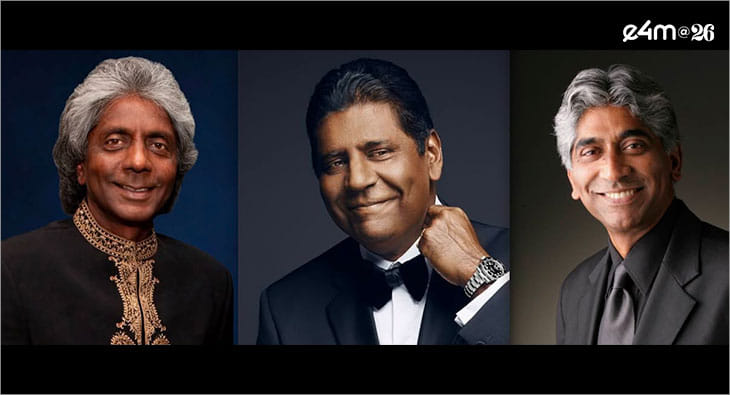

- On June 23, 2026, Vijay Amritraj was awarded the Padma Bhushan, India's third-highest civilian honor, during a ceremony at the Rashtrapati Bhawan in New Delhi, attended by prominent figures from various sectors.
- Amritraj, a notable Indian tennis player, rose from humble beginnings in Chennai to achieve significant success in international tennis, including victories over legendary players and a career-high ATP ranking of World No. 18.
- He, along with his brothers Anand and Ashok, became the first Indian siblings to compete together at Wimbledon, contributing to India's presence in global tennis and later branching into successful careers in acting and film production.
- The Amritraj brothers' journey is celebrated as a testament to resilience and determination, with Vijay continuing to advocate for tennis and philanthropy while maintaining his Indian roots despite living abroad.
On the evening of 23 June 2026, the Ganatantra Mandap of the Rashtrapati Bhawan in New Delhi was embellished for a premier ceremonial event. A magnificent investiture ceremony was underway. The top political leadership, members of the judiciary, civil servants, defence officials and eminent citizens of India were present. At the announcement of his name, a tall, handsome Indian dressed in a Wimbledon green Jodhpur jacket, gracefully crossed the red carpet with folded hands. The President of India, Droupadi Murmu, awarded him the Padma Bhushan, India’s third-highest national honor.
The entire hall applauded one of India’s greatest tennis players - Vijay Amritraj.
Volumes have already been written about Vijay Amritraj, and yet his story never loses its power to astonish and inspire. It is, at its core, a tale of extraordinary courage: a young man from Madras (Chennai now) who looked at the towering giants of world tennis and refused to be intimidated by any of them. He came from a country with no real tennis tradition to speak of, no infrastructure, no safety net, only talent, hunger, and an unshakeable belief that he belonged on the biggest stages in the sport.
This story opens in the 1960s, when three brothers from a middle-class Roman Catholic Christian family and a modest home in Madras took to playing tennis. Their mother Maggie funded the lessons from a packaging business run out of the garage. Their father Robert, a railway man, watched three sons become the first Indian family of professional tennis players. Their grandfather’s wish that one boy play Wimbledon was answered by all three.
The gifted tennis players became the first three siblings from India to compete in the same edition of the Wimbledon tournament and to walk out together onto the Centre Court and, later, onto the world stage. Before that, the eldest, Anand Amritraj, held India’s junior title from 1965 to 1967; Vijay continued the family tradition from 1968 to 1970, and the youngest, Ashok, too became the top junior champion of India.
Vijay, once an ailing child whose mother took school notes at his hospital bedside, rose to beat the best in international tennis. In July 1973, at just twenty-one years old, Vijay stunned the tennis world by capturing the Volvo International title in Bretton Woods, USA, a triumph that announced, unmistakably, that India had arrived on the global tennis map. What followed was nothing short of remarkable. He didn’t simply compete against the legends of his era; he beat them. Bjorn Borg. Jimmy Connors, John McEnroe. Ivan Lendl. Rod Laver. Stan Smith. His success led a journalist to create the acronym for tennis greats – the ABC of Tennis (Amritraj, Borg and Connors). Each victory was a statement, proof that Vijay could stand toe-to-toe with anyone the sport had to offer. Wimbledon and the US Open both saw him repeatedly claw his way into the quarterfinals, cementing his place among the game's true powerhouses.
Vijay’s career spanned an extraordinary arc: a first professional match in 1970, a last in 1993, sixteen singles titles, and quarterfinal runs at both Wimbledon and the U.S. Open. Vijay achieved a career-high ATP singles ranking of World No. 18 in 1980. A three-time National Singles Champion, he represented India with distinction for over two decades, helped the country reach the Davis Cup Finals in 1974 and 1987, and was selected as an Olympic torchbearer for the 1988 Seoul Olympics. Standing six foot four, he carried with him not only his own ambitions but the pride of India as well as an entire diaspora. “Every time I played,” he once said, “people would come and give me a note at the end of the matches. Indians who had left the country to try their luck somewhere else, doctors, engineers. When I asked them why they were thanking me, they said their employers, after seeing me play, were proud to have an Indian in their business.” In the 1980s, he stepped from the tennis court onto the screen, playing an MI6 agent in the film Octopussy, and stood racket in hand, beside James Bond, steering him to a career as an actor in Hollywood. Today his elegant and eloquent voice is a familiar presence on Tennis commentaries across the world.
On the tennis courts around the world, alongside Vijay stood Anand Amritraj, his elder brother, who learned the geometry of doubles, the quiet art of covering another man’s space. A formidable player in his own right, he reached as high as seventy-fourth in the world in singles. Together, the two formed a terrific doubles partnership of real distinction, winning eight titles and reaching the semi-finals at Wimbledon in 1976. Time and again, the two brothers faced the very best in the world and refused to back down, a living testament to grit, determination, and an unbreakable competitive fire.
In 1974, the chance to win the Davis Cup for the first time for India rested on the shoulders of Anand and Vijay. They had to beat South Africa and win the Davis Cup for India. South Africa, with its official policy of apartheid, insisted that Indian crowds at Ellis Park in Johannesburg would be segregated for the matches. The Government of India, opposed to the racist apartheid laws of South Africa, elected to boycott the finals. It was a tough call to withdraw from the Davis Cup finals, but the principled stance of the players was appreciated globally. A few years ago, Anand also took on a different kind of leadership, briefly serving as non-playing captain of India’s Davis Cup team.
The youngest of the three, Ashok reached the Wimbledon juniors final in 1974 and notched four professional victories before choosing an entirely different arena. He crossed from the baseline into one of the toughest arenas – the global entertainment business. In Tinseltown, he traded the tennis court for the film studio, and Hollywood has been his court ever since. Ashok ambitiously founded Hyde Park Entertainment to develop, finance, and produce entertainment products for the world market. Hyde Park’s big-budget productions have attracted the A-list and Oscar-winning talent of Hollywood, including Angelina Jolie, Antonio Banderas, Bruce Willis, Cate Blanchett, Dustin Hoffman, Jennifer Aniston, Idris Elba, Richard Gere, Robert De Niro, Susan Sarandon, Sylvester Stallone, among others. Ashok’s box office triumphs include ‘Ghost Rider: Spirit of Vengeance’ starring Nicolas Cage; ‘Walking Tall’ featuring Dwayne Johnson; ‘Premonition’ with Sandra Bullock; and the $ 164M-plus-grossing Steve Martin-Queen Latifah hit comedy ‘Bringing Down the House’. Hyde Park's critically acclaimed features are ‘Shopgirl’ starring Steve Martin and Claire Danes, and ‘99 Homes’ featuring Andrew Garfield and Laura Dern.
More than a hundred films later, he stands near the peak of his career as the most successful Indian in Hollywood history, with a total gross upwards of two billion dollars. Besides winning the International Emmy and being applauded at the Golden Globes and Cannes, Ashok was conferred with the prestigious Chevalier, the French distinction of the Ordre national du Mérite awarded by the President of the French Republic.
Meanwhile, Vijay’s dedication to the sport that made him world famous continues, and he is the only Asian to have been unanimously elected to honorary membership of The All England Lawn Tennis Club at Wimbledon. In 2024, he became the first Asian man inducted into the International Tennis Hall of Fame in the Contributor category, recognition that gathered a lifetime as player, broadcaster, administrator, and advocate into a single, overdue sentence. And even though a resident of Southern California for four decades, he holds on to his Indian Passport.
The Amritraj brothers took India to Davis Cup finals, then carried the Indian courtesy to all the courts around the world, and now with quiet philanthropy, they are giving back to the land where they were born. Vijay credits his mother, Margaret (Maggie) Amritraj, herself a tennis player, with teaching him to accept challenges head-on. In his autobiography, he wrote: “How many families with all the right connections, facilities and geographical advantages try and fail to get one son or daughter through the gates of the All England Club with a competitor’s pass tied to their lapel? What kind of absurd vision did it take for one woman to believe that she could do it with three? I suppose you have to know my mother to have some idea; even then, knowing her as well as I do, I am not sure I can fully explain it.”
It is the grit and sacrifice of ordinary middle-class Indian parents, and the refusal to accept the world’s map of possibility that turned three boys from Chennai into a family name that has gone global. The inspirational story of the three Amritraj brothers is worthy of a feature film or web series. Perhaps, one day, Ashok will turn the camera on his own family’s story. If he does, the circle will at last be complete, from a modest home in Madras, to the grass of Centre Court, to Hollywood and the screens of the world. The lesson for us is not fame alone. In the decades I have known the three self-effacing Indian sports champions, they have never taught me how to improve my forehand. But somewhere along the way, the three Amritraj brothers taught me something else. That life itself is a long, quiet lesson in self-belief, family values, and modesty.
Bhuvan Lall is a filmmaker, novelist, author, biographer and creative entrepreneur
Read more news about Digital Media, Television Media, Out of Home Advertising, Print Media, Latest Advertising India
For more updates, be socially connected with us onInstagram, LinkedIn, Twitter, Facebook, YouTube & Google News