The Final Is the Real Blockbuster: Cricket’s new viewership economy
Guest Column: Ganapathy Viswanathan, Independent Communication Consultant & author, writes how a Cricket World Cup final is now a cultural event as much as a sporting one with a big bonus for brands
 by
by
Published: Mar 8, 2026 8:41 AM | 4 min read
 Follow Us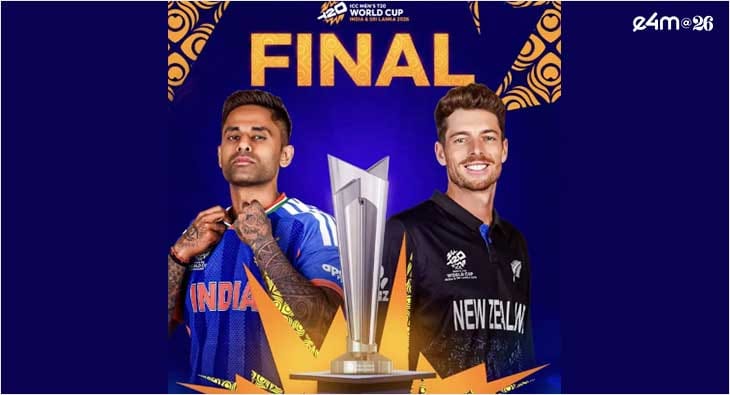

As India prepares to face New Zealand in the T20 World Cup 2026 final at the Narendra Modi Stadium, the tournament is reaching more than just its sporting climax. It is also offering a revealing glimpse into the changing economics of global sports viewership.
After nearly eight weeks of cricket, the numbers emerging from streaming platforms are hard to ignore. The second semi-final between India and England has already rewritten digital records. According to ICC Chairman Jay Shah, the match reached a peak concurrency of 65.2 million viewers on JioHotstar and the highest ever recorded for a live-streamed event anywhere in the world.
And the final hasn’t even been played yet.
For broadcasters, advertisers and sports administrators, that statistic signals something important. Cricket’s biggest audiences today are not driven only by historic rivalries. Increasingly, they are driven by India playing matches where everything is on the line.
A Digital Tsunami
To understand the scale of this moment, it helps to look at how quickly the numbers have climbed between the last T20 world cup and now.
The 2023 ODI World Cup final between India and Australia in Ahmedabad set a major digital benchmark with roughly 59 million concurrent viewers on Disney+ Hotstar. At the time, it was widely described as a landmark moment for live sports streaming.
A year later, the 2024 T20 World Cup final between India and South Africa, played in the United States, drew around 53 million concurrent viewers across streaming platforms. Even with a different format and location, the pattern remained clear: a final involving India tends to bring massive audiences together. The viewership would have been still better but for the timings of the match being played.
Now the 2026 semi-final between India and England has gone even further, reaching 65.2 million concurrent viewers.
With India once again in the final, it would not be surprising if the tournament pushes past the 70-million mark.
The Real Driver: Stakes
For years, cricket’s broadcast conversation has revolved around one match above all others: India versus Pakistan.
That rivalry still generates enormous interest, but recent tournaments suggest the bigger story lies elsewhere. The most powerful driver of viewership today is not just rivalry but matches with good opponents.
Knockout matches carry a different kind of tension. Every ball feels heavier because the result matters immediately. Fans are not simply watching a game; they are watching the possibility of victory or heartbreak unfold in real time.
And in the streaming era, that shared, real-time attention is incredibly valuable.
Why Finals Are Cricket’s Super Bowl
For advertisers, events like a World Cup final offer something that has become increasingly rare in modern media: mass collective viewing.
Most digital content spreads audiences across countless platforms and devices. But a World Cup final involving India does the opposite. It concentrates tens of millions of viewers into a single moment.
That kind of scale is why marquee cricket matches now command some of the most expensive advertising slots in global sport. In many ways, a World Cup final has become cricket’s equivalent of the Super Bowl — a cultural event as much as a sporting one. And a big bonus for brands who are present during the finals.
Moving Beyond the India–Pakistan Obsession
One of the more interesting insights from recent tournaments is how the hierarchy of cricket viewership is evolving.
During the 2024 T20 World Cup, the India–Pakistan match drew roughly 29 million concurrent viewers. That figure is impressive by any measure. Yet it was still far below the audience that tuned in for the final.
The lesson from the data is simple. Rivalries generate excitement. But knockout matches create history and make it more engaging with the audience.
Fans are increasingly drawn to games that carry real consequences — semi-finals, finals and high-pressure elimination matches.
Cricket’s Streaming Future
As India and New Zealand walk out for the 2026 final, the match will decide more than just a champion. It will also underline how dramatically cricket’s media landscape has changed.
Streaming has expanded the reach of the game, and India remains the gravitational force at the centre of that ecosystem.
But the deeper takeaway is this: in modern cricket, the biggest moments are defined less by rivalries and more by what is at stake.
In the streaming era, the real blockbuster is not a group-stage clash.
It is the knock out matches, semi finals and finally the finals.
Disclaimer: The views expressed here are solely those of the author and do not in any way represent the views of exchange4media.com.
Read more news about Marketing News, Advertising News, PR and Corporate Communication News, Digital News, People Movement News
For more updates, be socially connected with us onInstagram, LinkedIn, Twitter, Facebook, YouTube & Google News
