From Chandra to the Next Chapter: How Tata will shape its leadership future
Guest Column: Ganapathy Viswanathan, Independent Communication Consultant & Author, examines what will matter beyond who succeeds N. Chandrasekaran - authority, independence and accountability
 by
by
Published: Aug 14, 2026 8:18 AM | 7 min read
 Follow Us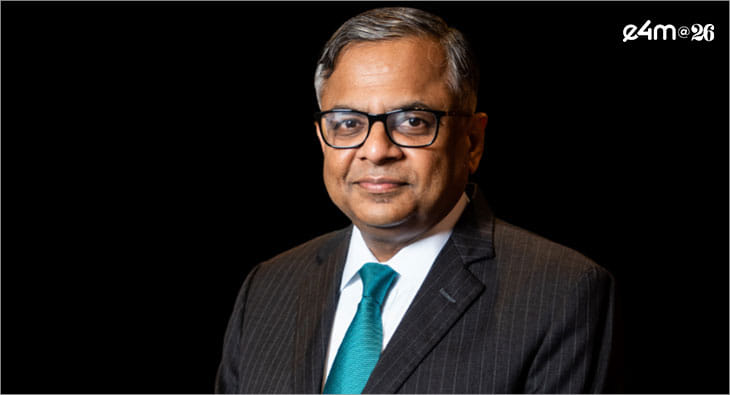

- N Chandrasekaran, the first non-Parsi professional chairman of Tata Sons, has announced he will not seek reappointment when his term ends on February 20, 2027, following a lack of unanimous board support for his extension.
- His tenure has seen significant growth in Tata Group's financial performance, with revenues rising to approximately ₹16.24 lakh crore and profits increasing by 51.9% to about ₹1.71 lakh crore, reflecting a strategic transformation of the group's portfolio.
- Chandrasekaran's leadership emphasized institutional understanding and long-term planning, with notable initiatives including the return to aviation through Air India and investments in new sectors like semiconductors and digital commerce.
- The Tata Trusts are forming a committee to select his successor, raising questions about the future balance between professional management and the influence of the Tata family and Trusts in the leadership of the group.
For almost a decade, N Chandrasekaran represented something significant about the Tata Group. He was not a Tata by birth, not a member of the family and not a Parsi. He was a professional who had risen through the ranks of Tata Consultancy Services to eventually become the first non-Parsi professional to occupy the top chair at Tata Sons.
That made his decision not to seek another term more than just another corporate succession story. Chandrasekaran has decided not to seek reappointment as Chairman of Tata Sons when his current term ends on February 20, 2027. His decision followed months of uncertainty around his continuation, after the board did not arrive at unanimous support for his proposed extension. He has also asked that the succession process begin early so that there is sufficient time for an orderly transition.
For an organisation as institutionally important as Tata, the obvious question is not simply who will replace Chandrasekaran. The more interesting question is: what kind of Tata will emerge after Chandrasekaran?
What Made Chandra Different
Chandra's appointment in 2017 was itself a powerful statement. After the dramatic removal of Cyrus Mistry, Ratan Tata returned briefly as interim chairman before Chandrasekaran was chosen. He came from within the Tata system, but he was not part of the Tata family. That distinction mattered.
He represented the idea that the Tata Group could be led at the highest level by a professional who understood the institution, its values and its culture without being a member of the family.
And perhaps that was his greatest leadership strength.
At the top of a conglomerate of this size, leadership is not about running individual businesses. The CEOs of TCS, Tata Motors, Tata Steel, Titan, Tata Consumer Products and the group's other companies have their own responsibilities and boards. The Tata Sons chairman's job is to make the big calls, allocate capital, balance competing interests, identify future opportunities and, above all, protect the institution.
Chandrasekaran largely operated in that space. His leadership style was not flamboyant. It was built around institutional understanding, measured decision-making and the ability to take large, long-term bets.
The Numbers Tell Their Own Story
His tenure has also produced some remarkable numbers.
According to the Tata Sons Annual Report for FY2025-26, the aggregate revenue of Tata Group companies rose 7.8% to ₹16,24,030 crore, or approximately ₹16.24 lakh crore. More strikingly, aggregate profit after tax rose 51.9% to ₹1,70,525 crore, or about ₹1.71 lakh crore. The report notes that revenue was 2.1 times and profits 5.4 times their FY20 levels.
These numbers provide an important measure of the scale of the transformation during the Chandrasekaran years.
But the Chandra story cannot be reduced to revenue and profits. His tenure has been about reshaping the Tata portfolio for a very different economic era.
Beyond Revenue: Rebuilding the Tata Portfolio
The return to aviation through Air India was one of the most visible moves. Tata went from having a historical association with aviation to once again owning and building one of India's largest airline businesses. The merger with Vistara created a significantly larger aviation platform.
At the same time, Tata began placing major bets on areas that would have been difficult to imagine as core Tata businesses a generation ago—semiconductors, electronics manufacturing, digital commerce, new-age technology and a broader digital ecosystem through Tata Digital.
This is where Chandrasekaran's leadership becomes particularly interesting.
He was not simply managing the Tata businesses that existed when he took over. He was trying to prepare the group for the businesses that Tata would need in the future.
His stated priorities around Air India and Tata Digital underline the fact that both remain unfinished stories. Air India needs to become a stronger and more efficient global airline, while Tata Digital has to demonstrate that the group's enormous brand equity can translate into a successful digital ecosystem.
That means Chandrasekaran's legacy will ultimately be judged not only by what he achieved but also by what happens to the bets he leaves behind.
Will Tata Feel a Leadership Vacuum?
There inevitably will be some disruption when a leader at this level leaves. But large institutions survive precisely because they are supposed to be bigger than individuals.
Every major organisation eventually reaches a point where a long-serving leader moves on. The real test is whether there is leadership depth underneath.
Tata has that depth.
The group has CEOs who run some of India's most important companies. It has a large professional management structure. It has executives who have spent decades within the Tata ecosystem and understand its culture.
So the departure of Chandrasekaran does not necessarily mean a leadership crisis. But it does create a moment of institutional introspection.
The bigger question is whether the Tata Group has someone within its own ecosystem who can take over the mantle while maintaining the balance between continuity and change.
The Family, the Trusts and the Professional CEO
Because Tata is not a conventional promoter-driven family business.
The Tata Trusts collectively own 66% of Tata Sons, the principal holding company of the group. But these are philanthropic trusts rather than a conventional family-owned operating company. Their dividends support institutions and programmes across healthcare, education, livelihoods, culture and other areas.
That makes Tata's governance model unique.
The family and the Trusts have enormous institutional influence, but the operating businesses have traditionally been run by professional boards and executives.
So Chandrasekaran's departure should not automatically be interpreted as Tata returning to family management.
That would be too simplistic.
The more interesting question is whether the balance between professional leadership and promoter/trustee influence is being recalibrated.
That is perhaps the real story behind this succession.
Who Takes the Chair?
The Tata Trusts have now begun the process of forming a committee to recommend the next chairman of Tata Sons. The selection will therefore be watched not merely for the name of the next chairman, but for what that person represents.
Will Tata once again choose someone from within its professional management system?
Will it select a leader who has grown inside the Tata ecosystem and understands its culture?
Or will the next chairman have a closer relationship with the Tata family and the Trusts, signalling a more visible role for the institution's traditional custodians?
These are questions the market, employees and corporate India will all be watching.
Going by Tata's history, the next chairman is likely to emerge from within the broader Tata ecosystem or at least be someone who understands the Tata way of doing business. The group is too complex and too diverse to be handed over simply to an outsider with little understanding of its culture.
But whoever takes over will inherit a very different Tata from the one Chandrasekaran inherited in 2017.
The Tata Model Is Being Tested Again
The next chairman will inherit not just a group generating ₹16.24 lakh crore in revenue and ₹1.71 lakh crore in profit. He or she will inherit a conglomerate in the middle of a major strategic transition—with Air India, semiconductors, electronics, digital commerce and new-age businesses all requiring significant capital, patience and leadership attention.
There is therefore little room for a chairman who is merely a custodian.
The next leader will need to be an institution builder, capital allocator, strategist and diplomat rolled into one.
And that brings us back to Chandrasekaran.
Ratan Tata chose a professional to lead Tata after one of the most difficult leadership episodes in the group's history. Chandrasekaran then spent almost a decade building his own imprint while retaining the Tata philosophy.
He leaves behind a group that is larger, more global and more diversified than the one he inherited.
Now Tata has to make another choice.
And that choice will tell us a great deal about the Tata Group of the next decade.
The question is not whether Tata is going back to family management.
It is more subtle than that.
Is Tata moving towards a new balance between professional leadership and the institutional influence of the family and its Trusts?
The answer will lie not merely in who occupies the chair after Chandrasekaran, but in how much authority, independence and accountability that person is given.
Because ultimately, the Tata story has never been only about who owns the institution.
It has been about who can be trusted to lead it.
Read more news about Digital Media, Television Media, Out of Home Advertising, Print Media, Latest Advertising India
For more updates, be socially connected with us onInstagram, LinkedIn, Twitter, Facebook, YouTube & Google News