Next IPL Media Rights: Could CTV redraw the map to bring more bidders to the table?
With Connected TV emerging as a major viewing and advertising screen, the next tender could see BCCI explore more granular packages, say industry sources
 by
by
Published: Sep 28, 2026 9:16 AM | 7 min read
 Follow Us

The biggest question confronting the Board of Control for Cricket in India (BCCI) as it prepares for the next IPL media rights cycle early next year may not be who will bid for the tournament, but how the rights are packaged to give more players a reason to bid.
With the current five-year cycle ending with the 2027 season, the industry is already debating what the next tender could look like. One possibility being discussed is a further unbundling of rights, including a potential separate Connected TV (CTV) proposition from digital.
There is no indication yet that the BCCI has taken a decision on such a structure. However, with the board’s members in Mumbai for the AGM on September 18, it is understood that the upcoming sale of media rights, including the potential packaging of rights, was among the issues discussed.
Read more on CTV and e-gaming ban impact on IPL 2026
The industry chatter comes at a time when CTV is becoming a substantial screen in India, while the economics of premium sports rights are entering a more mature phase.
India's CTV audience grew from 129.2 million in 2025 to 206.9 million in 2026, a 60% jump in one year, according to Ormax Media's OTT Audience Report 2026. The IPL itself is reflecting that shift. JioStar reported that CTV was the fastest-growing platform during IPL 2026, which reached up 26% year-on-year during the tournament and consumption ultimately grew 22%.
For BCCI, the larger question, therefore, is whether a more granular rights architecture could broaden the bidder universe, improve price discovery and create more commercially meaningful entry points without diluting the value of the core IPL package.
Read more: Advertiser mix rebalances in IPL 2026
“The next IPL auction will need to create more points of entry for bidders. The objective should not be to simply replicate the TV-versus-digital structure of the last cycle, but to identify how consumption has evolved and package rights accordingly. CTV is one such area that has become commercially meaningful,” said a senior broadcaster.
A proven case for changing the rights architecture
The 2022 auction demonstrated how dramatically package design can alter the economics of IPL rights.
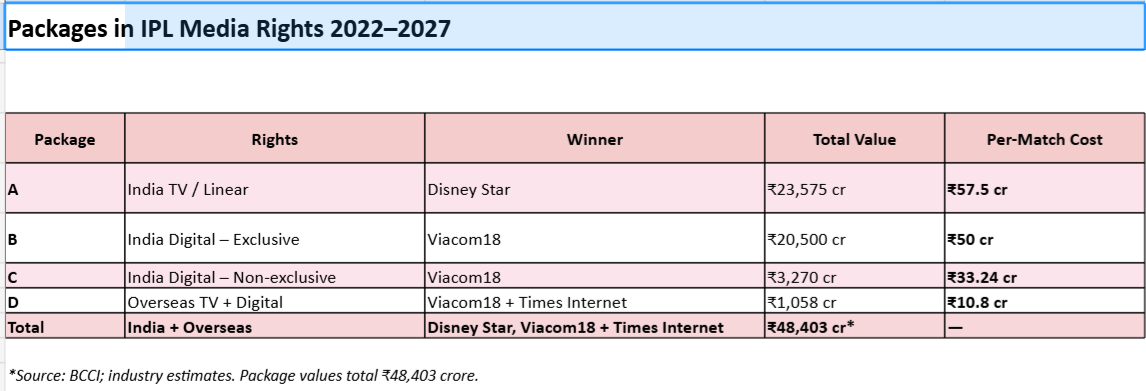
BCCI split the Indian rights into separate television and digital packages, with Disney Star winning Package A, the India TV rights, for ₹23,575 crore and Viacom18 securing Package B, the India digital rights, for ₹20,500 crore. Viacom18 also won Package C, a non-exclusive digital package covering 18 matches per season, for about ₹3,273 crore. Overseas TV and digital rights were shared by Viacom18 and Times Internet under Package D. The combined value of the 2023–27 rights reached ₹48,390 crore.
The significance went beyond the headline number. The auction established digital as a rights category capable of commanding value comparable with television, while the non-exclusive package created another price point for premium IPL inventory.
Read more on CTV's premium reset with IPL 2026
It was almost three-fold from the previous cycle, when Star India acquired the consolidated global TV and digital rights for ₹16,347.5 crore for 2018–22.
But the market has changed again. Following the Reliance-Disney transaction, JioStar now controls the IPL's television and digital rights for the current cycle, creating an integrated proposition across linear television and streaming.
That makes the next auction structurally different from 2022. The question is whether the BCCI can use the tender architecture to attract a wider set of bidders, particularly at a time when the number of platforms capable of writing very large cheques remains limited.
A recent industry discussion around ICC rights tenders has also focused on the need for better price-discovery models, with the IPL tender expected to precede the next ICC media rights process.
Why CTV is entering the conversation
The strongest argument for examining a separate CTV proposition comes from the changing consumption landscape. According to Ormax Media, India's CTV audience has grown 60% in a single year to 207 million, while the overall OTT audience stands at 665 million.
Besides, a TradeDesk and WPP report highlighted that 83% of CTV viewers search for more information after seeing an ad. Among premium CTV viewers, that rises to 89%. The study noted that they’re the most ad-responsive segment on the channel. “The big screen doesn’t end the journey. It starts. Web and AI search, website visits, purchase consideration — measurable from first impression to final decision.”
The IPL's own consumption data points in the same direction. JioStar reported that CTV reach grew 26% year-on-year during IPL 2026, with CTV eventually registering 22% growth in consumption for the season. The tournament's overall reach crossed 1.2 billion.
CTV occupies an increasingly distinct position because it combines the large-screen, living-room experience traditionally associated with television with the targeting and addressability associated with digital video.
Arun Rao, sports marketing expert, believes that CTV package could be a reality for many reasons, “CTV is offering a unique audience, and with its growing share of viewership, this audience is likely to command a premium. We could see CTV inventory being valued at a premium, with CPMs in the ₹650–₹800 range,” he said.
That commercial distinction could make CTV worth examining separately for a property such as the IPL, where large-screen viewing and appointment-based consumption remain important even as streaming becomes the dominant distribution layer.
Indranil Das Blah, founder of AMP Sports & Entertainment, does not agree with the proposition. “I don’t think we’ve arrived at a stage where CTV can be sold separately. I’m not aware of any sports property globally that uses this model and there’s probably a reason for that. If I was a digital platform buying rights, CTV would be an integral part of my plans,” said Blah. “Theoretically, it may make sense but practically, I don’t think it’s something that the media will buy into. At least at this stage.”
His argument highlights the central commercial dilemma: CTV may be a distinct advertising screen, but that does not automatically make it a distinct rights product.
More entry points, but not more fragmentation
CTV need not be the only route through which BCCI could broaden the next auction.
The Board could potentially examine a structure distinguishing between linear television, mobile-first digital, CTV, non-exclusive digital inventory and selected match packages. The eventual architecture, however, would depend on bidder appetite, rights valuation and whether each proposition has enough independent commercial value.
“The objective would not necessarily be to create the maximum number of packages. Excessive fragmentation could dilute the value of individual rights, complicate the consumer proposition and make it harder for bidders to build sustainable businesses around them. The challenge is therefore to create meaningful entry points, rather than simply more pieces of the same property,” observers warn.
The 2022 process already showed that different players can be attracted to different rights. Sony, Zee and Viacom18 were among the India bidders, while Amazon and Google had acquired the tender document but did not ultimately submit technical bids.
The global market also offers examples of platforms taking different-sized bites of premium sport. YouTube distributes NFL Sunday Ticket, a package of out-of-market Sunday afternoon games, while Prime Video carries Thursday Night Football and Netflix has taken a selective approach to live sports, including NFL games.
That does not mean the IPL can simply replicate these models. But it demonstrates that premium sports rights can be structured around specific, commercially meaningful propositions rather than always being sold as an all-or-nothing package.
The real test
The bigger question is how much further the IPL can grow its media rights value.
The 2023–27 rights deal of ₹48,390 crore was almost three times the ₹16,347 crore fetched in the previous cycle. But Media Partners Asia has projected that the value of the IPL's 2028–32 domestic rights could remain broadly flat at around $5.4 billion, pointing to a more mature phase of monetisation. That would make the architecture of the next tender more consequential.
If another bidding war of the scale seen in 2022 is difficult to replicate, BCCI may have to extract additional value through segmentation, differentiated rights and a broader bidder pool, rather than relying only on the IPL's scale and brand strength.
The 2022 auction showed that changing the structure of the rights can fundamentally change the economics of the property. The 2028–32 cycle could test the next iteration of that idea: whether a more modular IPL rights map can create enough new entry points to deepen competition without fragmenting the value of the league itself, quips an agency leader.
Read more news about IPL 2024 News, Internet Advertising, Marketing India, PR and Corporate Communication, Television Media
For more updates, be socially connected with us onInstagram, LinkedIn, Twitter, Facebook YouTube & Google News