IPL 2026: Advertiser mix rebalances as capital discipline sets in
From cement, tyres and airlines to Pokémon, Krafton and Google Gemini, IPL 2026 reflects a shift toward a balanced base of traditional and new-age brands
 by
by
Published: Mar 27, 2026 9:17 AM | 6 min read
 Follow Us

After years of dominance by fantasy gaming firms and venture-funded startups, the Indian Premier League (IPL) sponsorship market is undergoing a reset—one that reflects tightening capital flows as well as a broader recalibration in advertiser strategy.
With the 2026 season set to begin on March 28, early deal activity shows legacy sectors—spanning infrastructure, manufacturing, aviation, BFSI, healthcare, Food & Beverages, and real estate—reclaiming premium inventory across broadcast and franchises. At the same time, youth-focused platforms, gaming companies and global tech brands continue to feature prominently, pointing to a more diversified advertiser mix rather than a simple replacement cycle.
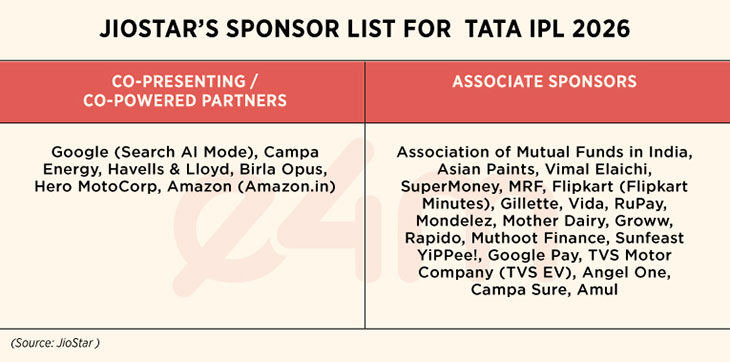
At the broadcast level, JioStar has onboarded 27 sponsors, led by co-presenting partners such as Google Search AI Mode, Campa Energy and Havells & Lloyd, alongside co-powered brands including Birla Opus, Hero MotoCorp and Amazon. A broad base of associate sponsors further underlines the depth of advertiser demand.
Even as legacy sectors dominate premium slots, new-age and youth-focused brands remain deeply embedded across the ecosystem. The roster includes platforms such as Krafton, Pokémon and Big Ant Studios, alongside global tech players like Google and AI-led offerings such as Gemini—underscoring the IPL’s continued appeal as a high-impact platform for digital-first brands targeting younger audiences.
Notably, Google Gemini has signed a 3-year deal with IPL shelling out Rs 270 crore. Their projected ad & promotional expenses around IPL over 3 years is likely to be Rs 500-550 crore, according to industry estimates.
Aditya Dutta, Founder of Impetus Sports Capital and former COO of the Gujarat Titans, observes, “The advertiser mix in the current IPL season is well-balanced. The return of legacy brands will have a long-term positive impact. Traditional advertisers typically forge deals for 3–5 years, whereas with high-burn startups, most agreements were only for one or two years. This year, most of the top-tier slots across teams and broadcasters are dominated by legacy brands, while tech giants occupy the mid-level, which could lead to a correction in sponsorship costs, making the band more sustainable.”
Citing the example of Barclays, which maintained a high-profile association with the Premier League for 15 years, serving as title sponsor from 2001 to 2016, and the Official Banking Partner, later, Dutta explains, “While newer, disruptive brands focus on customer acquisition, with legacy brands, we can expect higher investment, stronger brand-building initiatives, and deeper fan engagement which is good for stability of the league itself.”
Notably, IPL-linked ad revenue touched Rs 6,000 crore last season, with gaming brands—occupying the most premium slots including title sponsors of the league and teams—accounting for nearly Rs 2,000 crore. However, the government of India banned the real money gaming brands last September which cast a shadow over the viability of the league. Industry experts point out that this season’s bumper deals, driven by mass-market brands, could substantially bridge the gap.
What IPL’s latest ownership deals mean for its brand growth?
Beyond the boundary: IPL franchises scale up fandom economy
T20 WC ad revenue hits Rs 1,500 Cr; India-Pak & final clashes drive premium spends
BCCI deals signal early shift in sponsor strategy
The pivot toward balance-sheet-backed advertisers has been building over the past year. exchange4media had earlier reported that Apollo Tyres signed a ₹579-crore, three-year deal as lead sponsor of Team India, replacing Dream11—marking its first-ever association with Indian cricket. Soon after, Asian Paints entered the ecosystem with a ₹45-crore-per-year deal as BCCI’s Official Colour Partner.
BCCI’s current sponsor roster—featuring IDFC First Bank (title sponsor), Adidas (kit partner), and Atomberg, SBI Life and Campa as official partners—further reflects the shift toward established brands, replacing earlier reliance on venture-funded categories such as edtech and fantasy gaming.
Premium inventory, core advertisers
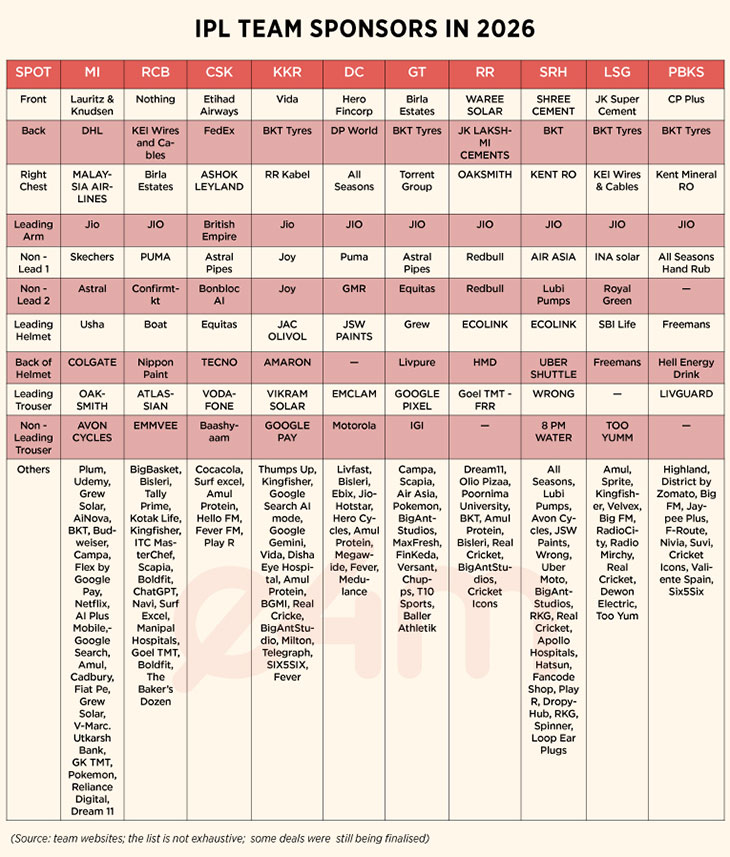
Core economy players dominate marquee slots: Etihad Airways with Chennai Super Kings, Waaree Energies with Rajasthan Royals, and Shree Cement with Sunrisers Hyderabad. Gujarat Titans’ partnership with Birla Estates, Mumbai Indians’ tie-up with Lauritz Knudsen, and Kolkata Knight Riders’ deal with Vida (Hero MotoCorp’s EV brand) reinforce the trend. Despite macro pressures, demand remains strong, with Gujarat Titans signing over 37 sponsors and Mumbai Indians around 30.
“More than volume, the mix of renewals, upgrades, and long-standing associations underscores sustained confidence in the Titans’ brand. At the core is a robust on-kit lineup led by Birla Estates in the marquee front-of-jersey position, complemented by Torrent, BKT Tyres, Jio, Astral Pipes, and Livpure—partnerships built over time around shared purpose,” GT said.
On-field integrations include new names like Google Pixel, Grew Solar, and IGI, while Equitas has moved from helmet branding to the jersey. “We have curated a diversified, future-facing mix. Global tech platforms such as Google (Search & Gemini) drive digital engagement, while AirAsia adds travel and lifestyle relevance. Established brands like Campa, Budweiser 0.0, Amul, Dream11, and Scapia anchor mass connect, alongside youth-focused platforms such as Krafton, Pokémon, and Big Ant, bringing gaming and interactive experiences into the fan journey,” the Titans added.
Funding squeeze reshapes spend
Industry executives say the shift reflects a broader tightening of capital and a re-evaluation of marketing efficiency.
“The current slowdown reflects a cyclical pullback… but what’s more significant is the return of legacy sectors with a long-term brand-building lens,” said Rohit Potphode, Managing Partner, dentsu India.
The correction is most visible in the pullback of fantasy sports platforms. Once dominant across team jerseys and league-wide deals, these brands have largely moved to secondary roles, with their reduced presence in top-tier inventory reflecting regulatory pressures and tighter funding. In some cases, such as Gujarat Titans, gaming brands are absent altogether.
Long-term deals to define next phase
The evolving mix is reshaping how advertisers approach the league. Legacy sectors are leaning toward longer-term partnerships, deeper integrations, and year-round engagement, delivering more predictable revenues for franchises.
Lauritz Knudsen Electrical and Automation, a part of Schneider Electric India, has renewed its Mumbai Indians association for a second year, deepening a partnership rooted in performance and consistency. Rajat Abbi, VP and Chief Marketing Officer, Schneider Electric India said, “This second year builds on a strong foundation and elevates the partnership.”
Boldfit also entered its second year of association with RCB. also enters its second year. Pallav Bihani, Founder, Boldfit, said, “We want to celebrate last year’s win and get BOLDER this season,” he said. “Our partnership evolves from support to co-creation, building products with the team for everyone who trains bolder.”
Meanwhile, tech, gaming, and youth brands continue to drive fan engagement and digital innovation, with improved measurement and attribution enhancing IPL’s value as both a scale and performance platform.
“The result is a balanced ecosystem—legacy advertisers provide stability, while new-age brands sustain innovation and cultural relevance, making the IPL more resilient, even if less exuberant than in peak startup years,” said a sports marketing executive.
Read more news about IPL 2024 News, Internet Advertising, Marketing India, PR and Corporate Communication, Television Media
For more updates, be socially connected with us onInstagram, LinkedIn, Twitter, Facebook YouTube & Google News
