#e4mXplains: India’s co-viewing surge is advertising’s new power play
With 49% of households co-viewing daily and brand recall rising 74% in shared contexts, marketers can no longer afford to plan for the solo viewer
 by
by
Published: May 4, 2026 8:12 AM | 9 min read
 Follow Us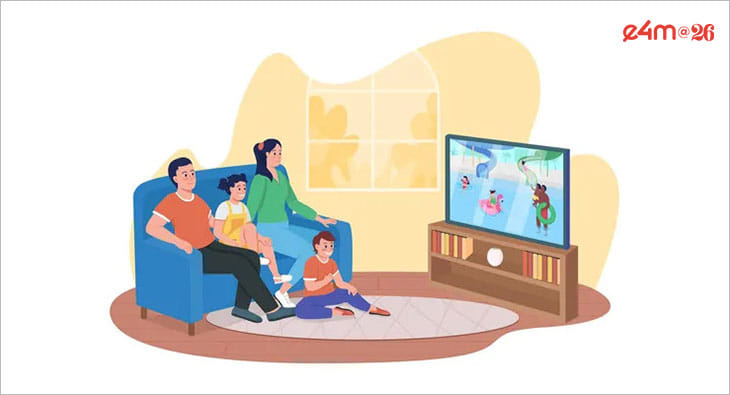

- Co-viewing, the practice of watching content together, is becoming a significant behavior in India's media landscape, influencing how brands engage with audiences in a rapidly growing digital market, which reached Rs 2.78 trillion in 2025.
- A report by PubMatic reveals that 41% of co-viewing in India is planned, contrasting with the more spontaneous viewing patterns seen in other Asia-Pacific regions, indicating a deliberate approach that enhances brand message retention and emotional engagement.
- Connected TVs are the primary devices for co-viewing, with 76% of participants using them, while multi-device engagement is common, as 43-55% of co-viewers utilize multiple screens simultaneously.
- Co-viewing leads to higher advertising attention and brand recall, with 42% of co-viewers reporting increased attention to ads, and 38% more likely to act on advertisements, highlighting its potential as a powerful marketing strategy in India's evolving media economy.
There is something deceptively simple about two people sitting down to watch a screen together. It looks like leisure. It looks like habit. But in the evolving architecture of India's media economy, that shared moment of attention is increasingly one of the most commercially potent environments a brand can occupy. Co-viewing, the act of consuming content together whether on a living room television, a laptop propped against a pillow, or a smartphone passed between hands, has moved well beyond a lifestyle observation. It is now a measurable, recurring, and strategically significant media behaviour, one that is quietly reconfiguring how advertising works in one of the world's fastest-growing digital markets.
India's media and entertainment sector crossed Rs 2.78 trillion in 2025, growing nine percent year-on-year, according to the FICCI-EY M&E Report 2026. Digital media alone scaled to Rs 1,110 billion, becoming the single largest segment, while OTT platforms crossed Rs 272 billion with paid video subscriptions reaching 216 million across 143 million households.
Against this backdrop of scale, co-viewing is not a niche phenomenon sitting at the edges of media behaviour. It is structurally embedded into how millions of Indian households consume content every single day. The infrastructure for shared screen time, broadband penetration, connected television sets, and family subscription plans, has quietly arrived. What is only now being understood is the depth of its commercial consequence.
The question that advertisers, platform owners, and media planners are beginning to ask is not merely who is watching, but who is watching together, and what happens to a brand message when it lands inside that shared moment. PubMatic's How Co-Viewing Redefines Attention in APAC report offers the most granular answer yet, and for India specifically, the findings challenge some of the most deeply held assumptions in the country's media planning culture.
The Architecture of a New Viewing Culture
India does not co-view the way the rest of Asia-Pacific does. According to the PubMatic report, while the broader regional pattern skews toward spontaneous, in-the-moment shared viewing, India reveals a significantly more intentional behaviour. A striking 41 percent of co-viewing in India is planned in advance. Only 31 percent is spontaneous, and 28 percent is driven by routine habit. This is appointment-driven, deliberate shared viewing, which places it in an entirely different category of media engagement from casual, accidental co-consumption.
That intentionality matters enormously for advertisers. When a viewer plans to watch something with someone else, they are creating a shared attention contract. The content, and therefore the advertising surrounding it, enters a context of heightened social awareness. People are not just watching. They are watching in the company of someone they care about, and that social layer transforms how messages are processed and retained.
Connected TV has become the primary screen for this behaviour. The PubMatic report finds that 76 percent of co-viewers in India use Connected TV as their main co-viewing device, a finding that sits directly alongside FICCI-EY data showing the CTV ecosystem has grown to approximately 40 million weekly active households, up from 30 million in 2024. Yet the story does not end at the television set. Smartphones are a secondary co-viewing screen for 47 percent of audiences, laptops for 36 percent, and desktops for 23 percent. Between 43 and 55 percent of co-viewers, depending on content type, engage across multiple devices simultaneously. This is not a single-screen phenomenon. It is a networked, multi-surface shared experience, and that has direct implications for how campaigns are designed and sequenced.
The content driving people to watch together follows a clear hierarchy, according to PubMatic's research. Movies lead at 83 percent, followed by television series at 72 percent, sports at 61 percent, news at 60 percent, and family-friendly content at 56 percent. Live events, at 33 percent, may appear lower on the list but are growing in significance. The FICCI-EY M&E Report 2026 notes that India's live events sector grew 44 percent in 2025, reflecting a broader cultural shift toward collective, participatory media experiences. The desire to share a moment, to react together, to feel something in company, is not a passive residual of old media habits. It is an active, accelerating impulse.
What Shared Attention Does to a Brand Message
The commercial case for co-viewing rests on a set of outcomes that are difficult to achieve in solo viewing environments. According to the PubMatic report, 42 percent of co-viewers report higher levels of attention to advertising when watching with others, with 22 percent describing the increase as significantly higher. Only 16 percent report lower attention. The majority experience no diminishment of engagement, and a substantial portion experience a genuine uplift. In a media environment where attention has become the scarcest and most fiercely competed-for resource, this is not a marginal finding.
The Dentsu e4m Digital Advertising Report 2026 characterises this shift explicitly, describing attention, emotional connection, and cultural resonance as the new currencies of value in Indian media. Co-viewing sits precisely at the intersection of all three. It is a shared focus event, emotionally amplified by the presence of others, and embedded in the cultural fabric of household life.
Brand recall in co-viewing contexts, as measured by the PubMatic study, is particularly striking. Fifty-three percent of co-viewers report stronger brand recall after watching an advertisement together, with 38 percent seeing no change and only 10 percent reporting weaker recall. In a separate data cut from the same report, the uplift is even more pronounced, with 74 percent reporting stronger brand recall in shared viewing contexts. Emotional response follows a similar pattern, with 67 percent reporting a stronger emotional reaction to advertising when watching with others. These are not incremental improvements. They represent a categorical difference in how brand messages are absorbed and retained.
The social dimension of co-viewing amplifies advertising beyond mere exposure. PubMatic's findings show that 43 percent of co-viewers actively discuss or react to advertisements they see together, with 16 percent doing so for most ads and 27 percent for some. Only 28 percent rarely or never engage with advertising socially in a shared viewing context. This means that for nearly half of co-viewing occasions, an advertisement becomes a conversation. It enters the social exchange between two people, which is a form of organic amplification that no media plan can manufacture through reach and frequency alone.
From Attention to Action
If attention and recall are the upstream outcomes of co-viewing, then the downstream commercial case is equally compelling. The PubMatic report finds that 38 percent of co-viewers say they are much more likely to act on something after seeing an advertisement in a shared context. Another 30 percent are moderately more likely to act, and 18 percent are somewhat more likely. Only two percent are less likely to act. The conversion signal here is unusually strong for a brand advertising environment.
When action does occur, it skews toward deeper, more considered engagement rather than impulsive behaviour. 54 percent seek more information about the brand or product. Forty-three percent visit the brand's website. Forty percent look out for other advertising from the same brand. Thirty-four percent check social media pages, and 33 percent discuss or share the brand with others. This is the profile of a genuinely interested, actively curious consumer, not someone who has simply glanced at a screen.
This pattern connects directly to the convergence of commerce and content that multiple industry reports are tracking. The Dentsu e4m Digital Advertising Report 2026 notes that retail media and e-commerce advertising surged 55.86 percent to Rs 17,601 crore in 2025. The Pitch Madison Advertising Report 2026 records that quick-commerce advertising scaled from Rs 300 crore in 2023 to Rs 4,000 crore in 2025, while the FICCI-EY report notes point-of-sale advertising grew 50 percent to Rs 220 billion.
The commercial infrastructure is being built precisely around the kind of high-intent, post-exposure behaviour that co-viewing generates. When a consumer decides, after watching an advertisement with their spouse, to search for a product, they are entering a commerce ecosystem that has been dramatically expanded to meet that intent. Co-viewing, in this sense, is not merely an advertising context. It is the beginning of a purchase journey.
The Frequency That Changes Everything
What prevents co-viewing from being treated as a specialist or occasional media moment is its sheer frequency in Indian households. The PubMatic report reveals that 49 percent of co-viewers watch together daily, and 36 percent do so multiple times a day. Only one percent engage with shared viewing on a monthly basis. This is a daily media habit, as embedded in household routine as meals or conversation, and it is concentrated in the hours when advertising can reach its most receptive audiences.
Co-viewing peaks between 9 and 11 in the evening, the late prime window when households have wound down and attention is at its most relaxed and socially open. The early prime window between 5 and 9 in the evening is the second significant peak. Both represent the hours when families and couples are most likely to be together, most likely to be sharing a screen, and most likely to be in the social and emotional state that makes advertising genuinely impactful.
The broader market context makes the urgency of this conversation unmistakable. The Pitch Madison Advertising Report 2026 puts India's total advertising market at Rs 1,55,105 crore in 2025, with digital already commanding a 60 percent share and driving the entirety of net growth while traditional channels declined in absolute terms. The Dentsu e4m report projects digital advertising will reach Rs 98,034 crore by 2027, growing at a 17 percent compound annual growth rate and approaching 70 percent of total ad spend. Within that digital shift, the FICCI-EY report shows CTV alone nearly doubled to approximately Rs 6,000 crore, even as linear TV ad revenues declined 10.3 percent.
Advertisers are not abandoning the large screen. They are paying a premium for the measurable, high-attention environments it now offers, and co-viewing sits at the heart of that value proposition.
The old model of media planning, built on reach and frequency, assumed that more impressions delivered to more individuals would accumulate into brand effects. The new model being built around environments like co-viewing is premised on something more nuanced. It asks what happens when a message is received not by an isolated individual, but by two people together, in a moment of shared focus, emotional openness, and conversational proximity.
The data from India suggests the answer is significantly better outcomes across every metric that ultimately matters to a business, from attention through to action. The shared screen, it turns out, is not just a bigger surface. It is a fundamentally different kind of media environment, and India's marketers are only beginning to price that difference correctly.
Read more news about Marketing News, Advertising News, PR and Corporate Communication News, Digital News, People Movement News
For more updates, be socially connected with us onInstagram, LinkedIn, Twitter, Facebook, YouTube & Google News