e4m English Journalism 40 Under 40: India’s newsroom leaders take up the hardest questions
The 4th Edition of the conference on trust, Gen Z, print, and the classroom-to-newsroom gap closed with the 40 Under 40 Awards, recognising young journalists shaping the next decade of Indian media
 by
by
Published: Aug 3, 2026 11:47 AM | 4 min read
 Follow Us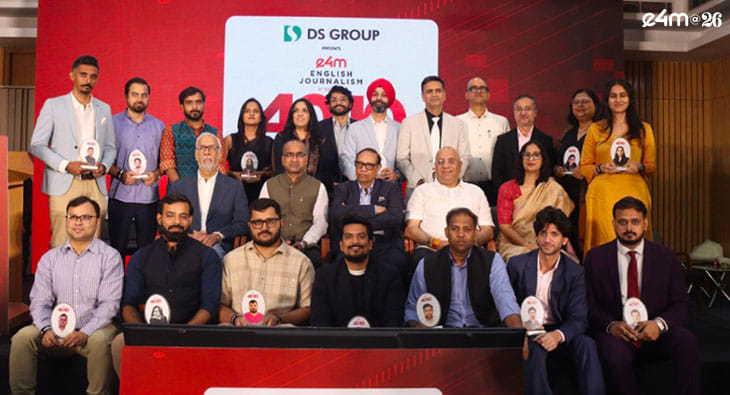

- The 4th edition of the e4m English Journalism 40 Under 40 Conclave, organized by exchange4media and supported by DS Group, focused on the evolving landscape of English-language journalism in India, featuring keynotes, discussions, and panels.
- Topics included the impact of streaming and social media on news priorities, the challenges of reporting in a changing world, and the generational divide in news consumption, particularly among Gen Z.
- The event highlighted the importance of print journalism amidst digital trends and addressed the gap between journalism education and real-world newsroom demands.
- The evening concluded with an awards ceremony recognizing 18 journalists under 40 for their contributions to the field, emphasizing the enduring values of integrity, accuracy, and public service in journalism.
The 4th edition of the e4m English Journalism 40 Under 40 Conclave, presented by DS Group and organised by exchange4media, with Astro Sagga as the associate partner, convened senior editors, media educators, and industry leaders for a full day of keynotes, fireside chats, and panel discussions on the state and future of English-language journalism in India.
exchange4media English Journalism 40 Under 40 Conclave emphasised on 'The Changing Face of News' examining how newsroom priorities have shifted in the streaming and social-first era. A spotlight session on 'Reporting India in a Changing World' looked at the new priorities shaping ground reportage, while a fireside chat titled 'Dissent in the Digital Age: How Social Media Is Reshaping Protest Coverage' examined how platforms have altered the grammar of covering unrest and public dissent. Additionally, insightful panel discussions such as 'Has Mainstream Media Lost Gen Z and Can It Win Them Back?' brought editorial leaders from national newsrooms. A second panel, 'Beyond the Algorithm: Why Print Still Matters,' featuring editorial voices from Fortune India, Hindustan Times, and academia, made the counter-argument: that considered, edited, print-anchored journalism retains a trust premium that feed-based consumption cannot replicate. A special keynote, 'Never Stop Climbing: Lessons in Leadership, Careers and Reinvention,' was an enabler for in-depth reflections on four decades of industry change.
A session titled 'From Prime Time to Digital First: Reinventing Journalism in a Changing Media World' set up the day's most direct panel: 'The Classroom-Newsroom Gap: Are We Training Journalists for Reality?', where heads of media studies departments and working journalists debated whether journalism education is producing graduates equipped for a newsroom built on real-time verification, multi-platform publishing, and audience-first metrics. Indian English-language journalism is navigating a genuinely difficult moment: declining trust in institutions generally, a measurable generational drop-off in traditional news consumption, the economic pressure of platforms and algorithms on both broadcast and print revenue, and a widening gap between how journalism is taught and how it is practised.. By formally honouring journalists under 40 across reporting, editing, and digital leadership, the property builds a visible pipeline of next-generation newsroom leadership at precisely the moment the day's panels argue that pipeline is most in question, making the awards not just a celebration, but an implicit answer to the conference's own central anxieties about who will run Indian newsrooms next.
Dr. Annurag Batra, Chairman & Editor-in-Chief, BW Businessworld, and Founder, exchange4media, highlighted,
“Journalism is not measured by who publishes first, but by who earns the public's trust. In an age where information travels in seconds and opinions spread even faster, journalists remain society's most important fact-finders, truth-tellers, and custodians of accountability. Their work goes beyond reporting events, it gives context to complexity, separates fact from fiction, and helps democracies make informed decisions. Every generation consumes news differently, but the values that define great journalism remain unchanged: integrity, courage, accuracy, independence, and public service. The journalists we honour today embody these values while embracing innovation with responsibility. They remind us that technology may transform the tools of journalism, but it is human judgment, ethical reporting, and commitment to the truth that will always define its future. In celebrating these leaders, we are not only recognising individual excellence, we are reaffirming our faith in journalism's indispensable role in shaping a more informed, accountable, and resilient society."
The evening's Awards Ceremony recognised the following journalists as this year's e4m English Journalism 40 Under 40 honourees:
| SNo. | Name | Organization |
| 1 | Abhishek Paul | NDTV |
| 2 | Akshay Ramesh | India Today |
| 3 | Amit Bhardwaj | India Today |
| 4 | Angad Jaura | India Today |
| 5 | Ankur Mishra | ET Now |
| 6 | Deepak Bopanna | NDTV |
| 7 | Jamie Mullick | Hindustan Times |
| 8 | Karishma Asoodani | Business Today |
| 9 | Madhuli Trivedi | Brut |
| 10 | Nishant Ranjan | Hindustan Times |
| 11 | Rahul Gautam | India Today |
| 12 | Rahul Gupta | India Today |
| 13 | Somya Lakhani | Hindustan Times |
| 14 | Soumeet Sarkar | NDTV Profit |
| 15 | Sreya Chatterjee | India Today |
| 16 | Srishti Ojha | India Today |
| 17 | Swapnil Radheshyam Mishra | Mumbai Mirror |
| 18 | Vishal Vivek | NDTV WORLD |
Read more news about Digital Media, Television Media, Out of Home Advertising, Print Media, Latest Advertising India
For more updates, be socially connected with us onInstagram, LinkedIn, Twitter, Facebook, YouTube & Google News