#e4mXplains: Google’s expensive adulthood: When Wall Street stops paying for the future
As Microsoft and Amazon confront their own AI bills, the latest earnings season raises an uncomfortable question: can yesterday's business models afford tomorrow's ambitions?
 by
Published: Nov 2, 2026 9:32 AM | 10 min read
 Follow Us


- Alphabet Inc. experienced a significant drop in market value, losing approximately $500 billion after a 12.6% decline in shares, despite reporting a 25% year-on-year revenue increase to $127.58 billion in Q3 2023.
- The company's advertising revenue, while still substantial, is now being outpaced by growth in its Google Cloud business, which saw a remarkable 103% increase, indicating a shift in Alphabet's revenue sources.
- Alphabet's capital expenditures have risen sharply, with a negative free cash flow of $9.07 billion reported for the second consecutive quarter, raising concerns about the sustainability of its investments in AI infrastructure.
- The changing landscape of consumer behavior and advertising spending patterns is prompting Alphabet to adapt its business model, as traditional search revenue growth slows and the company invests heavily in developing AI capabilities.
Nobody has ever tried to sound edgy by announcing that they use Microsoft Word.
There was a time when technology companies could make us excited about the most mundane things. Email invitations were coveted. A new browser felt like a declaration of independence. A search engine became a verb.
Google, perhaps more than any company of its generation, managed to make the infrastructure of everyday life seem like the future.
Read On: Google ad revenue rises 11% to $82 billion in Q3, but misses estimates
Now Gmail is what I use for work. YouTube is what I watch for entertainment. Google Maps tells me where to go. None of these products has become less useful. They've simply become ordinary.
I imagine you use several of them too. Congratulations to us both.
Which is a rather awkward development for a company that spent two decades being extraordinary.
And Wall Street, as it turns out, can be an exceptionally fickle admirer. It respects maturity. It just isn't necessarily willing to keep paying a premium for novelty that has worn off.
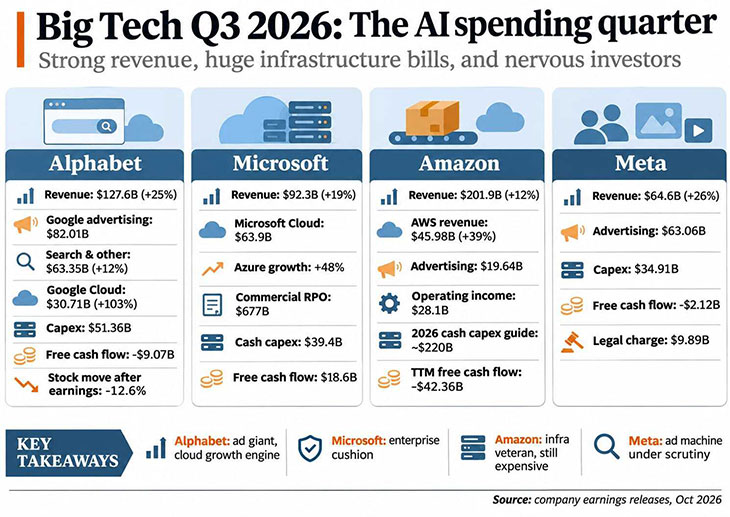
On October 29, Alphabet lost approximately half a trillion dollars in market value as its shares plunged 12.6%, their worst single-day percentage decline since the company went public.
Read On: #e4mXplains: Google made $82 billion from ads. Why wasn't that enough?
This would be easier to understand if Google's business were falling apart.
It isn't.
Alphabet's third-quarter revenue rose 25% year-on-year to $127.58 billion. Operating income increased 30% to $40.58 billion. Google Search and other advertising generated $63.35 billion, an increase of 12%. Its overall advertising business brought in $82.01 billion.
Google Cloud, meanwhile, grew a remarkable 103% to $30.71 billion. Its operating profit reached $11.12 billion, more than three times the figure recorded a year earlier.
These are not the results of a company in commercial decline.
I'm almost embarrassed to point this out, but we're apparently living in a world where growing revenue by a quarter and doubling your cloud business can earn you the financial equivalent of being thrown out of a moving car.
The numbers become rather more interesting when we stop looking at how much money Alphabet makes and start asking where its new money is coming from.
Between the third quarters of 2025 and 2026, Google Search and other advertising added approximately $6.78 billion in revenue. Cloud added $15.55 billion.
Cloud generated more than twice as much additional revenue as Search, despite being the much smaller business.
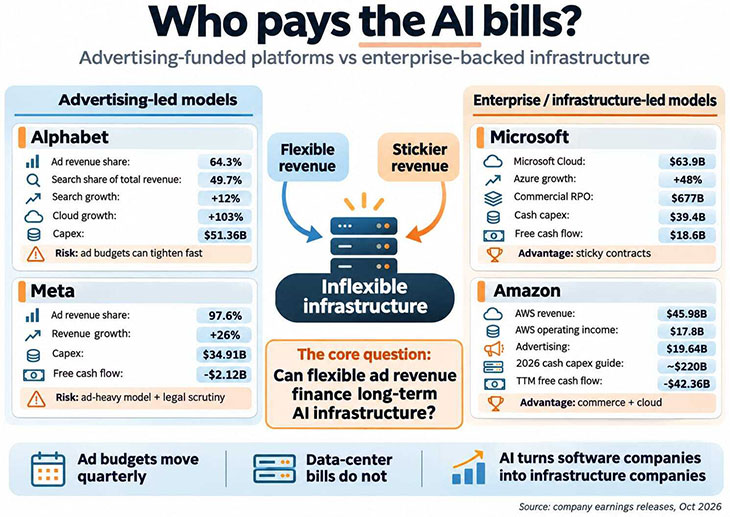
For the first time in Alphabet's separately reported quarterly series, Search and other contributed less than half its revenue, at 49.7%.
Search has not stopped growing. It remains one of the most successful advertising businesses ever conceived. But the engine of Alphabet's expansion is changing.
And the new engine has a considerably larger electricity bill.
Alphabet spent $51.36 billion on property and equipment during the quarter, against $42.29 billion in operating cash flow. The resulting free cash flow was negative $9.07 billion, its second consecutive quarterly deficit. A one-time European Commission fine payment and inventory built for Google's TPU systems also affected cash generation.
Alphabet expects capital expenditure of $195 billion to $205 billion for the full year, with spending set to increase significantly in 2027.
That is the bill for becoming an AI infrastructure company.
To appreciate what this means, consider Microsoft.
Microsoft underwent its cultural transformation years ago. Windows and Office stopped being exciting and became indispensable. Nobody needed Microsoft to remain the coolest company in technology. Businesses simply needed its software to keep working.
I cannot remember the last time somebody told me they were excited about Excel. I can, however, think of several companies that would cease functioning without it.
That institutional position has proved remarkably useful.
In its fiscal first quarter of 2027, Microsoft reported revenue of $92.28 billion, up 19%. Microsoft Cloud generated $63.9 billion, while Azure revenue grew 48%. Its commercial remaining performance obligations reached $677 billion.
Those obligations are not guaranteed profits, and they include business beyond AI infrastructure. But they provide considerable visibility into future enterprise revenue.
Microsoft also generated $58 billion in operating cash flow. After $39.37 billion in cash purchases of property and equipment, it retained $18.63 billion in free cash flow. Its broader capital-expenditure measure, including finance leases, reached $45.2 billion.
Read On: What does an ad look like inside AI? ChatGPT and Google are starting to answer
Microsoft is spending extraordinary amounts on AI. It simply has a mature enterprise business capable, for now, of generating substantial cash alongside those investments.
There is a reason companies continue paying for enterprise software during difficult economic periods. Their employees still need email. Their databases must function. Their systems must remain secure. Switching suppliers can be expensive, disruptive and sometimes practically impossible.
Advertising operates differently.
And I say this as someone who has spent a substantial part of his career writing about the advertising industry, which is not always a reassuring thing to admit.
Advertising is valuable. Performance campaigns can generate measurable sales, and businesses cannot always cut them without sacrificing revenue. But advertising budgets can generally be reviewed, redirected or deferred much more quickly than multiyear technology contracts.
Consider a company entering an uncertain quarter. Consumer confidence is deteriorating. Input costs are fluctuating. Trade policies are unpredictable. Management cannot confidently forecast demand.
Does it stop paying for its email and enterprise systems?
Probably not.
Does it reconsider how much it wants to spend acquiring new customers?
Quite possibly.
And that is Alphabet's emerging financial asymmetry.
Read On: Google is putting Search on the front page as AI starts selling ads of its own
Its established advertising business remains sensitive to customer spending decisions. But its new infrastructure business requires enormous, relatively inflexible commitments to chips, power, data centres, equipment and financing.
An advertiser can reduce next quarter's campaign budget.
The electricity supplier is unlikely to offer Google a corresponding discount.
Amazon offers another revealing comparison.
Amazon has never particularly needed to be fashionable. Its proposition is almost gloriously transactional. It has the product, the discount, the delivery network and, increasingly, an advertising opportunity right beside the purchase.
Amazon doesn't need me to believe it's changing civilisation. It would quite like me to buy an air fryer. Preferably today. It can deliver it tomorrow.
Meanwhile, Amazon Web Services rents computing infrastructure to businesses that would rather not build it themselves.
In the third quarter, Amazon generated approximately $201.9 billion in revenue, up 12%, with operating income of $28.1 billion and a record operating margin of 13.9%.
AWS revenue grew 39% to approximately $46 billion and produced $17.8 billion in operating profit. Amazon's advertising business generated another $19.64 billion.
Yet Amazon was punished by investors too.
The company spent approximately $77.3 billion purchasing property and equipment during the quarter and expects approximately $220 billion in cash capital expenditure for 2026. Its trailing-twelve-month free cash flow fell to negative $42.36 billion, from positive $14.79 billion a year earlier.
So this is not a convenient story about successful enterprise companies and unsuccessful advertising companies.
Amazon understands infrastructure better than most businesses on the planet. Its cloud operation is enormously profitable. It still faces the same fundamental question.
How much capital can a company commit today before investors begin demanding more convincing evidence of tomorrow's returns?
There is, of course, another enormous advertising company missing from this comparison.
Read On: Google wants AI to become marketers' strategist. Is the industry ready?
Meta.
Its third-quarter revenue grew 26% to $64.60 billion, of which $63.06 billion came from advertising. Capital expenditure reached $34.91 billion, and free cash flow was negative $2.12 billion.
Its results also included a $9.89 billion charge connected to a settlement with US state attorneys general over litigation concerning teen mental health and social media.
And this week, Meta settled with two teenage plaintiffs in a Los Angeles test case over allegations that its social platforms were designed to encourage compulsive use. Meta denies deliberately designing its services to addict young people. In an earlier case in March, a jury found both Meta and Google's YouTube negligent.
I use WhatsApp for practically every kind of communication. I'm aware of the contradiction.
But I have strong feelings about Meta, its business model and the continuing litigation over harms allegedly caused to children. I don't think I can bring the detachment to its commercial strategy that this particular comparison deserves.
I'd rather acknowledge that limitation than pretend otherwise.
The financial results are there. Readers can draw their own conclusions. For the purposes of this argument, I'll leave Meta alone.
Returning, with some relief, to Google.
For much of the commercial internet's history, Google benefited from an almost unbeatable position. People arrived with questions, problems and purchase intentions. Advertisers paid to appear at precisely those moments.
Google didn't necessarily have to create consumer desire. It could make a fortune by being present when desire was expressed.
But consumer behaviour is changing, and Google is changing with it.
The company says Search query growth is now the strongest in five years, including commercial queries. Yet Search revenue growth slowed from 17% in the preceding quarter to 12%.
Google's chief business officer, Philipp Schindler, acknowledged that AI Mode currently monetises less effectively than traditional Search. He identified currency movements as the biggest contributor to the quarterly slowdown, alongside advertiser spending patterns.
That matters because the company is investing heavily to make conversational AI compelling enough to retain users, even though those interactions do not yet monetise as effectively as its established search experience.
It is spending more to defend and reinvent a product whose economics are themselves changing.
And I can't help finding something faintly absurd about this.
Google spent decades making the internet feel effortless. Type a few words, receive your answer, and somewhere in that exchange an advertiser would make a payment.
Now the company is spending extraordinary amounts of money to build experiences that can answer more complicated questions, sustain longer conversations, complete tasks and help people make decisions.
The technology is becoming more impressive.
The economics, at least for now, are becoming more complicated.
None of this means Google is doomed. Quite the opposite. It has extraordinarily profitable businesses, substantial financial resources, a growing Cloud operation, world-class AI research and distribution through Android, Chrome, YouTube and its other services.
Its AI investments could eventually create far more valuable commercial opportunities than traditional Search ever offered.
But that future now comes with physical infrastructure, depreciation, energy costs and long-term financial obligations on a scale Google's original advertising business never required.
And there is a difference between being able to build the future and being able to earn an adequate return on building it.
The market's response to Alphabet's earnings does not prove that investors believe Google has become culturally irrelevant. Nor does it establish that advertising expenditure is about to collapse. Those would be convenient conclusions, but the financial statements cannot support them.
What the results do show is that enormous revenue growth is no longer sufficient to silence questions about the cost of achieving it.
Microsoft has already demonstrated that a technology company can become institutional infrastructure without needing to remain culturally exciting. Amazon has built an empire around transactions and infrastructure while absorbing enormous physical costs.
Google is discovering what that transition demands of a company whose defining commercial achievement was monetising consumer attention.
Perhaps this is simply what growing up looks like in technology.
The products remain indispensable. The company remains enormously successful. The novelty disappears, and the shareholders begin examining the bills.
Google doesn't have to fail to become old-fashioned. It merely has to stop being the future.
And even if it succeeds brilliantly at becoming the infrastructure of the next internet, it must now prove that the profits of the old internet can pay for getting there.
For 20 years, advertisers paid Google to help consumers find what they wanted.
Now Google is spending extraordinary amounts to make sure it remains somewhere consumers want to be.
Wall Street has a rather less romantic question.
Who's paying for all this?
Read more news about Digital Media, Internet Advertising, Marketing News, Television Media, Radio Media
For more updates, be socially connected with us onInstagram, LinkedIn, Twitter, Facebook, YouTube & Google News