#e4mXplains: Google made $82 billion from ads. Why wasn't that enough?
Alphabet's latest results reveal the growing cost of the AI revolution. Search is expanding, but monetisation is lagging, spending is accelerating & the web that made Google indispensable is changing
 by
Published: Oct 29, 2026 9:26 AM | 5 min read
 Follow Us

- Firefox has launched a campaign titled "The Internet You Loved Is Still Here," featuring nostalgic early-internet characters like Gary Brolsma and Tay Zonday, prompting reflections on the evolution of the web from its quirky origins to the current AI-driven landscape.
- Alphabet reported strong third-quarter financial results, with a 25% year-on-year revenue increase to $127.58 billion, but shares fell approximately 10% due to missed revenue expectations and declining net income, raising concerns about the future of Google Search.
- The rise of AI in search is altering the traditional relationship between Google and content publishers, as AI-generated summaries can provide answers without directing users to original sources, leading to a significant drop in traffic for publishers.
- Google is experimenting with new payment models for publishers whose content informs AI-generated answers, but the effectiveness of these initiatives in compensating for lost traffic and maintaining a vibrant content ecosystem remains uncertain.
Gary Brolsma is dancing to Numa Numa again. Tay Zonday is singing Chocolate Rain. Bad Luck Brian, Overly Attached Girlfriend and the Annoying Orange have also returned, courtesy of Firefox, which has assembled an early-internet reunion for its new campaign, The Internet You Loved Is Still Here.
It was an internet of dial-up, buffering videos and people making wonderfully peculiar things for no obvious reason. Not necessarily purer, but certainly less polished. Mozilla's advertisement asks what happened to that web, now home to AI Overviews and even Meta's Tamagotchi-like Muse Charm, and whether users might like more control.
The timing is exquisite. Three days after Firefox launched the campaign on October 25, Alphabet announced its third-quarter results, explaining just how enthusiastically people were embracing Google's increasingly AI-powered Search.
Somewhere between the Numa Numa guy and an AI Overview lies a rather large question: better for whom?
Google @ 28: Searching for answers
More searches, less certainty
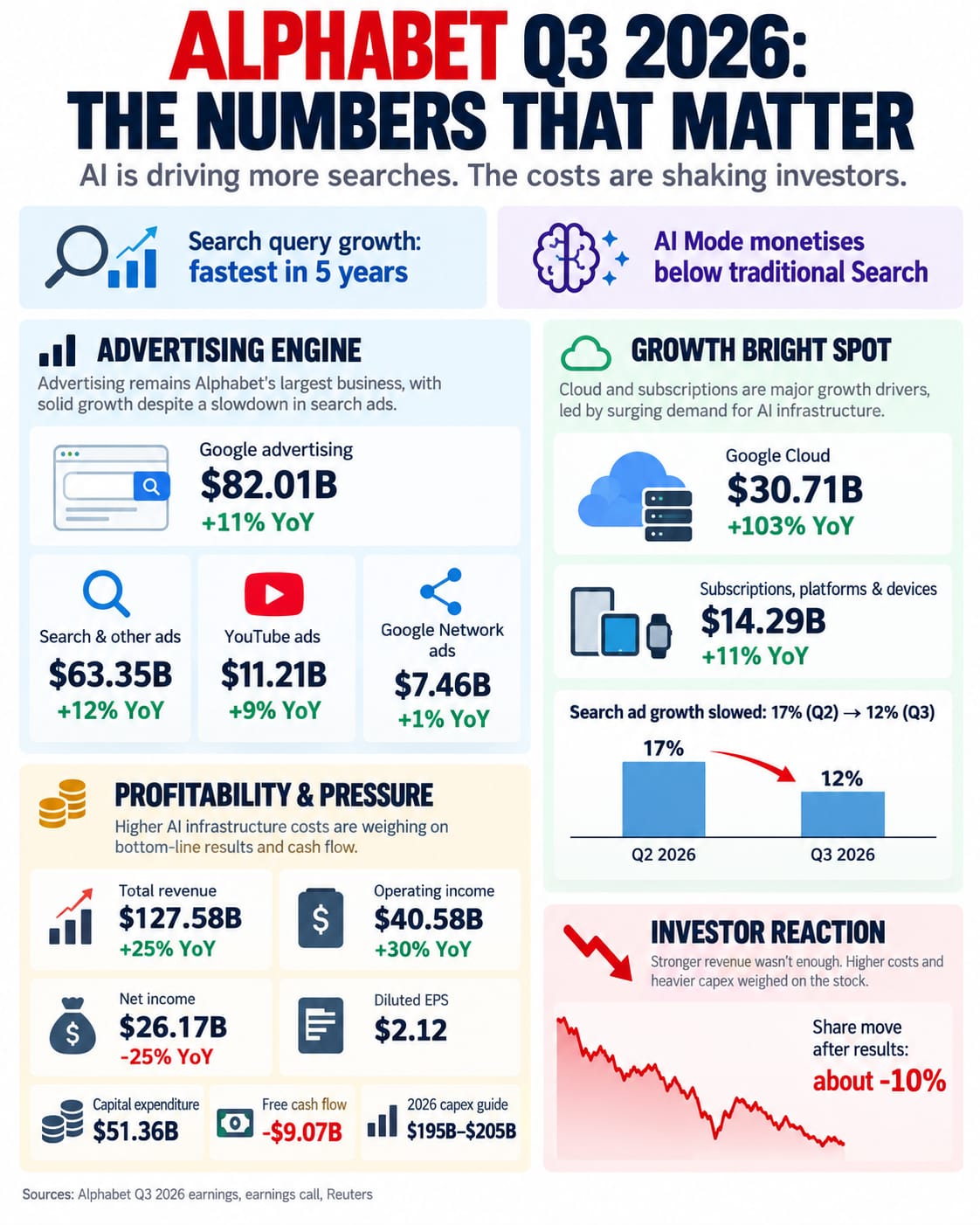
Alphabet's numbers were formidable. Revenue rose 25% year-on-year to $127.58 billion, with Google Services contributing $96.30 billion, up 11%. Google advertising generated $82.01 billion, an 11% increase: $63.35 billion from Search and other advertising, up 12%; $11.21 billion from YouTube ads, up 9%; and $7.46 billion from its advertising network, up 1%. Subscriptions, platforms and devices added $14.29 billion, up 11%.
Cloud was even more spectacular, with revenue more than doubling, up 103% to $30.71 billion. Operating income increased 30% to $40.58 billion, on a 31.8% margin. Hardly the results of a company approaching obsolescence.
Read more: Google redraws line between personal context and ads
Yet investors marked Alphabet shares down roughly 10% in after-hours trading. Revenue missed analysts' expectations of around $128.2 billion, advertising undershot forecasts by approximately $1.4 billion, and diluted earnings fell to $2.12 per share. Net income attributable to common shareholders declined 25% to $26.17 billion, partly reflecting investment losses.
And the price of building the next Search is becoming eye-watering. Quarterly capital expenditure reached $51.36 billion, leaving free cash flow negative $9.07 billion. Alphabet expects to spend $195 billion to $205 billion on capital expenditure in 2026, with a significant increase forecast for 2027.
Meanwhile, Google insists Search is thriving. Sundar Pichai said year-on-year query growth was its strongest in five years, driven in part by AI, including commercial searches. AI Mode queries average three times the length of traditional searches, while the Gemini app has reached one billion users.
But more questions do not automatically mean more advertising money per question. Search revenue growth slowed from 17% in the preceding quarter to 12%. Chief Business Officer Philipp Schindler said foreign exchange was the biggest reason, alongside changes in advertiser spending, but acknowledged that growing AI Mode usage had also weighed on revenue because it currently monetises less effectively.
Read more on Google’s AI publisher payments
Google is expanding ads in AI Overviews and AI Mode, and says most AI Mode queries are incremental. It may be right. But it still must persuade advertisers and investors that Search's future will earn its keep.
When discovery stops delivering visitors
For publishers, the reckoning is rather less hypothetical.
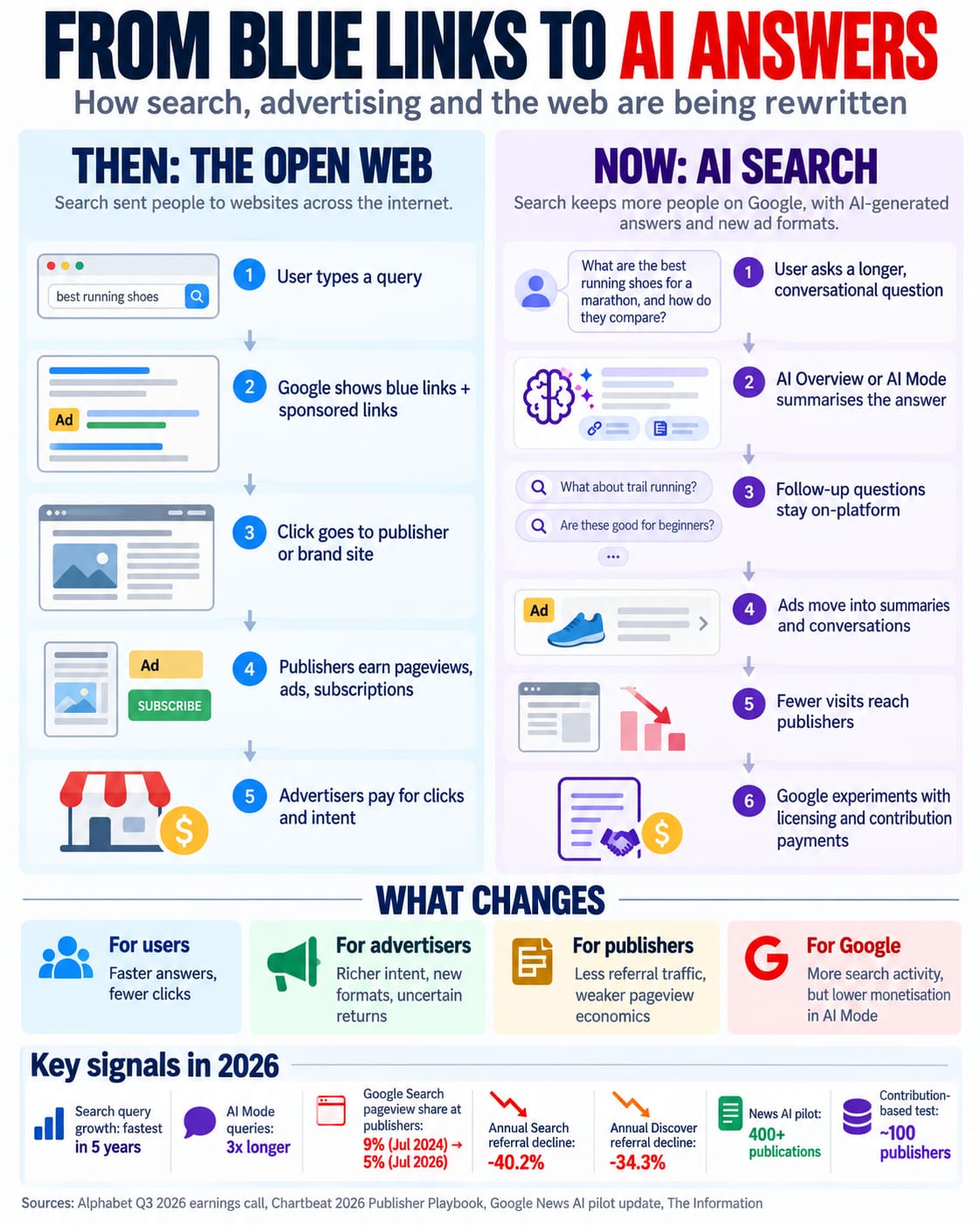
The arrangement was unequal, but comprehensible. Websites published information; Google's search engine helped people find it; and a share of those people clicked through, where advertising, subscriptions or other relationships could support further work. Google monetised other people's information, while its producers had an opportunity to earn something themselves.
AI summaries alter that exchange. An answer can be assembled and consumed without its source receiving a visit. Convenient for users and potentially lucrative for Google; less so for publishers needing visits.
The latest numbers bear out the pressure. Chartbeat's 2026 Publisher Playbook, released this month, found that Google Search's share of pageviews across its publisher network fell from roughly 9% in July 2024 to 5% in July 2026. The annual decline in Search referrals reached 40.2% in the year to July 2026, compared with 21.9% in the preceding year. Google Discover referrals fell 34.3% in the latest year.
Not all these losses can be attributed to AI. Ranking changes and changing habits matter too. But an industry built partly around discoverability is watching discovery produce fewer visits.
Rest of World offers a particularly sobering illustration. Semafor reported this week that the technology publication is seeking a new institutional home and faces ceasing publication independently in January 2027, amid collapsing search and social traffic. AI cannot alone be blamed, but the case illustrates journalism's distribution problem.
Google itself appears to recognise that links may not be the entire answer. Earlier this month it said more than 400 publications were participating in its News AI licensing pilot, which pays for enhanced content used to develop AI features. Separately, The Information reported a contribution-based payment experiment involving roughly 100 publishers whose material informs AI-generated answers. These are different programmes, neither yet a replacement for referrals.
Perhaps the deeper irony is that Firefox, the advertiser inviting us back to a more independent web, also depends heavily on payments from Google for its search partnership. Even rebellion has a search revenue model.
None of this means users should be sent through half a dozen websites to find a straightforward answer. Nor was the old internet a commercial Eden; advertising grew up alongside its memes.
But those apparently pointless videos, personal sites, forums and, eventually, professional newsrooms shared something important: there was still a reason to make things for a web people visited. Google has made an extraordinary business out of helping us find them. If AI makes finding an answer easier while making the production of answers harder to sustain, the internet may remain wonderfully searchable.
Whether there will be as much worth searching is another question.
Read more news about Digital Media, Internet Advertising, Marketing News, Television Media, Radio Media
For more updates, be socially connected with us onInstagram, LinkedIn, Twitter, Facebook, YouTube & Google News