The great AI content glut: When everyone can make everything
Brand experts say AI brings the advantage of combining production capacity with audience intelligence and the differentiation now depends on strategy, original ideas, and human judgement
 by
by
Published: Sep 22, 2026 8:52 AM | 7 min read
 Follow Us

- The advertising industry is increasingly adopting AI technologies, with 81% of Indian marketers reportedly using AI, allowing for rapid content production at significantly reduced costs.
- India's Pocket FM exemplifies this trend, increasing its annual content output from 25,000 to 2.5 million hours while cutting production costs by 80 times, with AI now powering 93% of its catalogue.
- As AI lowers the financial barriers for creative production, brands are able to generate multiple variations of advertisements quickly, raising questions about the value of traditional creative agency roles and pricing models.
- Industry experts suggest that while production costs have decreased, the need for strategic thinking and consumer insight remains crucial for differentiating effective advertising in a saturated market.
Artificial intelligence is now in everything. So much so that when Manforce announced its AI-powered prophylactics in an April Fool's campaign, the date was perhaps the most reliable indication that the product was a joke. The fictional features promised included futuristic sensors, personalised experiences and performance tracking. Somewhere in the marketing or sales department, one imagines, someone must have suggested there was scope for a subscription model.
We are all aboard the AI bandwagon now, brands especially. And nobody can get off. Announcing that your company doesn't use AI in today's business environment is rather like proudly informing prospective customers that they can find you in the Yellow Pages. Technically possible, perhaps, but hardly the sort of thing one puts in an investor presentation.
What does an ad look like inside AI? Read e4m report
And nowhere is this enthusiasm more understandable than in advertising, where an industry that has spent decades charging considerable sums to produce content has discovered that it can now produce considerably more of it for considerably less.
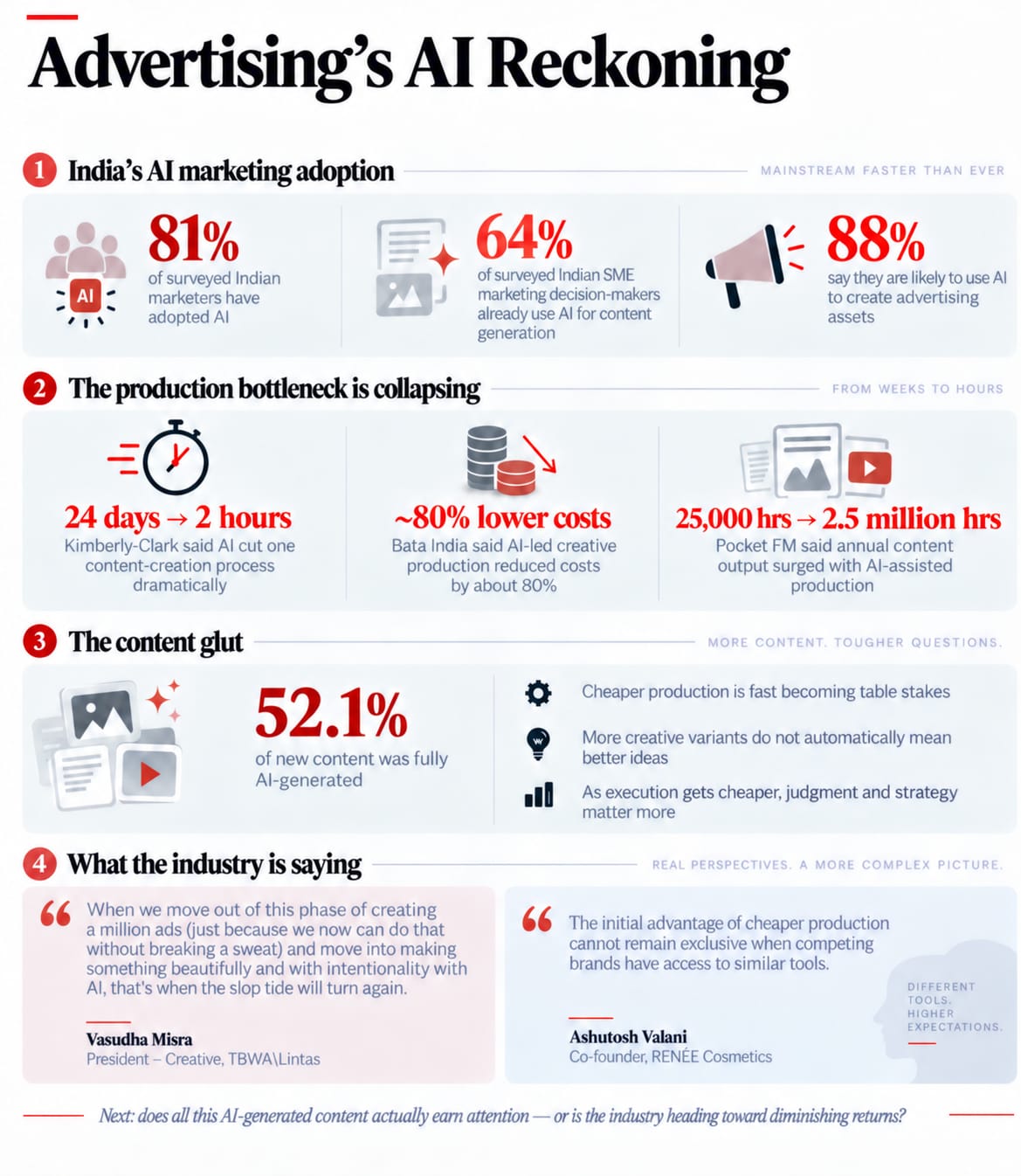
The sheer scale of this new production economy is perhaps best illustrated by India's Pocket FM. In September, the audio storytelling platform reported that AI had helped increase its annual content output from approximately 25,000 hours to 2.5 million hours, while reducing production costs by around 80 times. AI now powers 93% of its catalogue and 99% of its new content, according to co-founder and CEO Rohan Nayak. The company has also reached an annualised revenue run rate of $500 million, although that figure is not the same as actual annual revenue.
A new AI platform war? Read more
And Pocket FM is hardly alone in discovering the joys of near-limitless production. Research published by Neil Patel's NP Digital in August 2026 found that fully AI-generated material accounted for 52.1% of new content across 100 companies surveyed.
Granted, producing an audio drama is not the same as producing an advertisement. But the underlying economics are becoming increasingly familiar to marketers: when the cost of making another piece of content falls dramatically, the temptation to make another hundred becomes rather difficult to resist.
The economics are compelling. The implications for the business of making advertising are rather more complicated.
After all, when everyone can make everything, what exactly is everyone going to charge for?
Are AI platforms building next walled gardens?
The great production bonanza
According to Salesforce's tenth State of Marketing report, 81% of surveyed Indian marketers have adopted AI. Meanwhile, an Amazon Ads-commissioned study conducted by Opinium in April 2026 found that 64% of 300 surveyed Indian SME marketing decision-makers were already using AI for content generation, while 88% said they were likely to use it to create advertising assets.
For smaller advertisers, AI is lowering the financial barriers to sophisticated creative production. For agencies and production houses, it raises a somewhat less comfortable question: if a client can now have 50 creatives for the price of five, why should the next brief request only five?
Ketan Desai, Managing Director, Monks India, points out that the demand for additional creative is not simply a consequence of brands developing an enthusiasm for quantity.
"Algorithms require variations; this is the only way a piece of communication will be served to the audience. With today's tools, you can create multiple variations within minutes," he says.
For Desai, the advantage lies in combining production capacity with audience intelligence, understanding which creative approaches work for different consumer cohorts and testing them before committing further resources.
Ashutosh Valani, Co-founder of RENÉE Cosmetics, sees the same distinction from the brand side.
For the digital-first beauty brand, AI enables faster prototyping and experimentation with formats, hooks, creators and different ways of telling a product story. But Valani acknowledges that the initial advantage of cheaper production cannot remain exclusive when competing brands have access to similar tools.
"The question is no longer who is using AI. It is who is using it well enough to create something people actually want to stop and watch," he says.
For brands operating in e-commerce and quick commerce, the ability to experiment with different propositions has an immediate commercial application.
Meher Patel, Founder of Hector, a Wondrlab company, says inexpensive creative production allows advertisers to test different reasons for consumers to buy a product before directing media expenditure towards the propositions that work.
"When creative becomes cheaper, the quality of that judgment matters more," he says.
Producing ten versions of an advertisement, after all, is one thing. Testing ten genuinely different reasons to purchase the product is another.
When the client discovers the production budget
The transformation is already moving beyond individual creative assets and into the structure of advertising operations.
In May, Reuters reported that global companies, including Kimberly-Clark, Catalyst Brands and Target, were using their Indian capability centres to bring more advertising and marketing work in-house through AI.
Kimberly-Clark India head Deena Dayalan said a content-creation process that previously required 24 days could now be completed in approximately two hours using an India-developed AI platform.
The savings become even more consequential when brands begin reconsidering conventional agency arrangements.
Bata India has moved much of its creative production to an AI-led system developed with Zocket, ending its conventional creative-agency retainers. In September, the footwear company reported an approximately 80% reduction in creative-production costs and annual savings approaching ₹1 crore.
The figures are company-reported, but the commercial question is clear: what happens when advertisers no longer need to commission the same volume of work from external agencies?
Ambika Sharma, Founder and Chief Strategist, Pulp Strategy, captures the shift succinctly. "AI has commoditised execution, not thinking."
With faster and cheaper production becoming widely available, Sharma argues that differentiation increasingly depends on strategy, original ideas, brand understanding and human judgement.
It is a reassuring argument for an industry built around selling creative expertise. Whether clients will be equally enthusiastic about paying a premium for that thinking, particularly when execution has become dramatically cheaper, is another matter.
A million ads, and counting
There is, of course, a certain absurdity to the industry's enthusiasm for producing more advertising simply because it has acquired the ability to do so.
Vasudha Misra, President – Creative, TBWA\Lintas, believes the industry is still in a phase where AI-generated work is attracting attention partly because it is AI-generated, rather than because of the work itself.
She acknowledges that speed can sometimes matter more to a client than a carefully considered creative approach, but expects agencies and production houses that develop genuinely differentiated work using AI to enjoy a competitive advantage, at least until others acquire similar capabilities.
Her assessment of the current production frenzy is considerably less diplomatic.
"Again, when we move out of this phase of creating a million ads (just because we now can do that without breaking a sweat) and move into making something beautifully and with intentionality with AI, that's when the slop tide will turn again. Ummm...hopefully."
That rather hopeful qualification deserves attention.
The industry's new production capabilities have not eliminated the need for creative choices. They have simply reduced the financial and operational consequences of making another asset.
Dr Siddhant Sethi, Associate Director – AI and Emerging Initiatives, White Rivers Media, argues that inexpensive production is already becoming a baseline expectation rather than a competitive advantage.
"If everyone can make 50 versions of an ad instead of five, making 50 is not the advantage. The advantage is knowing what deserves to be made, what deserves to be killed, and what you learn before making version 51," he says.
Yasin Hamidani, Director, Media Care Brand Solutions, similarly argues that as access to AI tools becomes widespread, the competitive distinction moves towards consumer insight, strategy and brand distinctiveness rather than sheer production capacity.
There is a common thread running through these observations: creative production is becoming cheaper, but the industry's practitioners believe that the judgement surrounding it remains valuable.
They may well be right. The more uncomfortable question is whether the existing business models for supplying that judgement will survive unchanged.
For now, the advertising industry has acquired a remarkable new ability: it can make more content, faster and for less money than ever before.
Brands are delighted. Agencies are adapting. And somewhere, another hundred creative variants are being generated before anyone has finished approving the first fifty.
But once everyone can produce everything, who is going to watch it all?
In an upcoming piece, we examine whether the proliferation of AI-generated content is actually translating into greater reach and engagement, or whether advertising's newest productivity miracle is about to encounter a rather old economic principle: the law of diminishing returns.
Read more news about Internet Advertising India, Marketing News, PR and Corporate Communication News, Digital Media News, Television Media News
For more updates, be socially connected with us onInstagram, LinkedIn, Twitter, Facebook YouTube & Google News