What does an ad look like inside AI? ChatGPT and Google are starting to answer
With ChatGPT Ads live in India and Google testing conversational AI Search formats, advertisers face a new medium where assistance and promotion increasingly overlap
 by
by
Published: Sep 15, 2026 9:33 AM | 7 min read
 Follow Us

- The rise of AI in digital advertising is blurring the lines between commercial messages and organic content, as consumers shift from traditional search queries to conversational interactions with AI systems.
- OpenAI and Google are leading the way in India, with OpenAI integrating ads into ChatGPT and Google experimenting with conversational advertising through its Search platform, while Microsoft develops its own formats around Copilot.
- Advertisers are exploring new formats, such as sponsored cards and interactive experiences, but there is caution regarding the potential impact on consumer trust if ads are perceived as part of the AI's responses.
- The advertising industry is still determining effective strategies for this new medium, focusing on trust, context, and measurable outcomes, while existing guidelines on ad disclosure are evolving.
A banner ad, a sponsored search result, a promoted social post: digital advertising has spent decades teaching consumers where the commercial message begins and the organic experience ends.
AI is making that boundary considerably less straightforward.
As consumers increasingly move from typing keywords into search bars to asking conversational systems complete questions, the advertising industry is beginning to work out what exactly an advertisement should look like when it appears beside, beneath or eventually within an AI-generated answer.
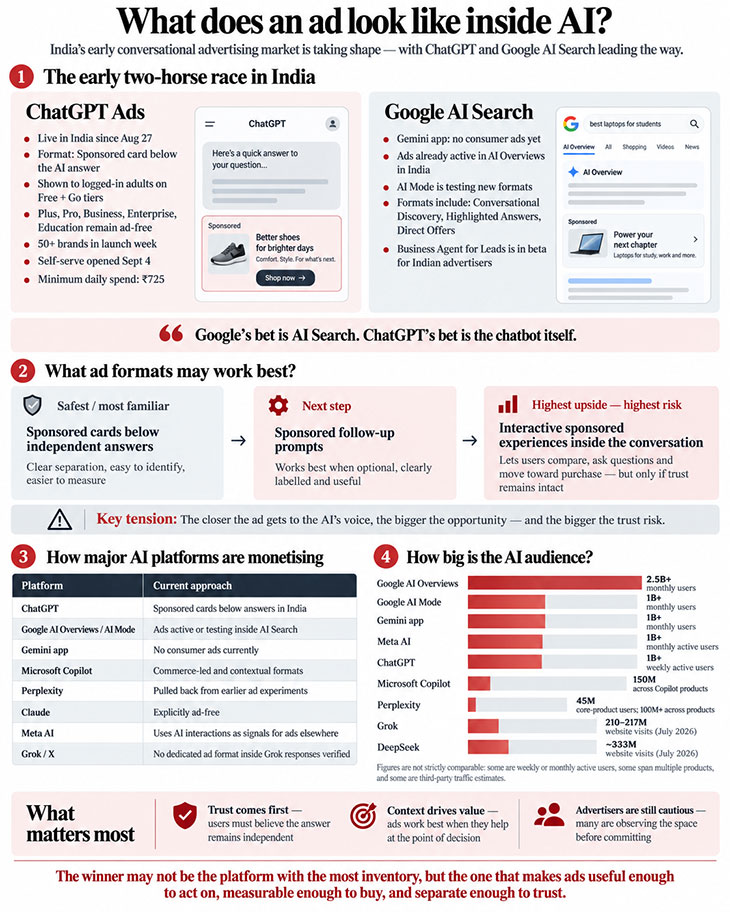
For Indian advertisers, the emerging market currently looks less like a crowded field and more like an early two-horse race. OpenAI has brought ads directly into ChatGPT, while Google is using its Search business (particularly AI Overviews and AI Mode) as its primary laboratory for conversational advertising. Microsoft is developing a separate set of commercial formats around Copilot, while most other major consumer chatbots remain ad-free or are monetising the information generated by AI interactions elsewhere.
OpenAI launched ChatGPT Ads in India on August 27, showing clearly labelled sponsored cards beneath responses for logged-in adults on the Free and Go tiers. Plus, Pro, Business, Enterprise and Education users remain ad-free. More than 50 brands were expected in the initial India rollout through WPP and Omnicom, while self-serve buying is now available with daily campaign budgets starting at ₹725. OpenAI says ads remain separate from its answers and do not influence what ChatGPT tells a user.
Also Read: ChatGPT Ads just hit $1bn run rate. Now comes the price test in India
The AI knows why you saw the ad. What about the advertiser?
Google has taken a different route. The standalone Gemini app remains without consumer advertising for now, although Google SVP Nick Fox has said the company is not ruling it out. Instead, Google is commercialising conversational AI through Search. Ads in AI Overviews are already available in India, where Google can use both the search query and the AI-generated overview when determining which ads appear.
AI Mode takes that experiment further. Google is testing Conversational Discovery ads, Highlighted Answers and Direct Offers, including formats where an independent Gemini-generated explainer appears alongside advertiser creative. Direct Offers can surface deals during the AI-assisted research process, while Business Agent for Leads, already in beta for Indian advertisers, allows consumers to chat directly with an AI agent trained on an advertiser's website.
That spread is important because the platforms are not merely choosing different-looking advertisements. They are making different bets about how close a commercial message can get to the AI's own voice before users stop trusting the distinction between recommendation and advertising.
Separate the ad, or make it part of the experience?
For Meher Patel, Founder of Hector, a Wondrlab Company, the safest formats are also likely to scale first.
“Sponsored cards placed below an independent answer are likely to scale first,” Patel said, pointing to their familiarity, clear identification and relative ease of measurement. Sponsored follow-up prompts could work for similar reasons when they remain optional and clearly labelled.
But Patel believes the bigger opportunity lies beyond a static card. An interactive sponsored experience could allow a consumer to question a product, compare alternatives, check whether it fits particular requirements and potentially move towards purchase without leaving the conversation. “For that to work, however, conversational intent has to be connected to accurate information about price, availability, offers and the specific requirement expressed by the consumer.”
Porus Jose, Content Head at Wife, a creative and brand communications agency, is more cautious about moving the commercial message into the answer itself. His preference is for “a clearly labelled line under the answer, not woven into it”, arguing that the trust currently extended to AI assistants could be damaged quickly if sponsored copy becomes indistinguishable from the model's own response.
Jose sees particular potential for opt-in sponsored follow-ups in high-consideration categories such as insurance, mutual funds, vehicle loans and education finance, where consumers are already researching and comparing several options before making a decision.
The distinction matters because conversational media behaves differently from the feed-based internet advertisers have spent years optimising.
“A chat window isn't a scroll. Nobody opens it to be surprised,” Jose said.
Abhishek Agarwal, Chief Growth Officer at Howl, a digital marketing company, similarly divides conversational behaviour into two broad phases: discovery and validation. Advertising has a more natural role during discovery, when a consumer is actively looking for hotels, restaurants, products or other options. During validation, as in when the user is asking which choice is actually best, commercial intervention becomes considerably more sensitive because the consumer is relying on the AI's perceived objectivity.
That could ultimately determine where the industry's ad formats settle. A brand appearing as another option while a user explores a category may feel useful. The same brand appearing to influence an answer to “which one should I buy?” may feel very different.
Darshana Shah, Brand & CX Strategist and Founder of Darshana Shah – Advisory & Consulting, argues that the opportunity is to shift advertising away from simply buying attention and towards being useful at the point of decision-making.
“If I am asking an AI assistant about a holiday and it recommends a relevant hotel or experience, that can feel useful rather than intrusive,” she said, adding that the quality of context and intent would become one of conversational advertising's biggest differentiators.
Advertisers are interested, but still working out what to do
That uncertainty is visible among advertisers themselves.
exchange4media reached out to a mix of large and smaller advertisers across categories for this story. All declined to comment, saying they were still firming up their decisions and strategies around the emerging medium.
That hesitation is notable given how low the barrier to initial experimentation has become on ChatGPT in India. It also reflects the fact that advertisers are being asked to evaluate something without an established playbook for placement, creative, attribution or even the consumer behaviour surrounding it.
Patel describes trust, context and measurement as a sequence rather than competing priorities: trust gives the platform permission to introduce advertising; context determines whether the advertisement is useful; and measurable outcomes determine whether brands continue investing. Traditional impressions and clicks, he argues, will eventually need to give way to measures such as qualified interactions, assisted conversions, conversion quality and incremental sales.
There is also an emerging disclosure question, although the industry is only beginning to confront it. ASCI's existing framework emphasises that advertising should be identifiable as advertising, while its May draft guidelines on AI-generated advertising focus primarily on when synthetically generated creative itself requires disclosure. They do not establish a specific design standard for how sponsored material should be separated from an AI-generated answer.
For now, the platforms are effectively writing those conventions themselves.
TL;DR
And that may be why the early contest between ChatGPT and Google's AI Search matters beyond their respective media businesses. ChatGPT is starting with a familiar proposition: give the answer first, then show the ad. Google is testing how far commercial information can become an interactive component of the AI-assisted search journey itself.
Microsoft is pushing further towards contextual commerce, Claude has rejected the premise entirely, Perplexity has retreated after experimenting with it, and Meta is so far treating the AI conversation more as an advertising signal than an advertising surface.
The eventual winner may therefore not be the platform with the most conspicuous inventory. It may be whichever platform works out how to make the commercial layer useful enough to act on, measurable enough to buy, and separate enough from the machine's answer that users continue to believe the answer itself.
Read more news about Digital Media, Internet Advertising, Marketing News, Television Media, Radio Media
For more updates, be socially connected with us onInstagram, LinkedIn, Twitter, Facebook, YouTube & Google News