Print publishers struggle to impose 15% ad surcharge even during festive season
Festive quarter typically contributes 35–40% of publishers’ annual ad revenue, but can newspapers turn higher bookings into better ad rates amid advertiser resistance and rising operating costs?
 by
Published: Oct 30, 2026 8:51 AM | 7 min read
 Follow Us


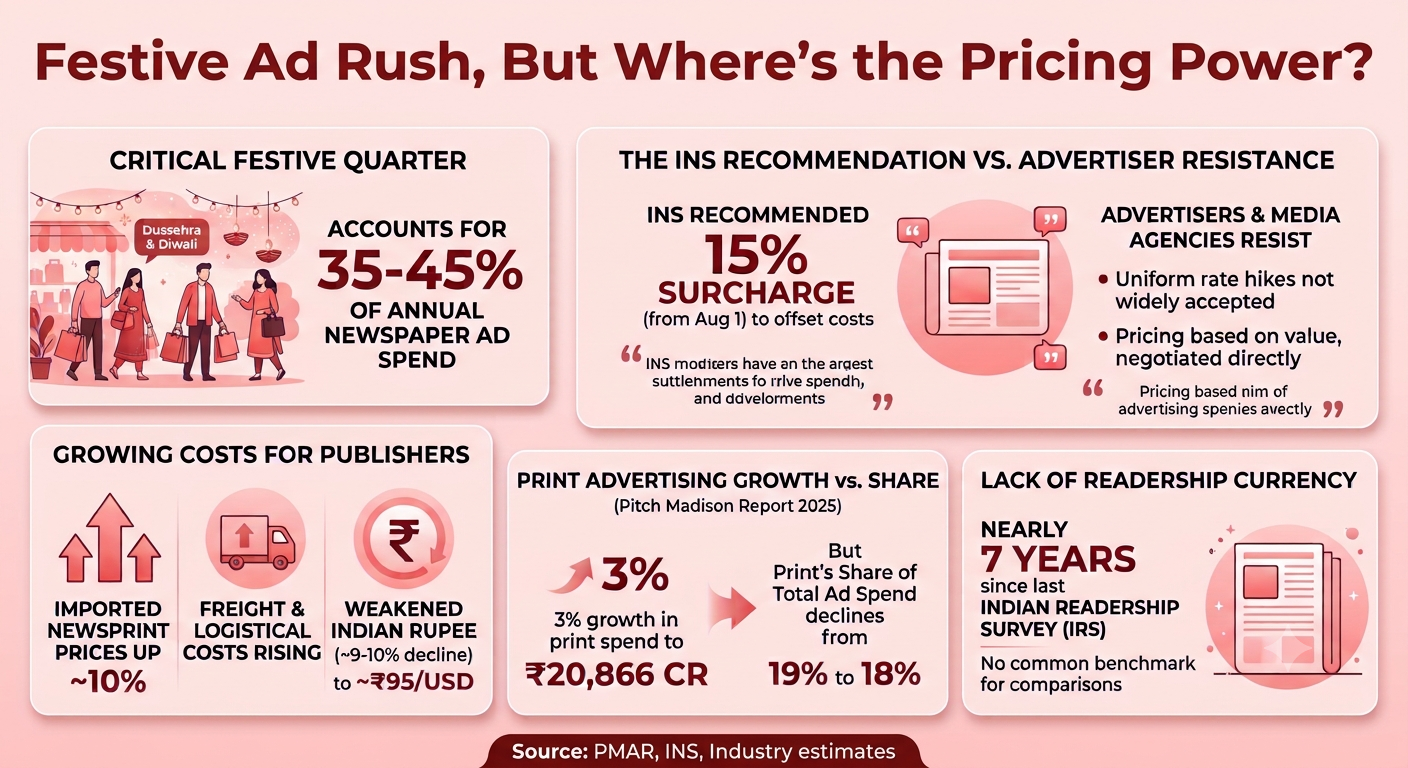
- The festive quarter is crucial for Indian newspaper publishers, contributing 40-45% of annual advertising revenue, but they struggle to raise rates amid economic pressures and advertiser resistance to a proposed 15% surcharge by the Indian Newspaper Society (INS).
- Despite increased advertising activity during the festive season, publishers face challenges in negotiating higher rates due to competition, market conditions, and the absence of a universally accepted readership metric, which complicates pricing discussions.
- Advertisers emphasize that rate increases must be justified by the value provided by publications, considering factors like audience quality and market position, rather than adhering to a uniform surcharge.
- The effectiveness of the festive quarter will be evaluated not just by the volume of bookings but also by whether publishers can achieve higher advertising yields to offset rising operational costs, including increased newsprint prices.
For India’s newspaper publishers, the festive quarter is one of the most consequential periods for annual advertising revenue, accounting for an estimated 40–45% of the yearly advertising revenue. Yet the seasonal surge in advertising does not necessarily translate into stronger pricing power.
As brands step up campaigns around Dussehra, Diwali and the broader festive shopping season, publishers face a familiar balancing act: secure a larger share of advertiser budgets without conceding too much on rates. The challenge is particularly significant this year, with the industry still debating the Indian Newspaper Society’s (INS) recommendation of a 15% advertising surcharge to offset rising costs.
Due to advertisers' resistance, most newspapers haven’t been able to implement the recommended surcharge, even as festive bookings peak with Diwali just a week away. Notably, INS had recommended that publishers begin implementing it from August 1, but advertisers and media planners confirmed to e4m that the increase has not gained widespread acceptance even after three months.
Newspapers, both English and regional, acknowledge that raising advertising rates has been difficult amid the prevailing economic conditions. Publishers cited difficult market conditions, intense competition and advertiser pressure as reasons for delaying the increase.
Mohit Jain, Chief Operating Officer and Board Member, Bennett, Coleman and Co. Ltd (Times of India Group), who is also the chairman of the ABC, said publishers have not been able to demand a 15% surcharge from advertisers so far, even as rising newsprint and freight costs make it increasingly challenging to sustain operating pressures.
“We have not implemented the surcharge yet. I don’t think others have done,” quips MV Shreyams Kumar, former INS chief and Managing Director of Mathrubhumi.
“Forget surcharge, most advertisers seek substantial discounts during the festive season as per longstanding tradition.”
Offering the advertiser’s perspective, marketers cautioned that any attempt to push through a uniform rate hike would overlook the significant differences in the market positioning and commercial strengths of individual publications.
A senior marketer argued, “A uniform increase in advertising rates does not necessarily work across publications with different readership profiles, market positions and commercial strengths. Advertisers weigh several factors when negotiating rates, including circulation, audience quality, available inventory, category demand and existing relationships with publishers.”
Advertisers insist that a publication’s ability to command a premium must be established through the value it delivers to advertisers, rather than through a prescribed increase. “Higher ad rates have to be justified by the value a publication delivers, whether through its readership, audience quality, content or effectiveness. Ultimately, pricing should be negotiated directly between advertisers and publishers based on what each brings to the table. Associations have no role in this,” an ad executive said.
The absence of a credible, common readership currency puts publishers at a further disadvantage in rate negotiations. Nearly seven years after the last Indian Readership Survey (IRS), advertisers continue to lack a universally accepted benchmark to compare readership, assess audience quality and measure incremental reach across publications, making it harder for publishers to substantiate their pricing demands.
Also Read: Rise in domestic newsprint prices: 'Movement is cost-driven and industry-wide'
Not just imports, rising domestic newsprint cost deepens publishers’ burden: INS
Print publishers hesitant to implement INS-recommended 15% ad surcharge
INS defends 15% ad surcharge, calls it a ‘temporary measure’ amid rising costs
Festive Bookings, But at What Price?
The festive period traditionally brings higher advertising activity across categories such as consumer goods, automobiles, retail and jewellery. For newspapers, this can mean more campaign bookings, larger advertisements and greater demand for premium positions.
However, higher demand does not automatically give publishers the leverage to raise rates. “Advertisers and media agencies continue to weigh print costs against campaign objectives, audience reach and competing media options. Discounts, negotiated packages and bundled deals can further affect the effective price at which inventory is sold,” a media planner explained.
The INS surcharge debate illustrates this gap between demand and pricing power.
Publishers argue that readership figures alone do not reflect the full value they offer advertisers. “Audience trust, editorial credibility, the quality of the advertising environment and the ability to command attention around major events also contribute to a publication’s commercial value. Besides, we have DAVP rates and ABC circulation figures that serve as benchmarks,” says a publisher.
Growth Is Not the Same as Pricing Power
The broader advertising numbers underline the challenge. According to the Pitch Madison Advertising Report, print advertising grew 3% to ₹20,866 crore in 2025, from ₹20,272 crore in 2024. Yet print’s share of total advertising expenditure declined from 19% to 18%.
The figures suggest that print advertising continues to grow in absolute terms but is not keeping pace with the expansion of the overall market. They do not, by themselves, establish whether publishers achieved higher rates or relied on increased volumes to drive growth.
For publishers, the distinction matters. Revenue growth can come from additional inventory sold, more advertisers or higher spending by existing clients. Improved pricing power, by contrast, requires advertisers to accept higher rates without equivalent concessions elsewhere in the deal.
Rising newsprint and operating costs add to the pressure. Imported newsprint prices have risen by around 10% over the past year, with publishers facing pressure from geopolitical volatility, freight costs and a weaker rupee, e4m reported earlier.
India remains heavily dependent on imports, with nearly two-thirds of its newsprint consumption sourced from overseas. The rupee has added another layer of pressure. At around ₹95 to the US dollar, it is roughly 9–10% weaker than the same period last year.
While the INS recommendation was intended to help publishers offset these expenses, an industry-wide advisory cannot determine what individual advertisers will pay. Publishers must still contend with competitive pressures and negotiations over the value of their inventory.
An industry leader points out, “An advertiser’s willingness to pay also depends on the value it sees in the medium. Audience reach, readership profile, credibility, market relevance and campaign outcomes all influence the case for a premium. Publishers must therefore balance the need to recover costs against advertisers’ expectations of value.”
INS Response
Karan Darda, CEO of Lokmat Media and Chairman of the INS, says the 15% surcharge is advisory, not mandatory, and that some publishers like Dainik Bhaskar and Lokmat have been able to implement it “in part” with a handful of advertisers.
While he did not name the advertisers or specify the percentage of the ad rate hike, Darda said the automobile sector had been more receptive. “The Indian market is robust, with several sectors, including automobiles and electronics, growing. Moreover, the trust in newspapers is higher compared with other media. This is helping us improve our prospects,” he said.
Some publishers, however, describe the partial implementation of surcharge as “normal negotiations”, in which they manage to secure a 2–4% hike compared with the rest of the season during the festive period.
The Yield Test
The festive quarter will offer a revealing test of print’s commercial position. If bookings rise but effective rates remain flat, publishers may see stronger business without a corresponding improvement in pricing power. If they secure higher rates while sustaining volumes, it would suggest that demand is translating into better revenue realisation.
“The distinction is important because protecting volume and improving yield are not always the same objective. A publisher that holds back a rate increase to retain a large advertiser may preserve business in the short term but continue absorbing higher costs. Conversely, pushing through an increase without sufficient advertiser support risks losing campaigns to competing publications or other media,” said an ad executive.
For an industry entering its most important advertising quarter, festive success may therefore be measured by more than the number of pages filled with campaigns or the volume of bookings secured. The bigger test is whether that demand translates into stronger advertising yields—and gives publishers greater room to recover rising costs.
Read more news about Print Media, TV Media, Advertising India, Digital Media, Marketing
For more updates, be socially connected with us onInstagram, LinkedIn, Twitter, Facebook, YouTube & Google News
