Does creativity need more disobedience in the age of dashboards?
With data, testing and brand safety shaping every brief, creative leaders ask whether agencies have turned too cautious, and where push-back should begin
 by
by
Published: Oct 6, 2026 8:45 AM | 9 min read
 Follow Us

- The Indian advertising landscape is increasingly data-driven, with accountability reshaping how advertising is measured and creative ideas are developed, leading to concerns about the viability of unconventional concepts.
- The Pitch Madison Advertising Report indicates that India's ad market reached ₹1,55,105 crore in 2025, with digital media comprising 60% of this share, projected to rise to 64% in 2026, highlighting a shift towards real-time reporting formats.
- Global studies reveal a trend of risk aversion among marketers, with only 13% considering their companies risk-friendly, which may stifle creativity despite evidence suggesting that bold ideas are often more effective.
- Creative leaders advocate for a balance between data and instinct, emphasizing the importance of trust and collaboration between agencies and clients to foster innovative ideas that can stand out in a crowded market.
Indian advertising has never had more ways to prove itself, and arguably never had fewer reasons to take a leap of faith. Briefs now come with dashboards attached, films are tested before they are shot, and placements pass through brand-safety filters before a single impression is served. The money is following the same logic.
Creative leaders say that growing accountability is beginning to alter not just how advertising is measured, but how ideas get made in the first place. The concern is that as brands seek greater certainty on outcomes, unconventional ideas can become harder to defend, briefs more difficult to challenge and creative instinct easier to overrule. Yet stakeholders also argue that the answer is not less data, but knowing where its authority should end.
According to the Pitch Madison Advertising Report (PMAR) 2026, India's ad market reached ₹1,55,105 crore in 2025, with digital already accounting for 60% of it and its share projected to touch about 64% in 2026. As more of the adex shifts to formats that report back in real time, the idea that cannot be justified in a deck or defended in a quarterly review is left with far less room to breathe.
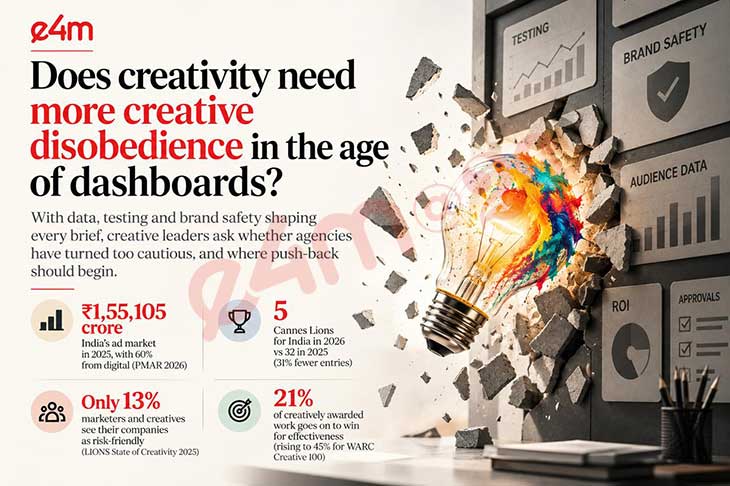
The awards table offers an uncomfortable parallel. India closed Cannes Lions 2026 with 5 Lions, 2 Silver and 3 Bronze, against the 32 it won in 2025, while entries fell 31.2% to 676 from 982 a year earlier. A number of agencies had flagged shrinking marketing budgets and slower client decision-making in the run-up to the festival, and a leaner slate of entries is not in itself proof of timidity. Even so, when the volume of ambitious work shrinks just as the appetite for certainty grows, it is fair to ask whether the industry is still making room for the kind of ideas that win awards and, more importantly, build brands.
Global studies point in the same direction. LIONS' State of Creativity 2025 study, which drew on a survey of over 1,000 marketers and creatives, found that only 13% see their companies as risk-friendly, while 29% admit to being highly risk-averse. The World Federation of Advertisers (WFA) and LIONS' Clients and Creativity 2026 report, based on inputs from 160+ senior marketers, likewise lists risk-averse cultures, short-term pressure, and too many decision-makers among the forces holding brands back.
The irony is that playing safe rarely pays. WARC's The Health of Creativity 2026 report, which analysed 6,360 ideas over 11 years, found that 21% of creatively awarded work went on to win for effectiveness, a figure that rises to 45% for ideas that made it to the WARC Creative 100. These are global numbers and not India-specific, but the direction of travel is hard to ignore.
The idea that cannot be proved upfront
Testing tools were built to de-risk spend, but they carry a built-in bias towards the familiar, because work that resembles what has already worked is easier to score. An idea with no precedent has no benchmark to be measured against, which is why many creative leaders argue that the most promising ones tend to look shaky on day one. That is the argument Josy Paul, Chief Creative Officer, BBDO Group India, and Chairman, BBDO India, makes. "The most interesting ideas are almost always uncertain in the beginning. If an idea can be completely justified before it is made, perhaps it isn’t an idea," he says.
Paul is not pitching for flying blind. His case is that evidence deserves a seat at the table but not the final vote, because instinct is what carries an idea across the distance between an insight and a finished piece of work. As he puts it, "Great creativity needs some evidence, but it also needs instinct. It needs a little irrationality. The courage to say, ‘I know we can’t prove this yet. But I believe there is something here’.”
Disobedience as an act of care
The phrase creative disobedience can sound like a licence for agencies to pick a fight with clients, but the leaders making the case for it use it differently. The point is less about overruling a brief than about refusing to treat it as the last word, especially in categories where the codes are so entrenched that every film begins to sound like every other film. Paul reframes the idea as an act of care for the brand. "For me, creative disobedience is not disobedience at all. It is love. If you really care about a brand, you don’t simply do what it asks you to do. You ask whether there is a bigger thing it could do," he says.
In practice, that begins with the questions a brief rarely invites. It could mean asking what happens if the brand takes a stand, or if the agency stops making an ad and actually does something instead. "The brief is a starting point. Creative disobedience is having the courage to ask the uncomfortable question. Why are we doing it this way? Why does everyone in the category sound the same?" Paul asks.
Those are also the questions where data earns its keep. Used to map the problem, the audience, and the noise in a category, research sharpens the provocation instead of blunting it. The trouble begins when the same dashboard is used to dictate what the answer must look like. Paul draws that line clearly. "I don’t think the answer is to reject data, testing, or brand safety. The answer is to know where they belong. Use data to understand the problem. Don’t use it to put a ceiling on empathy or imagination," he says.
Seen this way, disobedience is closer to service than rebellion. In Paul's words, "Creative disobedience isn’t about being difficult. It’s about being useful in a way nobody expected."
When social raises the risk appetite
The picture is not one of unbroken retreat, though. The always-on nature of social is forcing brands to make dozens of small creative calls every week, and that is quietly resetting what feels risky. Harikrishnan Pillai, Founder & CEO, TheSmallBigIdea, reads this through the lens of entertainment, where work is judged in near real time. "What’s changed is not the fundamentals of brand building, but the cadence," he says.
The old template of one large campaign a quarter, with social doing maintenance work in between, is giving way to a calendar where every touchpoint counts. Brands are now judged on how often they show up and how fluently they speak to their community, not just on the strength of the big idea. That has also dissolved the old divide between a polished television film and a diluted social cut. "Earlier, you’d see a clear split: a polished, conservative film for television and a separate, simplified version for social. Today, those boundaries are blurring fast. The tone, the risk appetite, and the storytelling are converging. Brands are willing to behave more like entertainment (responsive, culturally aware, and bold) because that’s what today’s audience rewards," Pillai explains.
For creative teams, this cuts both ways. It lowers the cost of trying a bolder voice in public, but it also raises the temptation to mistake volume for distinctiveness. The answer, according to Pillai, lies in treating consistency as a creative discipline in itself. "If they need to cut through the social noise of entertainment, creators, and users, they need to think of everyday as the new brand event," he says.
Trust is the real currency
If caution is the symptom, where does the dilution actually happen? Vishal Prabhu, Creative Director, Strategy, at White Rivers Media, an independent digital creative agency based in Mumbai that has created content for brands such as ITC, Coke Studio Bharat, and Netflix India, believes the gap between what agencies imagine and what finally gets approved is real but often overstated. "There is sometimes a gap, but it’s not as black and white as it’s made out to be," he says.
Part of the reason is that no brand operates in a vacuum. Business priorities, legal checks and cultural sensitivities set the edges of the canvas long before a pitch is made. "Creative freedom sounds great in conversation, but in reality, every brand is operating within business, legal, and cultural constraints," Prabhu says. The real fault line, in his view, sits elsewhere. "The issue usually isn’t a lack of freedom; it’s a lack of shared clarity," he adds.
A loose brief invites reshaping at every stage, from feedback to approval, until the idea that comes out bears little resemblance to the one that went in. A tight one, agreed upon by both sides on day one, lets even a daring idea travel through the system largely intact. "At the end of the day, the strongest work comes from collaboration, not confrontation. When there is trust between teams, bold ideas don’t get diluted; they get refined," Prabhu says.
That is where the two arguments meet. Paul, too, stops short of casting clients as the villains, given the weight of scrutiny they carry from boardrooms, benchmarks and social media. "I don’t blame anyone for wanting certainty. But the brands that become part of culture usually do something that isn’t entirely safe," he says.
What he asks of agencies is patience in the right place, and a different kind of ambition. "I don’t think agencies should spend their time fighting clients. I think we should spend our time earning their trust. Because once there is trust, you don’t need permission for every brave idea," Paul says.
So does creativity need more creative disobedience? From both ends of the table, the answer appears to be yes, but of a quieter kind than the phrase suggests.
In a market where 60% of ad spend already sits in digital and every campaign is expected to show its working, the disobedience that counts is less about defying the brief and more about earning the credibility to rewrite it early, with data used as the diagnosis and not the verdict. India's Cannes tally has slipped while the global evidence keeps tying bolder ideas to business results, and the agencies that build that trust first may well be the ones still making work worth entering next June.
Read more news about Internet Advertising India, Marketing News, PR and Corporate Communication News, Digital Media News, Television Media News
For more updates, be socially connected with us onInstagram, LinkedIn, Twitter, Facebook YouTube & Google News
