GTA VI: How a video game became the world's biggest marketing event
Rockstar's latest Grand Theft Auto release has brands scrambling, bosses okaying gaming holidays & Q-comm delivering copies in mins. How did a franchise built on mocking consumerism attain this scale?
 by
Published: Nov 20, 2026 9:06 AM | 10 min read
 Follow Us
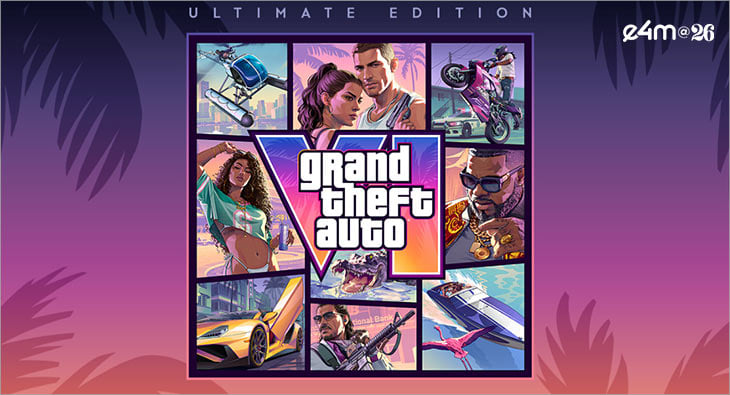

- The highly anticipated video game Grand Theft Auto VI (GTA VI) was released on November 19, 2023, thirteen years after its predecessor, GTA V, which generated over $800 million in sales within 24 hours of its launch in 2013.
- In a unique marketing trend, several companies offered employees time off to play GTA VI, aiming to associate their brands with the game's engaged audience and capitalize on the cultural phenomenon surrounding its release.
- Rockstar Games has resisted traditional advertising methods, instead creating a cultural event that attracts significant attention, with millions of views on promotional trailers and organic publicity that brands seek to leverage.
- The launch of GTA VI has sparked commercial activity beyond gaming, with increased interest in related hardware and accessories, particularly in markets like India, where gaming is predominantly mobile-based.
I still remember the first time I killed a man (virtually). Actually, it was several people, in a rather mathematically precise sequence, particularly since I'd had a tough day at school, where my mathematics had been made fun of. As you can tell by the use of the word several, it (and I) was very mathematical indeed. Apparently not grammatical, though.
It was the late 1990s. I had a computer waiting at home, and homework that I'm fairly sure is still waiting to be finished.
That was my introduction to Grand Theft Auto.
It turns out marketing executives and brand heads may have also been made fun of as children. Because the global economy appears to be slowing down for these 24 hours, as companies give employees the day off to play a video game, brands scramble to associate themselves with it, and Rockstar Games demonstrates that sometimes the best way to sell something is to have everyone else do the advertising.
This is not hyperbole. Entirely.
GTA VI has dropped.
The latest Grand Theft Auto arrived on November 19, thirteen years after GTA V, carrying expectations extraordinary even by the standards of the entertainment industry.
Its predecessor generated more than $800 million in worldwide retail sales within 24 hours of its September 2013 launch and crossed $1 billion in three days. By November 2026, GTA V had sold nearly 235 million copies worldwide, according to publisher Take-Two Interactive, with the entire franchise approaching 480 million units.
And GTA VI had already achieved extraordinary reach before anybody could play it.
The first trailer attracted more than 93 million views on YouTube within 24 hours in December 2023. Its second trailer generated more than 475 million views across platforms in its first day, according to Rockstar.
Consider the economics. Brands spend enormous sums persuading audiences to watch 30-second advertisements. Rockstar persuaded hundreds of millions of people to voluntarily watch promotional footage for a product that was still years away from release.
Then watch it again, frame by frame, examining everything from car interiors to street signs.
Marketing departments would presumably murder for that sort of attention. Figuratively, of course.
The day the office went to Vice City
The release has produced one of the more unusual corporate marketing trends in recent memory: employers giving their staff time off to play a video game.
Logitech introduced a dedicated gaming leave benefit for its global workforce of more than 7,000 people. Employees could use the day to play GTA VI or another game of their choice.
In India, consumer electronics brand boAt offered employees optional leave for the launch, while digital agency Influish and furniture company Inde by ChairsCarté were among the businesses announcing similar initiatives.
These are not merely exercises in generosity.
For gaming-adjacent companies, publicly embracing GTA VI creates an opportunity to associate their brands with an extraordinarily engaged audience. Even businesses without an obvious connection to gaming can use the occasion to communicate something about workplace culture and their understanding of popular entertainment.
The underlying economics can be attractive. A day of employee leave has a calculable cost. The organic publicity generated by announcing it may be considerably harder to purchase through conventional advertising.
The inevitable claims of a global productivity collapse, however, deserve some scepticism. Viral estimates of absenteeism are not equivalent to representative economic measurements. Nor does an announcement of gaming leave establish how many employees actually spent the day playing.
But even when the economic impact is exaggerated, the marketing phenomenon is real.
A video game has become an occasion around which brands, employers, retailers and consumers are organising themselves.
The ad empire that doesn't want your ads
Here lies the particularly delicious contradiction at the heart of Grand Theft Auto.
The franchise has spent nearly three decades ridiculing corporations, advertisers, consumerism and, depending on which fictional radio station one listens to, practically every institution in American society.
Cluckin' Bell and Burger Shot satirise fast-food culture. Sprunk and eCola offer their own versions of the soft-drink wars. Weazel News mocks television news, while Lifeinvader takes aim at social media and its attendant corporate absurdities.
And Rockstar has resisted the temptation to turn this fictional marketplace into conventional advertising inventory.
Earlier this year, Take-Two CEO Strauss Zelnick ruled out traditional product placement and real-world brand integrations in GTA VI, explaining that the franchise's fictional environment depends on its invented brands.
The irony is remarkable.
For years, marketers have been chasing opportunities to integrate brands into popular entertainment. GTA has created an immensely valuable entertainment universe by making fun of precisely those brands.
And rather than paying to appear inside it, real companies are now trying to become part of the cultural conversation surrounding it.
There is an important difference between these two approaches.
Product placement purchases visibility within entertainment. Cultural participation attempts to borrow some of the attention and affection that entertainment has already generated.
Rockstar has made the latter enormously desirable without surrendering control of the former.
A terrible driver, a magnificent business model
As a driven man who doesn't drive (because I can sit in the back seat and write articles like these, rather than driving in traffic and wondering if every other driver's parents were consanguineous), there is a particular thrill in being a terrible driver and not being dinged for it. Unless, of course, it's a police car.
That freedom is arguably the greatest asset Rockstar possesses.
Unlike entertainment products that end when the audience reaches the final scene, GTA encourages players to spend extraordinary amounts of time doing things that have very little to do with completing the central narrative.
One could spend hours driving around Vice City listening to fictional radio stations, exploring San Andreas, buying properties, or discovering precisely how much chaos could be inflicted before the police became seriously annoyed.
That also explains why the franchise's commercial value cannot be measured simply through launch-day sales.
GTA V became a long-running business through GTA Online, which introduced persistent multiplayer experiences, virtual purchases and continuing content updates.
Thirteen years after the original release, Take-Two was still reporting growth in recurrent consumer spending and GTA+ memberships.
The distinction matters. Traditional blockbuster economics concentrate revenue around a release window. GTA demonstrated how a successful entertainment property could generate commercial returns long after that initial purchase.
It also encouraged something more difficult to quantify: a community that continued creating and circulating content around the game.
For advertisers, this is an important lesson in attention economics. Cultural relevance is not necessarily proportional to the amount spent purchasing media. Sometimes it comes from giving audiences something they want to keep engaging with.
"All you had to do was follow the damn train"
There is also a particular joy to consuming entire pizzas to restore your health without immediately worrying about your waistline. Though GTA: San Andreas introduced the inconvenient possibility that the main character, CJ, could actually get fat and would then have to go to the gym. Thankfully, my main character doesn't have a fat bar, unless it's three Twixes.
Then there was Big Smoke, whose legendary Cluckin' Bell order remains one of the great monuments to competitive gluttony.
And, of course, his spectacularly unhelpful contribution to the notorious Wrong Side of the Tracks mission.
I recently completed that mission after approximately 38 attempts. On a mobile phone. With touchscreen controls.
Big Smoke, who spent most of the exercise offering criticism rather than meaningful assistance, would presumably still be disappointed.
But therein lies another remarkable part of GTA's commercial longevity.
San Andreas was originally released in 2004 for the PlayStation 2. Two decades later, it could be downloaded on a smartphone as part of a Netflix subscription, which is precisely how this writer acquired it.
Netflix brought the GTA trilogy to mobile subscribers in December 2023, providing another distribution channel for games that had already spent years generating revenue across consoles, PCs and mobile storefronts.
The GTA titles subsequently left Netflix Games as licensing agreements expired, but the experiment demonstrated how valuable older gaming intellectual property could remain to subscription services competing for consumer attention.
In other words, one did not necessarily have to purchase a new console or buy a standalone game to enter Rockstar's universe.
For a mobile-first gaming market like India, that distinction is significant.
From Los Santos to Bharat
India's enormous gaming population has traditionally been dominated by smartphones rather than expensive dedicated consoles.
GTA VI itself launched on PlayStation 5 and Xbox Series X|S, making its direct audience substantially narrower than that of a free-to-play mobile game.
Yet the franchise's cultural reach extends beyond the people who own compatible hardware. Trailers, livestreams, memes, gaming creators and older mobile titles have made GTA familiar to audiences who may never purchase the latest instalment.
And the launch is already generating tangible commercial activity in India.
According to data shared by quick-commerce platform Zepto, more than 100,000 users searched for GTA VI, PS5 consoles and controllers on the platform during launch week.
Bengaluru led GTA VI sales on Zepto, followed by Mumbai, Chennai, Pune, Delhi and Gurugram. The company said the game was available across 12 cities, including Noida, Ahmedabad, Surat, Nashik, Jaipur and Ghaziabad, with plans to expand availability further.
The figures require an important distinction. Searches for GTA VI, consoles and controllers are not equivalent to completed purchases. Nevertheless, they demonstrate consumer interest extending beyond the game itself into the surrounding hardware ecosystem.
Meanwhile, rival quick-commerce platform Blinkit also began offering GTA VI across 11 Indian cities, with the PlayStation 5 version priced at approximately Rs 5,999.
The world's most anticipated video game had become something consumers could order through applications ordinarily associated with milk, groceries and emergency supplies of potato chips.
For quick-commerce operators, this represents an opportunity to move beyond everyday essentials into high-value entertainment products. For console manufacturers and accessory brands, the release provides a potentially powerful demand driver.
And for marketers, it demonstrates how a major entertainment launch can generate commercial activity across categories that extend well beyond the product itself.
Of course, enthusiasm is not proof of effectiveness.
Not every brand needs to sell a console or announce a gaming holiday to participate. Brands have also joined the GTA VI conversation with a topical Instagram Reel, illustrating how the launch has become an opportunity for brands far removed from gaming to chase cultural relevance.
A brand receiving thousands of impressions from a GTA-themed social media post may have achieved little beyond temporary visibility. A gaming holiday may improve employer perception, but it does not automatically increase sales. Retail search volumes indicate curiosity and purchase intent, not necessarily conversion.
The distinction is particularly important in India, where gaming audiences vary enormously in their purchasing power, preferred devices and relationships with gaming culture.
Brands seeking to participate in the GTA phenomenon still need to answer familiar questions about audience relevance, commercial objectives and measurable returns.
But Rockstar's achievement suggests that the most valuable marketing opportunities are not always the ones that can be purchased directly.
Sometimes the cultural event becomes so large that businesses must respond to it, regardless of whether they have any formal relationship with its creator.
The finish line
And yes, the memes are true. We got GTA VI before we got The Winds of Winter.
More importantly, no one I have ever met has finished any of the GTAs. It's not a world to finish, but one to explore.
And while you explore, you see all the brands.
The fictional ones inside the game, relentlessly mocking consumerism. And the very real ones outside, desperately trying to become part of it.
Perhaps that's Grand Theft Auto's greatest marketing achievement. A franchise built around breaking the rules has managed to get an entire industry to play by its own.
Read more news about Marketing News, Advertising News, PR and Corporate Communication News, Digital News, People Movement News
For more updates, be socially connected with us onInstagram, LinkedIn, Twitter, Facebook, YouTube & Google News