YouTube enters the living room, but is ad money following just yet?
As YouTube's living-room business grows and India's CTV audience nears 207 million, brands are rethinking premium video, even as movement of ad money is considerably less straightforward
 by
Published: Nov 20, 2026 9:17 AM | 7 min read
 Follow Us


- YouTube's living room viewership accounted for over one-third of its global advertising revenue in Q3 2026, generating $11.2 billion, a 9% increase from the previous year.
- Nielsen reports that YouTube held a 15.8% share of U.S. television viewing in August 2026, the highest for any media distributor, while connected-TV viewers in India surged to 206.9 million, indicating growing competition.
- Despite the rise in connected-TV adoption, many small and medium-sized brands prioritize advertising on Meta platforms over YouTube, complicating the relationship between CTV growth and YouTube ad demand.
- The advertising landscape is evolving, with YouTube increasingly viewed as a core video channel, yet challenges remain in accurately measuring audience reach and the effectiveness of cross-platform advertising strategies.
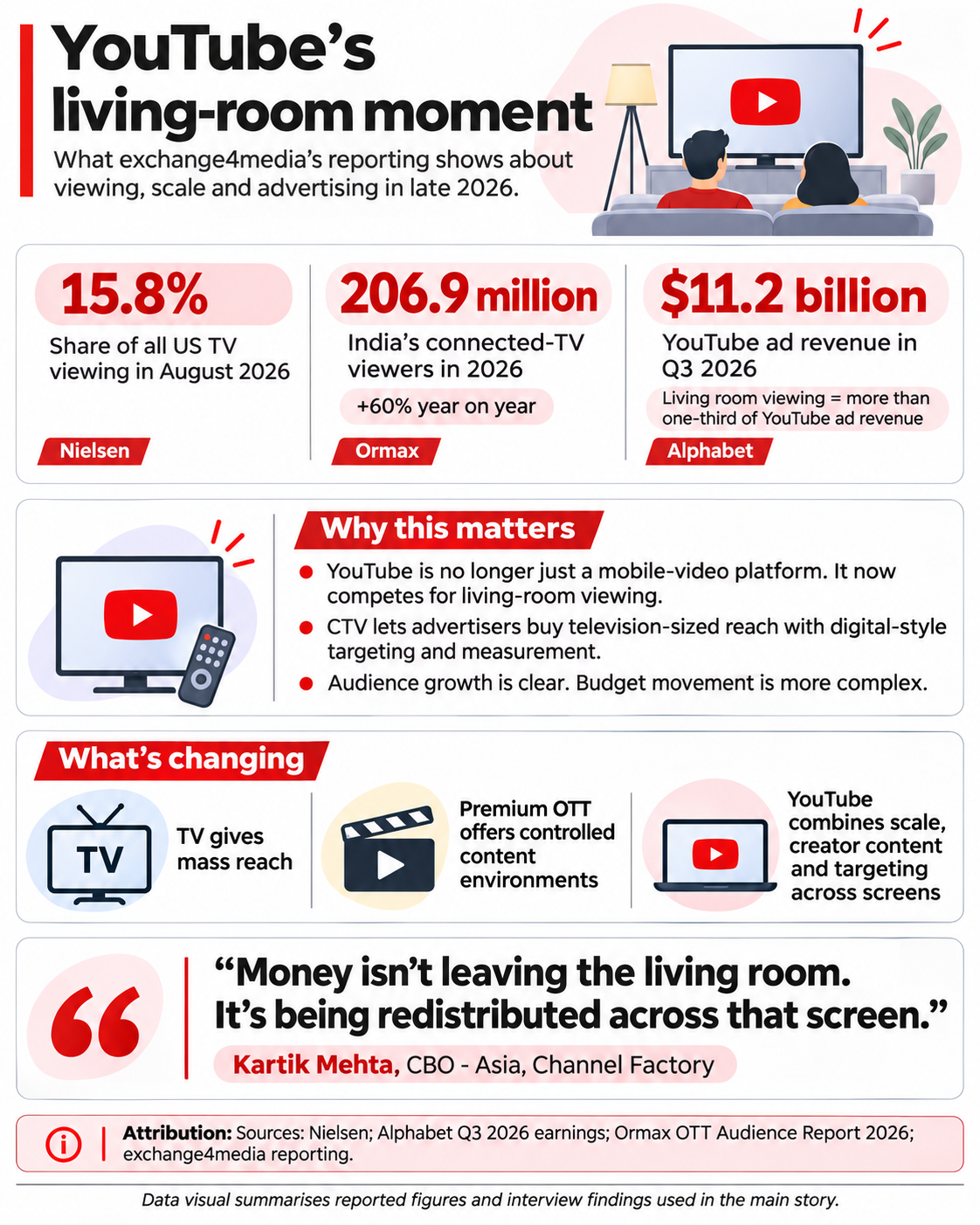
The living room is no longer an extension of YouTube's business. It is a substantial part of it. On October 28, Alphabet disclosed that viewing in the living room accounted for more than one-third of YouTube's worldwide advertising revenue in the third quarter of 2026. YouTube generated $11.2 billion in advertising revenue that quarter, up 9%.
The audience evidence is equally striking. Nielsen estimates that YouTube commanded 15.8% of all US television viewing in August, its highest share yet and more than any other individual media distributor. The figure is American, not Indian, but explains Hollywood's alarm.
India presents a more complicated picture. Ormax Media's September 2026 report estimates 206.9 million connected-TV viewers, 60% more than a year earlier, within a broader monthly online-video audience of 664.9 million. The figures do not isolate YouTube, but establish the scale of its potential competition.
The living room is becoming a marketplace
Connected TVs allow longer, often shared viewing sessions, while letting advertisers buy a television-sized experience without buying an entire network audience. In March, YouTube introduced 30-second non-skippable advertisements for its CTV inventory, borrowing a familiar commercial format from broadcasting.
The economics can broaden the advertiser pool. Kartik Mehta, CBO - Asia, Channel Factory, describes regional brands that cannot justify a nationwide linear-TV campaign but can buy placements on living-room screens in a handful of states, around locally relevant videos. For those advertisers, YouTube is creating a new television opportunity rather than simply replacing an existing one.
“Money isn’t leaving the living room. It’s being redistributed across that screen,” he said.
Not every YouTube rupee has been lost by a broadcaster.
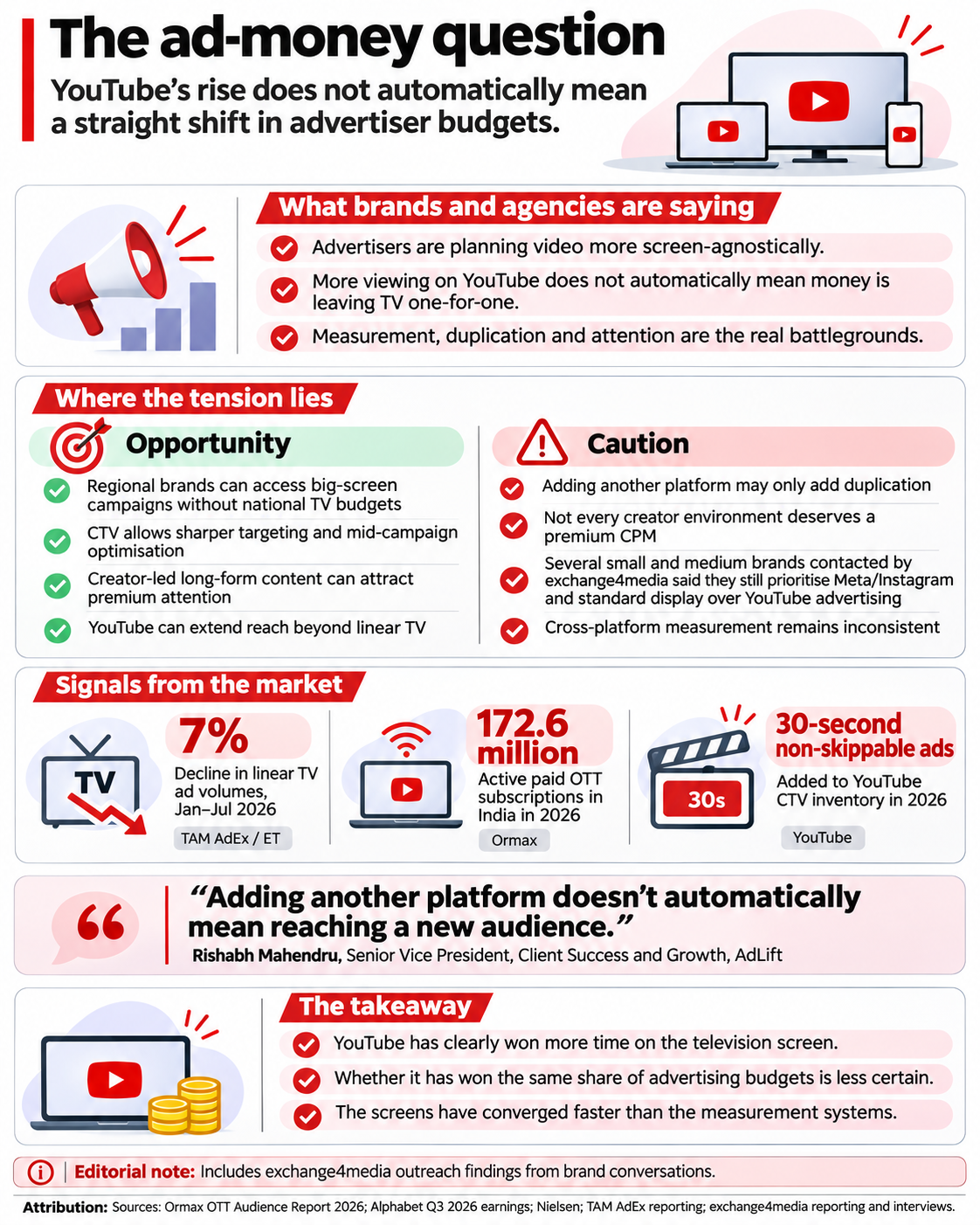
However, that opportunity is not uniformly translating into advertiser demand. Several small and medium-sized brands approached by exchange4media, including some already investing in CTV advertising, indicated that YouTube was not a priority in their media plans. Instead, their spending remained focused on Meta platforms, particularly Instagram, and conventional display advertising.
The distinction is significant: growing CTV adoption does not necessarily translate into greater demand for YouTube advertising, particularly among smaller advertisers with established performance-marketing priorities.
Simultaneously, the September report from WPP Media, The Trade Desk and Ormax Media estimates an average of 2.5 people per CTV advertising impression, with more than 80% of viewing occurring in company. These commissioned survey findings, rather than audited ad exposure, complicate the assumption that one impression means one viewer.
For Ratnakar Bharti, Vice President, Digital Strategy and Planning, Mudra, this changes the media plan itself. YouTube is increasingly treated as a core video channel, while television provides mass reach and premium OTT offers controlled entertainment environments. “The bigger change is that video planning is becoming more screen-agnostic,” he said. The challenge is avoiding repeated exposure to the same household.
The transfer of advertising money is harder to prove
There is evidence of pressure on conventional broadcasting, but considerably less public evidence showing exactly where every displaced rupee goes. TAM AdEx data, reported in August, showed a 7% year-on-year decline in linear television advertising volumes during January-July 2026. But the figure doesn’t establish YouTube's gains.
Even the most recent completed annual estimates require qualification. FICCI-EY reported a 10.3% decline in linear television advertising revenue in 2025 and 42% growth in advertising across the wider CTV market. The combined linear-plus-CTV advertising market was broadly stable. That measures a changing market, not Google's share of it.
“YouTube is increasingly being planned as television,” said Mihir Mehta, Co-Founder and Managing Partner, 0101.Today. His distinction is between expanding a digital-video buy onto CTV, supplementing a television campaign with incremental reach, and actively reallocating a broadcaster's budget. Each grows CTV investment for a different reason.
Euan Macdonald, Director of Investment, Monks, said planners are increasingly combining linear, premium OTT and YouTube CTV to address two problems: gaining incremental reach and managing frequency. Digital buying enables mid-campaign changes and measurement beyond the cost of a 30-second spot, but does not automatically make impressions more valuable.
This distinction matters to advertisers themselves. Amit Mathur, President - Sales and Marketing, Finolex Cables, said his team looks at television for familiarity and mass visibility, YouTube for targeted storytelling and measurable engagement, and OTT for specific programme environments.
A premium audience is not necessarily premium inventory
As creator-led podcasts, interviews and episodic shows take up more time on televisions, the historical line between user-generated video and studio entertainment is becoming less useful.
Macdonald said leading creators can now operate as independent studios, and curated YouTube creator packages can command rates comparable to premium CTV placements. But he also emphasised the advantages of professionally produced entertainment: predictable editorial environments, major cultural events and greater control over brand suitability.
The audience side of that proposition is visible in India. Ormax estimates 172.6 million active paid OTT subscriptions in 2026, up 16% from the previous year. Subscriptions are not unique people, but paid entertainment clearly retains a market.
Channel Factory's Mehta puts the question differently: “Premium is no longer about production value. It’s about context.” His example of a beauty advertiser blocking an entire category of content, and with it a credible regional-language dermatologist, illustrates how coarse brand-safety rules can undermine relevance. The agency example is not independently verified.
Rishabh Mahendru, Senior Vice President, Client Success and Growth, AdLift, draws another boundary. A creator recommending a product is not equivalent to an advertisement running before that creator's video. One can convey endorsement; the other buys access to an audience. Creator popularity alone cannot justify a higher CPM.
The measurement problem behind the screen war
The most important unanswered question may be how many additional people a campaign actually reaches. Advertisers can buy linear TV, an OTT service and YouTube while repeatedly reaching the same household. Views, completions, attention and sales remain distinct measures, complicating cross-platform comparisons.
“Adding another platform doesn’t automatically mean reaching a new audience,” Mahendru warned. He argues that YouTube's television-screen performance must be assessed separately from its mobile results, rather than buried in a blended platform total. Otherwise, buyers risk paying more to reach familiar viewers instead of expanding coverage.
For Gaurav Sehgal, Vice President - Marketing, Medusa Beverages, reach alone is an insufficient guide to allocating video budgets. “Millions of impressions mean little if the content does not hold attention or create recall,” he said. Medusa, like Finolex, favours an integrated approach, but did not share actual reallocations or comparative returns.
Across the board, or the screen as it were, sweeping budget-share claims remain unproven.
Instagram has copied the length, not the economics
YouTube's competition is widening beyond broadcasters and subscription platforms. In October, Instagram began a limited test of “Features”, allowing selected creators in the US and Brazil to upload horizontal videos running as long as 90 minutes. The test establishes intent, not an equivalent television audience.
Longer uploads also do not reproduce the incentives behind long-form production. YouTube's discovery, archives and revenue-sharing give creators reasons to build programmes with lasting audiences. Instagram's short-form distribution strength does not yet provide an equivalent long-form business model.
Yasin Hamidani, Director, Media Care Brand Solutions, argues that “simply allowing 90-minute uploads will not be enough.” Meta, he said, needs more reliable creator monetisation, long-form discovery and television consumption before it can challenge YouTube for podcasts and episodic entertainment.
The changing relationship between discovery, screens and advertising will also be part of the conversation at exchange4media's ninth Screenage conference on December 1 in Mumbai. Its focus on mobile-led discovery reflects how programmes found on phones compete for living-room viewing.
YouTube has demonstrated that the living room can generate serious advertising revenue. What India's advertisers have yet to establish consistently is how much of their spending buys new audiences, how much replaces existing video inventory, and whether creator attention deserves the same premium as professionally controlled entertainment. The screens have converged faster than the measurement systems, and the money is following with more hesitation than the headlines suggest.
Read more news about Digital Media, Internet Advertising, Marketing News, Television Media, Radio Media
For more updates, be socially connected with us onInstagram, LinkedIn, Twitter, Facebook, YouTube & Google News