Same parent, different brands: DPDP puts conglomerates' customer data-sharing in focus
Legal experts say common ownership offers no automatic exemption for cross-brand marketing, putting legacy customer databases, loyalty programmes and centralised CRM systems in focus
 by
Published: Nov 18, 2026 8:37 AM | 6 min read
 Follow Us


- India's Digital Personal Data Protection (DPDP) framework raises questions about whether conglomerates can share customer data between their different business units for marketing purposes, as shared ownership does not automatically allow such data sharing.
- The DPDP provisions, set to be implemented by May 2027, require companies to reassess how customer information is collected and used, particularly regarding legacy databases and consent obtained under previous privacy policies.
- Consent mechanisms must be clearly structured to inform customers about how their data will be used across multiple brands, as vague references may not suffice for legal compliance under the DPDP framework.
- Liability for improper data sharing may extend to both the originating and receiving companies, depending on their roles in determining the purposes and means of processing personal data, highlighting the need for careful management of intra-group data-sharing arrangements.
A customer buying clothes from a retail brand could also be a potential buyer for a sister company's financial services, electronics or travel offerings. For conglomerates, connecting these customer relationships is a valuable marketing opportunity. But India's Digital Personal Data Protection (DPDP) framework raises a fundamental question: can one group company use customer information collected by another to sell its products?
Legal experts say shared ownership does not automatically permit such data sharing. As the substantive DPDP provisions approach their May 2027 implementation deadline, conglomerates may have to revisit how customer information is collected, stored and used across their businesses, particularly through legacy databases, centralised customer relationship management (CRM) systems and loyalty programmes.
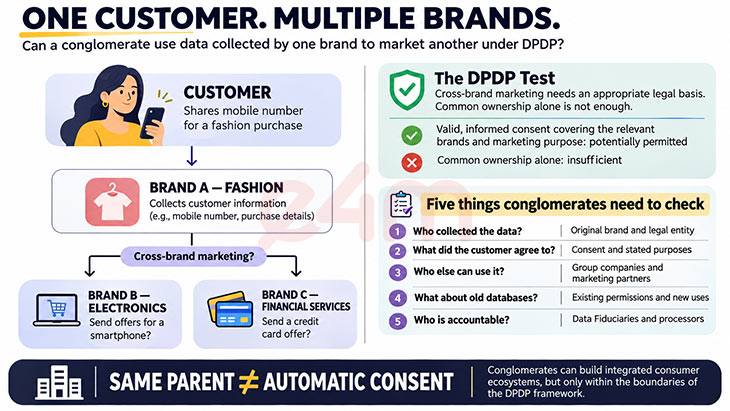
Consider a hypothetical conglomerate operating a fashion retailer, an electronics chain and a financial services company. A customer shares her mobile number with the fashion retailer while making a purchase. Can the group's electronics business subsequently use that number to promote a smartphone, or its financial services arm send her a credit card offer? Under the DPDP framework, such cross-brand marketing would need an appropriate legal basis; belonging to the same corporate group would not, by itself, authorise it.
The legacy database challenge
One of the biggest questions concerns customer information accumulated over years through purchases, registrations, loyalty memberships and promotional campaigns.
Such databases may have been built under older privacy policies that did not clearly distinguish between marketing by the original brand and promotional communications from other businesses within the same group.
Under the DPDP framework, previously obtained consent may support continued processing, subject to the Act's transitional requirements. However, it cannot automatically justify entirely new marketing purposes.
Madhu Gadodia, Deputy Managing Partner at law firm Naik Naik & Co., explained, "This provision is important, but it has limits. It applies only where consent was actually given. It does not validate cross-brand use for which there was never any consent, for example where data was collected under terms that said nothing about group marketing, or where such use was buried in generic terms and conditions."
For marketing teams, this raises the prospect of reviewing existing customer databases, identifying the purposes originally authorised and seeking fresh consent where proposed cross-brand campaigns fall outside that scope.
Does common ownership make a difference?
The DPDP Act does not provide a special exemption for sharing personal data between separate companies belonging to the same corporate group.
Suvarna Mandal, Partner at Saikrishna & Associates law firm, explained, "The DPDP Act does not provide any special exemption or relaxation for the sharing of personal data between companies belonging to the same corporate group. Under Section 4, personal data may be processed for a lawful purpose based on consent or one of the 'certain legitimate uses' recognised under Section 7. Common corporate ownership does not, by itself, constitute a ground for processing under the Act."
The distinction matters when different businesses operate as separate legal entities. Each company determining the purpose and means of processing customer information may have its own obligations as a Data Fiduciary.
Even where multiple brands operate under one legal entity, the lawful purpose and scope of consent remain relevant. Common ownership alone does not authorise an entirely new use of customer data.
Akshayy S Nanda, Partner, Saraf & Partners, said, "Common ownership does offer practical efficiencies, though not legal latitude. A group company that merely processes data on another’s behalf, such as a shared-services entity hosting a central customer database, may act as a “Data Processor” under a valid contract. That role ends the moment it begins using the data for its own marketing. The original company, moreover, remains responsible for processing carried out by it or on its behalf, whatever any intra-group agreement may say."
Can one consent cover multiple brands?
The framework does not prohibit conglomerates from operating shared CRM systems or group-wide loyalty programmes. The question is whether customers have been adequately informed about how their personal information will be used.
Ankit Sahni, Partner, Ajay Sahni Associates, said, "There is nothing under the DPDP framework that prohibits conglomerates from operating centralised CRM systems or group-wide loyalty programmes. It is possible to structure consent to cover multiple brands and marketing activities, provided consumers are clearly informed about the intended uses of their personal data, including its sharing with other group entities, and provide specific and informed consent."
This means a properly structured consent mechanism could support marketing across multiple group brands. However, vague references to affiliates or group companies may not sufficiently explain the intended processing.
For businesses, the practical challenge will be designing consent journeys that distinguish between information required to provide a service and permission to receive additional marketing communications.
What changes for adtech and agencies?
The issue also affects advertising technology ecosystems, where multiple platforms, analytics tools and marketing service providers may work together to execute campaigns.
Nikhil Kumar, a marketing leader, said, "The dynamics can be different in an adtech ecosystem, where multiple platforms or products may work together to deliver an integrated advertising solution. Data can be processed across these platforms where the disclosed purpose, consent and contractual arrangements permit it. Equally, where separate group entities independently determine how and why data is used, common ownership cannot substitute for the required permission. The distinction between a Data Fiduciary determining the purpose of processing and a Data Processor acting on its instructions is particularly important here."
For agencies handling customer databases, campaign audiences and CRM operations, the distinction between processing information on a client's behalf and independently determining its use could become particularly important.
Who faces liability?
Where customer information is shared for marketing without an appropriate legal basis, responsibility may extend beyond the company that originally collected it.
Both the disclosing and receiving entities could face regulatory consequences, depending on their roles in determining the purposes and means of processing.
Mandal explained, "Liability under the DPDP Act would depend on the role played by each entity in determining the purpose and means of processing personal data. The Act defines a Data Fiduciary as a person who, alone or in conjunction with others, determines the purpose and means of processing. Accordingly, where both the originating company and the receiving group company independently or jointly determine the purposes and means of processing, both may have obligations as Data Fiduciaries and could face regulatory consequences for their respective non-compliance."
With the principal consent and data-processing obligations scheduled to take effect on May 13, 2027, businesses have a defined window to review intra-group data-sharing arrangements, existing permissions and agency contracts.
The DPDP framework does not eliminate the commercial advantages of integrated consumer ecosystems. But it places greater emphasis on whether the consumer has authorised the purposes for which personal information travels between brands.
For conglomerates, the DPDP era could redefine the value of customer data: the advantage will lie not merely in how much information their brands collectively hold, but in how much of it they are legally permitted to use.
Read more news about Digital Media, Internet Advertising, Marketing News, Television Media, Radio Media
For more updates, be socially connected with us onInstagram, LinkedIn, Twitter, Facebook, YouTube & Google News