The MarTech lock-in trap: Are brands simply changing their digital landlords?
Brands are investing crores in martech to gain greater control over customer relationships. But are they simply exchanging dependence on advertising platforms for dependence on technology vendors?
 by
Published: Nov 18, 2026 9:11 AM | 7 min read
 Follow Us


- Marketers are increasingly investing in customer engagement technologies and first-party data to reduce reliance on advertising platforms, but this shift introduces new complexities and costs associated with technology intermediaries like CDPs and CRM systems.
- Estimates suggest that brands may need to budget significant amounts annually for marketing technology infrastructure, with costs varying widely based on the type and scale of the business, and the total expenditure often exceeding just software licenses due to additional integration and operational costs.
- While technology consolidation can streamline operations and reduce the number of vendors, it may also lead to increased dependency on fewer platforms, complicating the migration of customer data and capabilities if businesses decide to switch providers.
- Experts emphasize the importance of retaining control over customer data and ensuring portability of information, advising brands to consider the long-term implications and costs of leaving a technology provider during procurement discussions.
For years, marketers have been told that the answer to their dependence on advertising platforms lies in owning their customer relationships. Build first-party data, invest in customer engagement technology, bring analytics in-house and reduce reliance on intermediaries controlling access to consumers.
There is, however, a rather expensive complication. Or a complicated expense, depending on your perspective.
The technology required to achieve that independence increasingly comes from another collection of intermediaries. Customer data platforms (CDPs), CRM systems, attribution providers, marketing automation tools and cloud infrastructure have become integral to how brands identify, understand and communicate with consumers.
Each promises greater control. Each also introduces expenditure, technical complexity and potentially another form of dependence.
As Anil Pandit, Founder, Advantage Insights, puts it: "Swapping a Meta invoice for a martech invoice only changes the landlord, and that one is harder to spot."
The question for Indian marketers is no longer simply whether investing in marketing technology improves efficiency, but whether businesses are acquiring greater control over their customers or paying increasingly elaborate technology stacks to exercise that control.
The price of independence
"There is no single stack cost. Anyone offering one is selling a template," says Pandit.
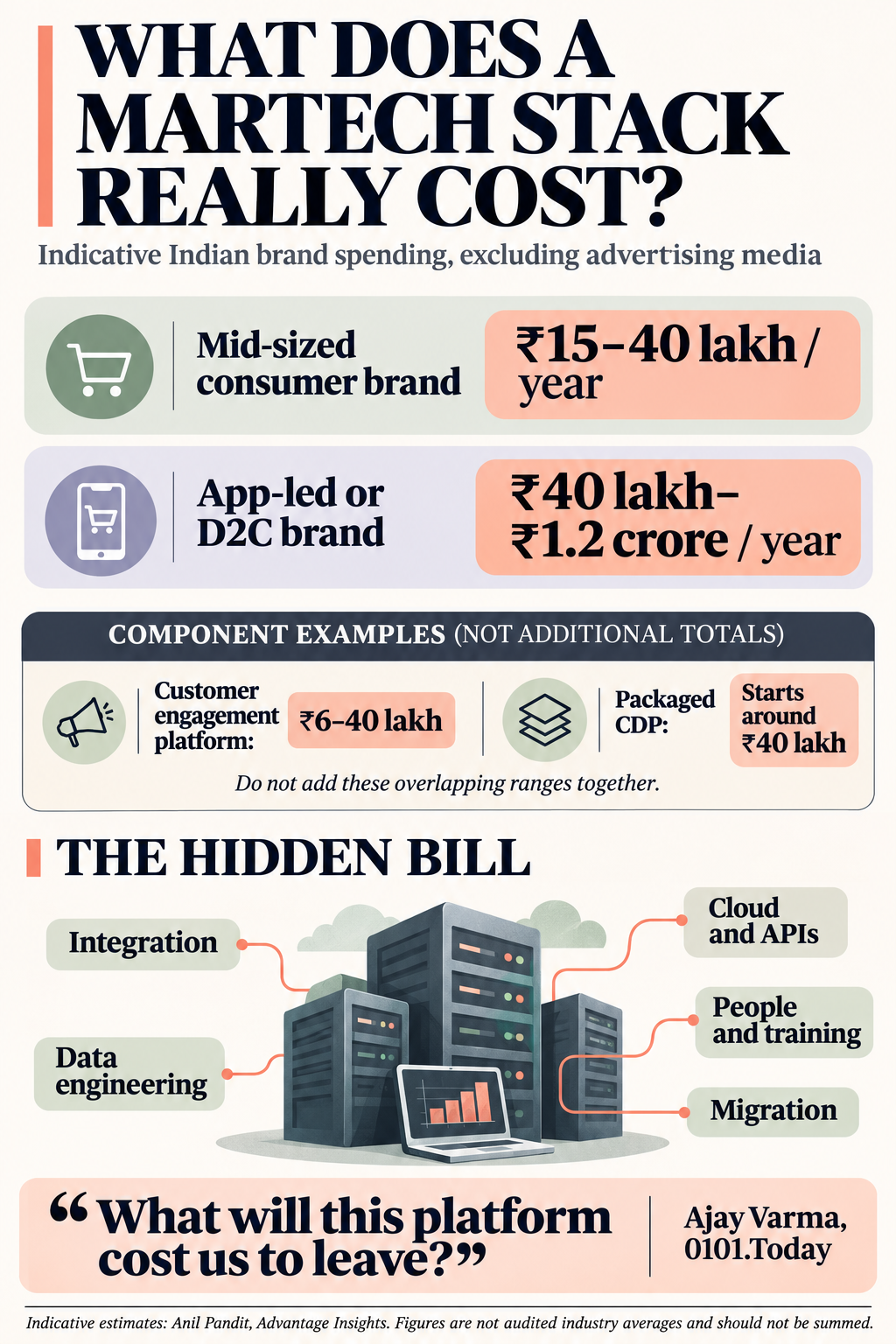
According to his estimates, an app-led or direct-to-consumer brand with a few lakh reachable customers should budget between ₹40 lakh and ₹1.2 crore annually for its marketing technology infrastructure, excluding media expenditure.
A conventional mid-sized consumer brand, particularly one relying on general trade and quick commerce rather than extensive direct engagement, may need between ₹15 lakh and ₹40 lakh.
Individual products can represent substantial investments. Pandit estimates that customer engagement platforms such as CleverTap, MoEngage and WebEngage typically cost ₹6–40 lakh, while a packaged CDP may start around ₹40 lakh, with implementation potentially pushing first-year expenditure considerably higher.
These are indicative estimates, not standardised industry prices. The component figures also overlap with overall technology budgets and cannot simply be added together.
More importantly, the software invoice rarely represents the entire expenditure.
"The biggest mistake brands make is calculating the cost of MarTech by adding up software invoices. The licence fee is often only the visible part of the bill," says Ajay Varma, Co-Founder and Managing Partner, 0101.Today.
Beyond subscriptions, brands must account for integration, data engineering, identity resolution, APIs, cloud processing, consent management, training and the personnel needed to operate these systems.
The costs can multiply when businesses purchase overlapping capabilities or implement technology without sufficient scale to justify it.
Pandit, for instance, questions the need for dedicated mobile measurement infrastructure in businesses without substantial app operations. Multiple attribution systems can also create competing claims for the same transaction, making it harder to determine whether the expenditure is delivering incremental value.
When the customer becomes a subscription
First-party data strategies emerged partly because brands wanted to reduce their dependence on advertising platforms. Rather than repeatedly purchasing access to audiences through Google or Meta, businesses could develop direct relationships through applications, websites, loyalty programmes and customer databases.
But accumulating customer information does not necessarily translate into operational independence.
"You stop renting the auction and start renting the profile, priced on users, events or messages. The better it works, the larger the invoice, and the integration you just paid for is the reason you cannot leave," says Pandit.
As customer volumes and engagement increase, so can the charges associated with processing data, maintaining profiles and activating campaigns.
The problem extends beyond recurring expenditure.
Customer records may remain accessible when a business changes providers, but behavioural histories, audience definitions, automated workflows and personalisation rules can be deeply embedded within a particular technology ecosystem.
Migrating those capabilities may require rebuilding integrations and customer journeys, potentially making the cost of leaving a vendor far greater than the price of its software subscription.
Consolidation: Savings or another trap?
One response has been technology consolidation. Rather than maintaining separate systems for segmentation, messaging, analytics and automation, brands increasingly have the option of combining capabilities within integrated platforms.
Piyush Sachdeva, Founder, Social Masla, observes that consolidation is particularly evident within individual technology layers, notably customer engagement and retention.
Platforms offering push notifications, email, WhatsApp, segmentation and automated journeys can replace multiple individual tools.
"Consolidation saves the most at the engagement layer, where one platform replaces three or four tools," he says.
However, these are also the systems containing customer profiles, behavioural information and automated journeys. Bringing everything together may simplify operations while making migration more complicated.
"The savings and the lock-in sit in the same place," Sachdeva observes.
Varma makes a similar distinction between consolidation and independence.
"You can reduce eight vendors to two and still become far more dependent on those two. The real test is portability," he says.
The challenge is not necessarily having too many technology partners. It is ensuring the business can retrieve its information, maintain consistent customer identifiers and move essential capabilities between systems without rebuilding its entire engagement infrastructure.
Sachdeva offers an example from his own operations. Social Masla maintains its buyer records in an independent database, automatically sharing copies with email and WhatsApp systems. He says replacing the email provider would involve redirecting the data flow rather than undertaking a major migration.
The underlying principle is straightforward: retain control over the customer record while treating the systems used to activate it as replaceable services.
Where technology creates value
The risks of dependency do not mean sophisticated marketing infrastructure is inherently wasteful.
Varma argues that underutilisation can be a greater problem than software pricing. Technology expenditure should be evaluated against its contribution to retention, conversion and operational efficiency rather than the number of features purchased.
"A ₹50 lakh technology investment that materially improves retention or conversion may be inexpensive. A ₹10 lakh platform that is barely being used can be extremely expensive," he says.
The experience of consumer-facing brands also illustrates why businesses continue investing in connected technology.
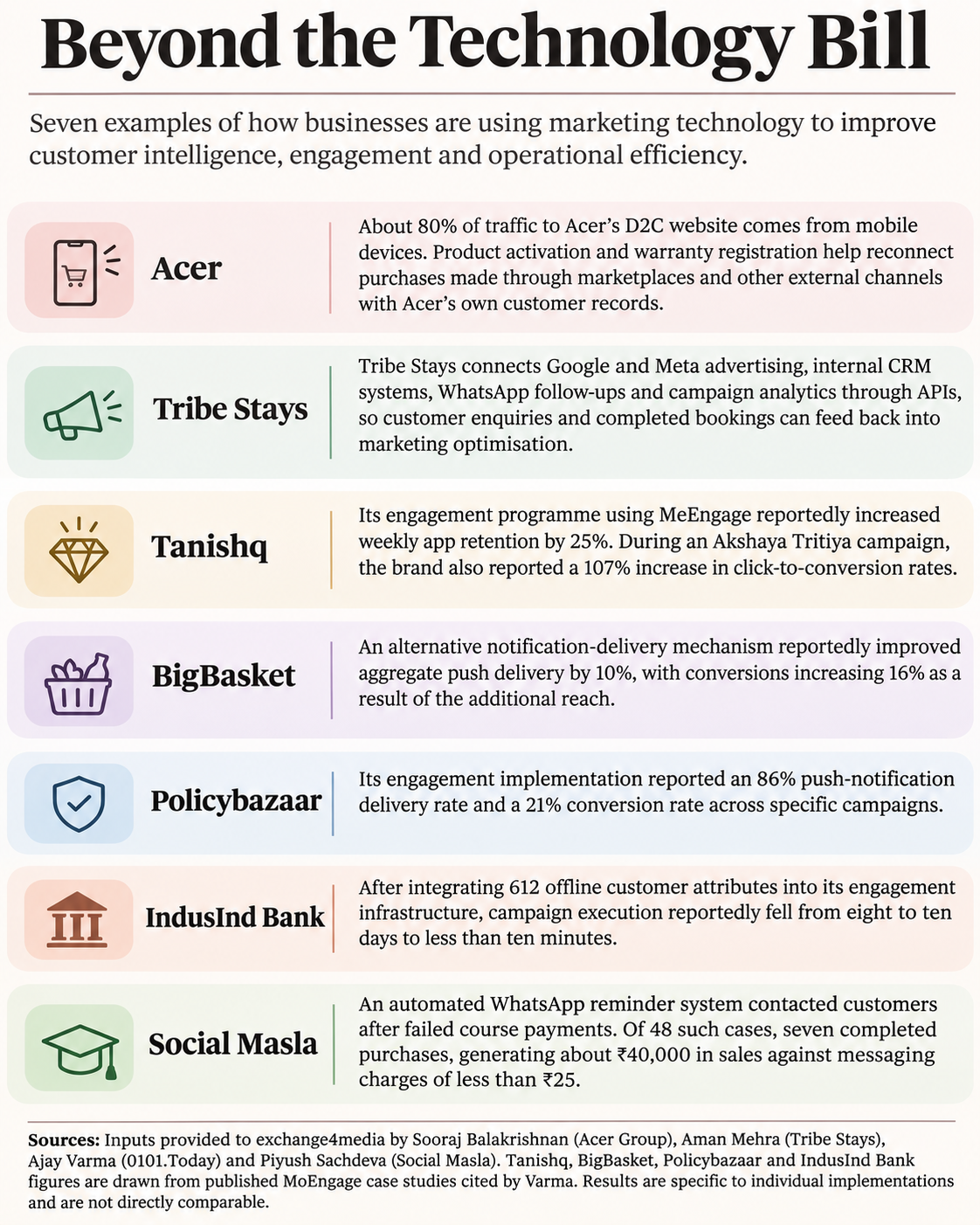
At Acer, approximately 80% of traffic to the company's D2C website comes from mobile devices. However, purchases through external marketplaces and multi-brand retailers create gaps in its visibility into the customer journey.
Sooraj Balakrishnan, Head of Marketing, Acer Group, says product activation and warranty registration help the company reconnect purchases made through external channels with its own customer information.
At Tribe Stays, advertising platforms, internal CRM systems, WhatsApp follow-ups and campaign analytics are connected through APIs.
Aman Mehra, Co-Founder, CMO and CTO, Tribe Stays, explains that customer enquiries feed into the company's CRM, while information about completed bookings helps refine subsequent advertising activity.
Both approaches demonstrate that bringing customer information together can improve visibility and operational efficiency without necessarily eliminating the need for external platforms.
What will it cost to leave?
As marketing platforms expand into AI-driven analytics, automation and decision-making, questions of portability and independence are likely to become more consequential.
Pandit recommends that businesses retain direct control over fundamental customer intelligence, including consent records and portable data infrastructure, while renting other capabilities where economically justified.
For Varma, the most important questions concern what happens when the commercial relationship with a technology provider ends.
Can the business retrieve its raw customer data? Does it control customer identifiers and event definitions? Can audiences move between platforms? Could another provider take over without rebuilding the customer journey?
"There is one question I believe should become standard in every enterprise MarTech procurement discussion: 'What will this platform cost us to leave?'," he asks.
It is a useful inversion of the industry's conventional sales pitch.
Brands have invested heavily in technology to reduce their dependence on intermediaries, improve customer understanding and develop more direct relationships.
The danger is not that this investment is inherently misguided. It is that businesses may recreate the dependence they were attempting to escape, this time within their own infrastructure.
The real measure of customer control may therefore be less about how sophisticated a marketing stack becomes, and more about whether a brand can continue using its customer intelligence when the technology surrounding it changes.
Read more news about Digital Media, Internet Advertising, Marketing News, Television Media, Radio Media
For more updates, be socially connected with us onInstagram, LinkedIn, Twitter, Facebook, YouTube & Google News