Cannes Voices: Leo South Asia’s Amitesh Rao on what brands still get wrong about gaming
As Leo South Asia's CEO takes his seat on the Entertainment Lions for Gaming jury, he has a pointed message for brands that confuse gaming culture with gaming aesthetics
 by
by
Published: Jun 10, 2026 8:53 AM | 9 min read
 Follow Us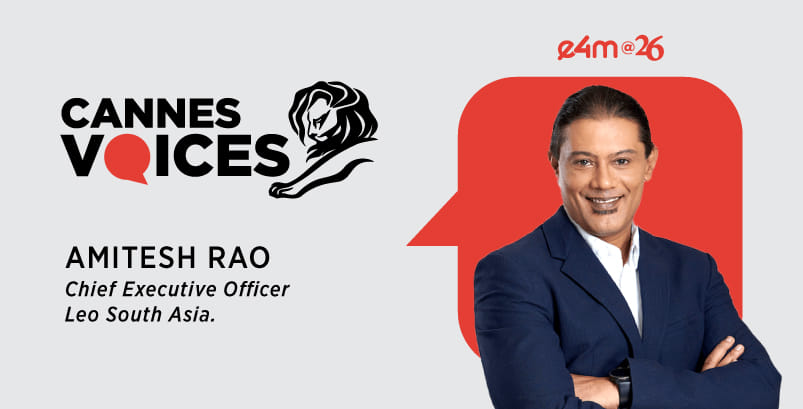

- Amitesh Rao, CEO of Leo South Asia and a seasoned gamer and entrepreneur, has been appointed to the Entertainment Lions for Gaming jury at the Cannes Lions International Festival of Creativity 2026, reflecting his deep understanding of gaming as a cultural ecosystem rather than just a media channel.
- Rao emphasizes the importance of brands genuinely engaging with gaming culture by enhancing player experiences rather than interrupting them, advocating for meaningful participation that adds value to the gaming community.
- He critiques the traditional advertising approach of treating gaming merely as a platform for ads, arguing that successful brands must recognize gamers' commitment of time and create authentic, culturally relevant content.
- With India's gaming market growing significantly, Rao calls for recognition of innovative work that expands the definition of gaming, focusing on its influence on various aspects of life beyond entertainment, and encourages brands to build culture rather than simply borrow from it.
Most advertising leaders who talk about gaming do so at a remove: the category is growing, the audiences are young, the engagement metrics are compelling, and the formats are evolving. Amitesh Rao - a gamer, entrepreneur and agency chief - talks about it differently. He talks about it the way someone does when they have been inside it.
As CEO of Leo South Asia (the Publicis Groupe agency that was India's most decorated at Cannes Lions 2024, taking home five Lions, including a Gold in Creative Data for Gatorade's Turf Finder campaign), Rao brings to the jury room a biography that is unusual even by the elastic standards of Indian advertising. He is an IIM Bangalore alumnus who has worked agency-side at JWT, Rediffusion, TBWA, and McCann; client-side in the Telco and data space at MTS and RPG; and entrepreneurially as the co-founder of two startups built in the years when gaming in India was not yet a category but a conviction: ARI e-Business, a software and simulation solutions company, and Nova Gaming Ventures, an e-commerce platform for digital games.
It is a biography that has produced, in his own words, a view of gaming as an ecosystem rather than a game. And it is that view, more than any single professional credential, that makes his appointment to the Entertainment Lions for Gaming jury at the Cannes Lions International Festival of Creativity 2026 feel less like a selection and more like an inevitability.
Within his first year at Leo Burnett South Asia in 2024, he had delivered the agency's most awarded Cannes performance in recent memory. The Turf Finder campaign used Google Maps traffic data to identify underutilised urban spaces in Mumbai, Delhi, and Bengaluru, and temporarily converted them into sports courts for cricketers and basketball players who had nowhere to play. The idea was deceptively simple and structurally precise: a data insight in service of a deeply observed human truth, executed without spectacle.
When we spoke to Rao ahead of the festival, the conversation moved from that broader sense of what creativity sitting at the confluence of culture, commerce, and technology can do to the specific and considerably more demanding question of what it takes to belong in gaming culture rather than merely borrow from it.
The cultural test
The Entertainment Lions for Gaming category has, since its introduction, contended with a structural tension: the brands most likely to enter are not always the brands most qualified to be there. Gaming is, to a significant portion of the marketing industry, still understood as a media channel to run pre-roll video, place banner ads in mobile games, and sponsor esports tournaments. The category exists, in part, to argue against that understanding. Rao makes the argument with notable directness.
"Gaming is shaping our world, our behaviours, our skill sets, and our sociocultural interactions," he says, "and the brands that recognise this and participate in it genuinely belong. Those that continue to see gaming as a media platform to drive awareness and reach, or as context to merely 'speak the language', struggle to leverage the medium or to resonate with gaming-friendly audiences. Work that truly belongs in gaming is that which creates value for the player — it could be through utility, progression, storytelling, community building, or cultural relevance. Simply borrowing visual tropes, avatars, or gaming language without understanding player motivation rarely creates lasting impact. Gaming is not a media channel anymore; it is a culture system."
The distinction between a media channel and a culture system is not merely semantic. A media channel is a distribution surface. A culture system is a set of values, behaviours, and social contracts that exist independently of any individual brand's participation in it. Gaming culture has its own economy of attention, its own language, its own celebrities, its own standards for what counts as authentic engagement. A brand that enters with a media mindset treats it as inventory. A brand that enters with a cultural mindset treats it as a community. Gamers, who are among the most sophisticated consumers of branded content on any medium, can tell the difference within seconds.
The gamer's credential
Rao's claim to the jury seat rests on something the category does not often get from its judges: direct knowledge from multiple sides of the same table. He has been a consumer of gaming since before the industry had the vocabulary to describe itself. He has founded businesses inside the gaming ecosystem. He has run creative agencies that have been tasked with building brands inside it. That triangulation is, in his view, what the category needs from a juror.
"I have been a gamer since before the word was invented," he says. "And having the perspective of a marketer and advertiser who has also run gaming businesses gives me a view of gaming as an ecosystem and not as a 'game'. That is useful perspective, because it is a world that is already so all-pervasive and nuanced that even using a single word like 'gaming' does not do justice to it. It takes a very different approach to successfully engage with gaming-friendly audiences — one that significantly diverges from conventional communication frameworks. For example, engagement must be earned and it must be organic; brands must recognise that gamers pay with time, not money."
The point about time as currency is one that the advertising industry has been slow to absorb in its full implications. Most brand communication operates on an interruption model: the consumer is doing something else, the brand intercepts that attention, the brand delivers its message, and the consumer returns to what they were doing. Gaming inverts this entirely. The player has made a choice to spend two, five, or ten hours inside a world. They have already committed their most valuable resource. The brands that succeed in that environment, while offering something in return for the attention rather than demanding attention as a toll, are the ones that respect that commitment. The brands that fail are the ones that try to replicate the interruption model inside a medium specifically designed to resist it.
Rao extends this further: "I see gaming influencing life far beyond gameplay itself — in education, employability, social relationships, in shaping how younger audiences are learning to interact with the world around them. And that makes this category far more consequential than many realise."
Meaningful participation versus opportunistic presence
The line between brands that belong in gaming and brands that are merely visiting it is often visible before the results are in. Rao's framework for evaluating entries in the jury room starts with a simple question: Does this work enhance the experience, or does it interrupt it?
"The most meaningful brand participation in gaming enhances the experience rather than interrupting it," he says. "Gamers are extremely resistant to intrusion, but highly receptive to brands that contribute something meaningful — whether that is access, entertainment, or community enablement. Opportunistic work often treats gaming like a trend, or worse, as a media vehicle."
The word 'access' in his answer is doing specific and important work. One of the most durable models of brand participation in gaming is the one where the brand's involvement removes a constraint that was previously holding players back: a barrier to entry, a content gate, or a geographic limitation. Gatorade's Turf Finder was structurally analogous to this principle. Even though it operated in physical rather than virtual space, it removed the constraint of no available court for urban players who wanted to play but had nowhere to go. The insight was the same: identify what gamers and athletes actually need, and make the brand the mechanism by which they get it. That is community enablement. It is not advertising. And that, in the Gaming category, is the highest form of the discipline.
What he is looking for
Rao's vision of what the Gaming category should reward in 2026 is an expansive one, and it reflects the breadth of his own relationship with the medium. The category he describes is not the one the industry typically imagines when it thinks about gaming awards, like flashy in-game integrations, branded skins, or esports sponsorships announced with fanfare. It is something considerably more ambitious.
"I would love to see more recognition for work that expands the definition of gaming itself," he says. "Gaming today is no longer limited to entertainment — it is influencing learning, employability, fandom, social interaction, and commerce. I am particularly interested in ideas that use technology and data in service of creating better experiences, rather than just spectacle. I intend to reward work that is brave enough to build culture, not just borrow from it."
The scale of what Rao will be judging is worth bearing in mind. India's video games market, excluding real-money gaming, grew 17% YoY to reach $1.5 billion in 2025, according to the Lumikai State of India Interactive Media Report 2025, even as regulatory changes forced a structural reset in the broader gaming industry. The gamer base stands at approximately 555 million, with a quarter of them paying players; a payer conversion rate that held steady through the turbulence of the past year.
Globally, gaming is already the largest entertainment category by time spent, outpacing film, music, and linear television. The brands that have not yet developed a coherent gaming strategy are not behind a trend. They are behind a structural shift.
The phrase 'brave enough to build culture' is a direct challenge to the majority of brand entries in the category, which borrow rather than build. Building culture in gaming means creating something that did not previously exist in the ecosystem, and that has value independent of the brand that created it. It means taking a position within a culture that already has its own values and standards, and being willing to be held to those standards. It is, as Rao suggests, an act of courage rather than a marketing decision.
That courage is the quality that Cannes Lions, at its most useful, identifies and rewards. In a category where the temptation to mistake aesthetic for understanding is permanent and the consequences of getting it wrong are immediate (gamers are a merciless audience), the jury's capacity to identify authentic cultural participation from its counterfeit is the thing that gives the award meaning. In Amitesh Rao, the Gaming category has a juror who has spent thirty years earning the right to make that call.
Read more news about Cannes Lions Festival, Advertising, Marketing, Digital Media, PR & Corporate Communication News
For more updates, be socially connected with us onInstagram, LinkedIn, Twitter, Facebook YouTube , WhatsApp & Google News