The future of creativity belongs to Humans and AI
Guest Column: Ganapathy Viswanathan, Independent Communication Consultant & Author, on why AI can enhance creativity but cannot replace human thinking, judgement and imagination
 by
by
Published: Aug 21, 2026 8:40 AM | 5 min read
 Follow Us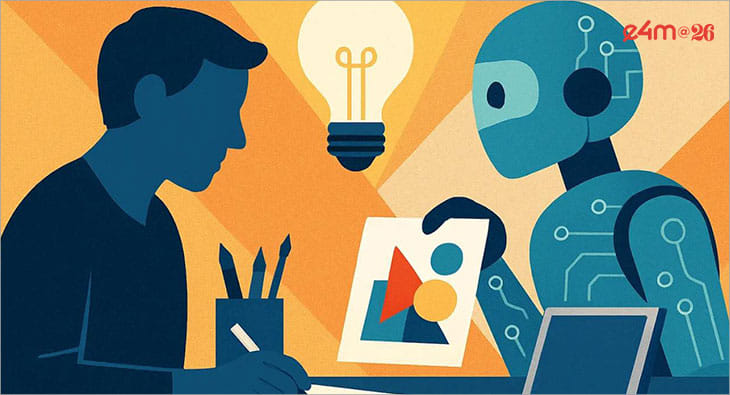

- The article discusses the ongoing debate about the role of Artificial Intelligence (AI) in creative industries, emphasizing that while AI can enhance efficiency, it cannot replace human creativity and judgment.
- The author reflects on past technological advancements in advertising, noting that AI, like previous tools, requires human direction and thoughtful input to produce meaningful results.
- Creativity is framed as a complex process that involves understanding human emotions and cultural contexts, rather than merely generating content, which AI can do quickly but without insight.
- The future of creativity is seen as a partnership between humans and AI, where success will depend on professionals who effectively combine technology with human intuition and experience.
The Human Mind Will Always Have the Final Word
These days, it is difficult to attend a conference, meet a client or even have a casual conversation with young professionals without Artificial Intelligence becoming the centre of discussion. Some believe AI will transform every business. Others are convinced it will eventually replace human creativity. I have been listening to these conversations for some time now, and I see the situation a little differently.
Having spent over three decades in advertising, marketing and public relations, I have witnessed several technological shifts. Every new development has arrived with the promise of changing the way we work. Some have lived up to that promise, while others have quietly become part of our everyday routine. AI is certainly different because its capabilities are far greater, but I do not believe it will replace the one thing that has always driven this industry—human thinking.
I Have Heard This Debate Before
When computers first entered advertising agencies, there was a similar fear. Many believed technology would slowly replace creative people. During one discussion, the Managing Director of a leading advertising agency made a remark that has stayed with me ever since. He said, "A computer is only an enabler. You still need someone to think."
At that time the statement sounded simple. Today it sounds even wiser.
AI is far more intelligent than the computers we used then. It can write, analyse, design and search through mountains of information within seconds. It has become an indispensable tool in many organisations, from the boardroom to the creative department. Yet every time I use AI, I am reminded that it is waiting for someone to tell it what to do. It needs direction before it can produce results.
The Quality of Thinking Still Matters
One lesson has become very clear over the past year. AI gives better answers when people ask better questions.
A vague prompt usually produces a vague response. A thoughtful prompt, backed by context and a clear objective, produces something far more useful. That is why I don't see AI replacing creativity. If anything, it is forcing us to think more clearly.
In communication, the hardest part has never been writing a press release or creating a presentation. The real challenge has always been understanding the problem, identifying the audience and deciding what message will truly connect. Those decisions still require experience, observation and common sense.
AI can organise information beautifully. It cannot replace human judgement.
Creativity Is Not About Producing More Content
There is another misconception that deserves attention. Many people believe creativity is simply about producing content. It is much more than that.
Some of India's most memorable campaigns did not become successful because they had the best technology. Think of Amul's topical advertisements, Fevicol's timeless storytelling or Titan's emotional festive campaigns. These ideas succeeded because someone understood people, recognised a cultural moment and found a simple way to tell a story. Technology helped execute those ideas, but it did not create them.
The same principle applies today. AI can produce ten campaign ideas in a minute. Choosing the one that will build a brand is still a human decision.
Communication Is Changing Faster Than Ever
The communication industry has perhaps adopted AI faster than most sectors. Agencies are using it for research, media monitoring, content development, consumer insights and campaign planning. PR professionals are using it to analyse conversations and prepare initial drafts. Marketing teams are relying on it to study consumer behaviour and optimise media investments.
Clients too have become comfortable with AI. In many meetings today, discussions are no longer about whether AI should be used. The conversation has shifted to how it can be used more effectively.
Interestingly, clients are not asking agencies to replace people with AI. They still expect original thinking. What they want is faster delivery, sharper insights and better business solutions. In other words, AI is improving efficiency, but creativity continues to remain the agency's biggest value.
There Is Another Side to AI
As AI becomes more powerful, it also raises questions that cannot be ignored. Who owns AI-generated content? How do we deal with misinformation? Can businesses blindly trust everything AI produces? These are issues every organisation will have to address.
No technology can replace ethics, responsibility and accountability. Those decisions will continue to rest with people.
That is why organisations should look at AI as an intelligent assistant rather than an intelligent replacement. Like every assistant, it performs well when guided by someone who understands the larger objective.
The Winners Will Be Those Who Combine Both
I do not see the future as a battle between humans and machines. I see it as a partnership.
People who refuse to learn AI may find it difficult to remain competitive. Equally, people who depend entirely on AI without applying their own judgement may also struggle. The real advantage will belong to professionals who combine technology with experience, data with intuition and speed with thoughtful decision-making.
That, in my opinion, is where the future of creativity lies.
Conclusion
Every generation believes the next technology will change everything. Some technologies do. AI will certainly transform the way we work, communicate and create. But after spending more than thirty years in this profession, I have learnt one important lesson. Good ideas have never come from technology alone. They have always come from people who observe carefully, ask the right questions and understand other people.
AI can make us faster. It can make us more productive. It can even make us more informed.
But it cannot replace curiosity. It cannot replace imagination. And it certainly cannot replace the human ability to understand another human being.
That is why I believe the future of creativity does not belong to humans alone or to AI alone. It belongs to those who know how to bring the two together.
Read more news about Digital Media, Internet Advertising, Marketing News, Television Media, Radio Media
For more updates, be socially connected with us onInstagram, LinkedIn, Twitter, Facebook, YouTube & Google News
