Beyond the Chatbot: Where AI moves revenue in media and advertising
Guest Column: Senior business leader Taranjeet Singh offers an honest look at where AI actually moves the needle, and where it doesn’t
 by
by
Published: Aug 19, 2026 8:43 AM | 7 min read
 Follow Us

- The article critiques the common perception that AI has fundamentally transformed businesses, emphasizing the need for measurable impacts on key business metrics such as revenue and retention rather than just showcasing impressive AI features.
- It highlights specific areas where AI can drive significant economic changes, including real-time campaign monitoring, dynamic pricing, and enhanced sales intelligence, all of which can lead to improved revenue retention and shorter sales cycles.
- The author warns against the misconception that productivity gains from AI tools automatically translate to increased revenue, stressing the importance of foundational elements like forecasting accuracy and data quality in realizing true business transformation.
- To ensure effective AI investments, businesses should focus on three critical questions: which metrics will be affected, the expected timeline for change, and how to measure success, thereby distinguishing between genuine transformation and superficial adoption.
Every quarter, someone in media declares that AI has changed everything.
And every quarter, the evidence usually looks remarkably similar: a chatbot that writes ad copy in seconds, a creative tool that produces 50 variations instead of five, or a dashboard with a slightly smarter-looking interface.
Useful? Absolutely.
Transformational? Not necessarily.
Because there is a more important question every CEO, CRO and business head should be asking:
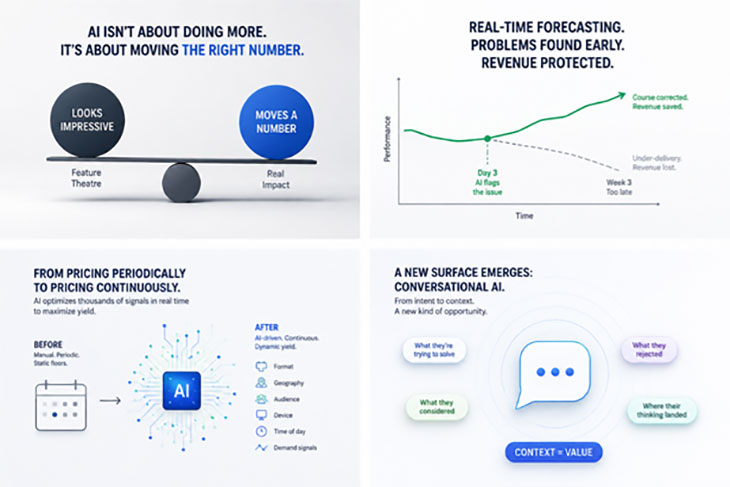
What number does this move?
Revenue? Yield? Retention? Conversion? Sales velocity?
If the answer is difficult to quantify, you may have an AI feature. You may even have a very impressive one.
But you don't necessarily have an AI business transformation.
That distinction matters.
After 25 years across media, technology and advertising, I've seen plenty of transformations that looked impressive in a presentation and very different when they reached the P&L.
AI is no different.
The real opportunity isn't in making existing work look more sophisticated.
It's in changing the economics of the business.
Where the revenue moves
There are a few areas where AI is already doing exactly that.
- Stop finding out three weeks late
For most of my career, knowing a campaign was under-delivering often meant finding out three weeks too late, usually from the client, and usually during a conversation nobody particularly wanted to have.
AI changes that equation.
Real-time forecasting and pacing can identify the problem on day three, not week three.
That sounds like an efficiency improvement.
It isn't.
It's a revenue-retention story.
A campaign that gets corrected before it materially under-delivers is a client relationship protected. A renewal protected. A difficult commercial conversation avoided.
And the same principle applies beyond advertising.
The earlier you can identify revenue leakage, the cheaper it is to fix.
That's where AI becomes commercially interesting.
- From pricing periodically to pricing continuously
Media businesses have always wanted to price inventory dynamically.
The problem was never the ambition.
It was the scale.
Trying to adjust pricing across formats, geographies, audiences, devices, placements and demand segments meant teams could only ever work with snapshots.
A pricing team might review floor prices weekly. Perhaps monthly. Perhaps across a handful of major markets or formats.
AI changes the unit of decision.
Instead of asking:
"What should we charge for this inventory this week?"
you can start asking:
"What is this impression worth right now?"
And then ask that question again five minutes later.
AI-driven yield systems can continuously respond to live demand signals, adjusting pricing across thousands of variables that no human team could realistically manage manually.
That's not automation for automation's sake.
It's a direct supply-side revenue lever.
And that is why pricing and yield optimisation is one of the most interesting applications of AI in media.
The impact can show up in weeks rather than quarters because the technology is touching the thing being sold the price of the inventory itself.
- Giving every salesperson the intelligence of your best salesperson
There is another opportunity that is less glamorous, but potentially just as valuable.
Sales intelligence.
Understanding a prospect used to take time.
What is happening in their category? Have they raised funding? What are their strategic priorities? Where are they growing? What might be keeping their CEO or CMO awake at night?
For a handful of strategic accounts, great salespeople would do this research instinctively.
For everyone else, it often meant spending a weekend preparing for a Monday meeting.
AI compresses that process from hours to minutes.
But again, the benefit isn't simply that a salesperson saves time.
The real benefit is what happens to the quality and speed of the revenue process.
A better-prepared salesperson can have a better first conversation.
A better first conversation can create a better opportunity.
A better opportunity can shorten the sales cycle.
And a shorter sales cycle moves revenue forward.
That's an important distinction.
AI doesn't have to create more sales conversations to create more revenue. It can make each conversation more valuable.
- And then there's the one nobody has fully figured out yet
Conversational AI as an advertising surface.
This is the one I'm watching particularly closely.
Search gave advertisers a very specific moment of intent.
Social gave them attention and discovery.
Conversational AI potentially offers something different: context.
The platform doesn't just know what a person clicked.
It can potentially understand what they are trying to solve, what they considered, what they rejected and where their thinking ultimately landed.
That could become an extraordinarily valuable advertising environment.
But here's the catch:
We don't know yet.
The industry is moving quickly, but the measurement hasn't caught up.
OpenAI is rolling out advertising inside ChatGPT, while Perplexity has taken a very different position on the relationship between advertising and trust. That contrast is important.
The category itself is still being defined by the platforms building it.
For advertisers, that means conversational advertising should currently be treated as an experiment particularly for brand and discovery objectives rather than assuming it is already a proven performance channel.
The opportunity is enormous.
The proof isn't there yet.
And those two statements can both be true.
Where the money doesn't move, yet.
This is where I think the industry needs a little more honesty.
Generative content tools are impressive.
AI-written creative is impressive.
AI-powered chat features bolted onto existing products are impressive.
And they can absolutely make organisations more productive.
But productivity and revenue are not the same thing.
If an AI tool allows a team to produce the same output with 20% fewer hours, that's valuable.
It can improve margins.
It can free people to do higher-value work.
But it doesn't automatically create 20% more revenue.
That distinction sounds obvious.
Yet I see businesses making this mistake repeatedly: investing heavily in the visible parts of AI while neglecting the less glamorous infrastructure underneath.
Forecasting accuracy.
Pricing logic.
Data quality.
Sales intelligence.
Measurement.
These aren't the things that make the best demos.
They're the things that show up in the CFO's numbers.
The question every AI investment should answer
This brings me to what I think is the most important discipline for businesses entering the AI era.
Before investing in an AI initiative, ask three questions:
Which number does this move?
How quickly should it move?
And how will we know if it didn't work?
That's it.
It isn't particularly sexy.
It doesn't make for the most impressive conference presentation.
But it is the difference between AI transformation and AI theatre.
We used to have the same problem with digital transformation.
Then with data.
Then with cloud.
There was always a new technology everyone felt they needed to "do something" with.
The companies that created lasting value were rarely the ones that adopted the technology fastest.
They were the ones that understood where it could change the economics of their business.
AI hasn't changed that discipline.
It has simply made the cost of ignoring it much higher.
The winners won't necessarily be the companies with the most AI.
They'll be the companies that can answer, with confidence:
"Here's the number AI changed. Here's how much it changed it. And here's why we know."
That's where the money is.
And that's where the real AI transformation begins.
For 25 years, Taranjeet Singh has built and scaled revenue businesses across media, technology, and advertising. In this biweekly column, he cuts through AI hype to look at what’s actually changing for businesses, for people, and for an industry that doesn’t always get the risks right. No theatre, no vendor pitches, just an operator’s view of where the numbers actually move.
Read more news about Digital Media, Internet Advertising, Marketing News, Television Media, Radio Media
For more updates, be socially connected with us onInstagram, LinkedIn, Twitter, Facebook, YouTube & Google News
