The next first-party data battle is about making data work
At the e4m Real Time Programmatic Conference, marketers said the edge is shifting from acquisition and storage to connecting signals, acting on them and giving consumers a reason to share more
 by
by
Published: Oct 3, 2026 7:51 AM | 5 min read
 Follow Us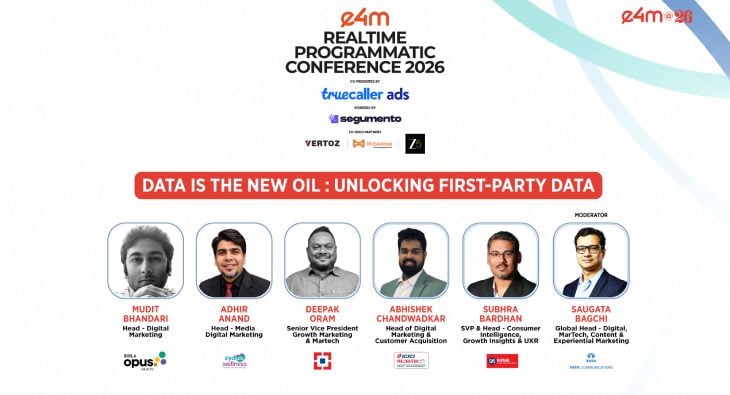

- The panel discussion at the e4m Real Time Programmatic Conference highlighted the challenge of turning large pools of first-party data into actionable insights, emphasizing the need for effective data integration and decision-making processes.
- Marketers from various companies noted that while customer data platforms (CDPs) are common, simply having access to data does not guarantee improved customer understanding or engagement; the focus should be on deriving insights and adapting strategies based on consumer behavior.
- The conversation also addressed the balance between customer acquisition and retention, suggesting that data originally intended for acquiring customers can be repurposed to enhance retention and service experiences.
- Panelists emphasized the importance of consumer consent and the need for brands to demonstrate genuine value in data sharing, advocating for a shift from merely collecting data to creating systems that translate existing data into meaningful actions for long-term customer value.
For years, the marketing conversation around first-party data was largely about building the database. Today, with brands sitting on increasingly large pools of behavioural, transactional and customer information, the harder question is what they can actually do with it.
That was a recurring theme of the panel discussion, Data is the New Oil: Unlocking First-Party Data, at the e4m Real Time Programmatic Conference where marketers from Birla Opus, Zydus Wellness, HDFC Bank, ICICI Prudential Asset Management Company and Kotak Mahindra Bank discussed the growing gap between having data and turning it into actionable intelligence.
Mudit Bhandari, Head - Digital Marketing, Birla Opus, argued that the competitive advantage has moved beyond simply collecting information. “How are we collecting the data? How are we integrating the data? And how are we making the business decision out of it?” he said, describing the journey from signals to decisions, action and outcomes as the more important part of the equation.
That shift is particularly relevant as marketers grapple with what one might call a data paradox: organisations have more information than ever, but extracting the right signal from it remains difficult.
Subhra Bardhan, SVP & Head - Growth Strategy, Consumer Intelligence & Insights, Kotak Mahindra Bank, pointed to the challenge of connecting different sources of information. He outlined four broad buckets: behavioural data, external consumer and market intelligence, internal intelligence such as emails and call-centre interactions, and future-facing signals such as social media trends. The challenge, he said, has historically been the time required to process and connect these sources.
AI is now changing that equation, with systems increasingly able to process large volumes of calls, emails and other data sources and surface insights in real time. But Bardhan also stressed that simply having access to the same technology does not make every marketer equally effective.
“LLMs are like cricket bats, it's a tool. Not everyone can bat like a Virat Kohli,” he said, arguing that human ingenuity and the quality of inputs remain critical to the quality of outputs.
The CDP question: investment versus action
The same issue extends to the martech stack. Customer data platforms and data infrastructure have become near-standard investments, but the presence of a CDP does not automatically translate into better customer understanding.
Abhishek Chandwadkar, Head of Digital Marketing & Customer Acquisition, ICICI Prudential Asset Management Company, said brands have largely addressed the first stages of data collection and connection. The more important question now is what happens after the data is connected.
“Are we creating a lot of insights from that CDP? That's the first question you should ask yourself,” he said.
For Chandwadkar, the value lies in linking customer behaviour to an action. If users repeatedly drop off at a particular stage of a digital journey, for instance, the data should help marketers understand the reason and create a more relevant experience. The same logic applies to communication: if a consumer is not responding to email but is engaging on another channel, brands should be using their data to adapt rather than repeatedly sending the same message.
That makes personalisation less about inserting a consumer's name into a communication and more about changing the communication itself based on behaviour.
Acquisition may get the attention, but retention gets the value
The panel also questioned whether marketers remain overly focused on acquisition at the expense of customer lifetime value. Bhandari pointed out that acquisition is relatively easy to attribute to a media investment, while understanding what happens after the first transaction is considerably harder. A customer acquired through a discount may either disappear after one transaction or become a repeat customer because the overall experience worked.
“Acquisition and retention generally go hand-in-hand,” he said, arguing that brands need to understand the intent behind customer behaviour rather than simply tracking whether a transaction happened.
Deepak Oram, Senior Vice President - Growth Marketing & Martech, HDFC Bank, took the argument a step further, suggesting that data and technology originally built for acquisition can also be repurposed for retention and service. He cited an example of customers with high account balances repeatedly seeking help digitally. Instead of treating that as another acquisition signal, the same data could potentially be passed to service teams so the customer receives proactive assistance.
“Can that be repurposed? So, that little switch in thinking is something that I feel is missing, and that has to happen,” Oram said.
The implication is that the value of first-party data may increasingly lie in how many parts of the customer journey it can inform, rather than how effectively it can generate the next acquisition.
Consumers will share data, but there is a limit
Yet the expansion of first-party data has another constraint: consumers need a reason to participate. Adhir Anand, Head - Media and Digital Marketing, Zydus Wellness, said consumers are generally willing to share information when they see genuine value in doing so. The problem begins when consent becomes little more than a mechanism for tracking.
“There’s a fine line between consent and creepiness,” Anand said, pointing to personalised diagnostics, relevant communities and other experiences where consumers can see a direct benefit from sharing information.
He also argued that data collection cannot be treated as a one-time transaction. Consumer needs, motivations and behaviours change, making ongoing, consent-led data enrichment necessary.
That distinction between utility and intrusion may become increasingly important as brands seek to build richer customer profiles. The panel's discussion repeatedly returned to the idea that consumers are more accepting of data use when it helps them make decisions or improves their experience, rather than when it simply enables more aggressive targeting.
The larger takeaway from the discussion was therefore less about collecting more data and more about building a system that can translate existing data into relevant action.
As Bhandari put it, data, signals, decisions and better experiences need to work together to create long-term customer value.
For marketers, the first-party data race may consequently be entering a different phase: less about who has the biggest database, and more about who can make that database useful without making the consumer regret sharing it.
Read more news about Marketing News, Advertising News, PR and Corporate Communication News, Digital News, People Movement News
For more updates, be socially connected with us onInstagram, LinkedIn, Twitter, Facebook, YouTube & Google News
