Programmatic DOOH: Bridging Digital & Physical
At e4m Real Time Programmatic Conference 2026, industry leaders discuss how programmatic DOOH is changing the way brands buy, create and measure OOH campaigns
 by
by
Published: Oct 2, 2026 8:35 AM | 10 min read
 Follow Us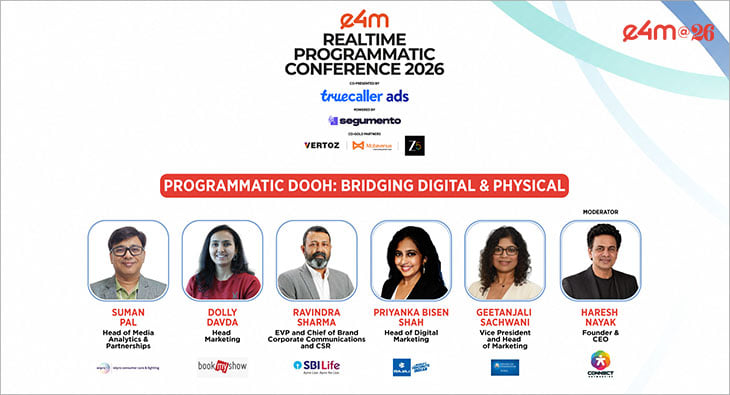

- The panel discussion at the e4m Real Time Programmatic Conference 2026 explored the evolution of digital out-of-home (DOOH) advertising, emphasizing the shift from location-based to audience and contextual buying facilitated by programmatic technology.
- Marketers highlighted the importance of real-time optimization and dynamic audience targeting, allowing for tailored messaging based on contextual factors such as weather or consumer behavior, which enhances the relevance of advertisements.
- Experts discussed the need for collaboration between content and media teams to create effective DOOH campaigns, stressing that personalization should not compromise consumer comfort or privacy.
- The conversation underscored that the future of DOOH relies on integrating data, creativity, and human insight to deliver relevant messages at the right time, moving beyond traditional outdoor advertising to a more dynamic marketing approach.
Outdoor advertising has traditionally been built around locations, footfalls and visibility. But as audience data, technology and real-time signals enter the medium, marketers are beginning to ask a larger question: is digital out-of-home (DOOH) simply making outdoor buying faster, or is it making the medium smarter?
One of the panel discussions at e4m Real Time Programmatic Conference 2026 was “Programmatic DOOH: Bridging Digital & Physical”, chaired by Haresh Nayak, Founder & CEO, Connect Network Inc.
The discussion brought together Suman Pal, Head of Media, Analytics & Partnerships, Wipro Consumer Care & Lighting; Priyanka Bisen Shah, Head of Digital Marketing, Bajaj Auto Ltd.; Dolly Davda, Head - Marketing, BookMyShow; Geetanjali Sachwani, VP & Head - Marketing, Franklin Templeton; and Ravindra Sharma, EVP and Chief of Brand, Corporate Communications and CSR, SBI Life.
Haresh Nayak opened the discussion by looking at how OOH has evolved with the availability of data, technology and platforms, and questioned whether programmatic buying was actually making the medium smarter.
Suman Pal explained that the biggest change brought by programmatic DOOH is the shift from buying locations to buying audiences and contexts.
“What programmatic DOOH has done is really shift the media outdoor format from a location-based buying to an audience and contextual buying model,” Pal said.
He explained that traditional outdoor planning involved site selection, waiting periods, estimating footfall and then calculating reach. Programmatic changes that process by enabling dynamic audience targeting, real-time optimisation and greater flexibility in how and when a message is served.
“If today I want to change the creative based on certain triggers, whether it's weather-based or mobility or contextual targeting I want to do for certain products or certain SKU, I can do that,” he said.
Marketers can select the location, time band and day part based on the requirement instead of committing to a particular site for a month or longer.
Furthermore, he describes, “Automation can only help you to buy media better, but the real transformation is actually happening when we are actually measuring that and it became very, very agile to sort of buy that media programmatically.”
Taking the discussion from media buying to consumer journeys, Nayak asked Priyanka Bisen Shah whether programmatic DOOH was unlocking something that traditional outdoor could not.
Shah said the fundamental shift was from location to context.
“What I feel is that OOH, we used to buy location and with DOH right now we are buying context. We are buying a location, of course, because location comes with it. And we are buying audiences,” she said.
For Bajaj Auto, the ability to serve different messages based on where consumers are, what they may be looking for and what their likely use case is can make the medium more relevant.
Shah cited Chetak as an example. A consumer in a hilly area may be more interested in the scooter’s hill-assist feature, while a location near schools may call for messaging around its utility for young mothers.
“In some places, I will serve an ad which shows the hill assist. In some places, I will serve ads which show that there is a large capacity. In some places, I will show the ad where you are dropping your kid to the school,” she said.
But this, she stressed, places a greater demand on the creative.
“Whenever we are planning a DOH campaign, two important things. One is that, A, will I be able to really service so many consumer mindsets? Can I actually create those many contextual ads? If the answer is yes, only then will I go ahead and start investing in DOH.”
Otherwise, she said, “it is just a parallel to an OOH in a digital format.”
Shah also stressed that the effectiveness of programmatic DOOH cannot sit with the media team alone.
“It is a shared responsibility between the content team who develops it and the media team who actually executes it. So there has to be a synergy between the two,” she said.
She also pointed to smaller DOOH screens at railway stations and gyms as an opportunity for brands to reach more defined audiences. In her example of a coffee brand using a yawning creative in a subway and then placing product sampling further along the consumer journey, DOOH helped connect awareness, consideration and eventual purchase.
“This is how they translated from awareness to consideration to actual sales,” Shah said.
Nayak then took the discussion to BookMyShow, asking Dolly Davda whether the future of programmatic DOOH was about targeting audiences or targeting moments.
Davda said both have a role.
“I genuinely feel that there is a scope for both to coexist,” she said.
For an entertainment platform, intent can change rapidly. While traditional outdoor can help create awareness and recall, programmatic can work further down the funnel by responding to what is happening in the consumer’s environment.
“Intent is very, very incredibly time bound. And while awareness is the top funnel that helps you build, what programmatic does it helps you build a lot of mid funnel,” Davda said.
She cited the example of Navratri events. If weather conditions change and rain is expected, messaging can shift towards indoor events.
“If my messaging changes to saying indoor Navratri events, right? That's absolutely relevant because you're saying don't let rains ruin your plans,” she said.
Similarly, a cinema billboard could dynamically communicate that four shows in a particular mall are already house full. The information itself changes the consumer’s intent.
“If I know there are four house full shows here in this mall, when you're walking around, and if I'm saying, ‘These are the house full shows,’ it changes the intent. And that house full status quo changes dynamically. It's a real time thing,” she said.
For BookMyShow, the combination of first-party audience data and contextual signals can therefore add another layer to targeting.
“We are an app with first party data, but this eventually increases a lot of intent because it's contextual,” Davda said.
However, she also raised a key consideration around personalisation: relevance cannot come at the cost of consumer comfort.
“It should never feel like you are being watched upon. You don't want it to look like it's surveillance and you are tracking me, you know everything,” she said.
Instead, the experience has to feel relevant, with the right message reaching the right person at the right time.
Moving the conversation to financial services, Nayak asked Geetanjali Sachwani, VP & Head - Marketing, Franklin Templeton, whether contextual relevance could be as powerful in BFSI, where consumer decisions tend to involve longer consideration and trust.
Sachwani argued that programmatic DOOH can play an important role in financial services precisely because awareness and financial literacy remain uneven across audiences.
She drew from Franklin Templeton’s recent 4,000-kilometre journey from Kanyakumari to Kashmir, which covered 21 cities and involved interactions with around 6,000 women across colleges, universities, self-help groups and different professions.
She mentioned that the experience demonstrated how strongly context can vary from one audience to another.
“The woman I'm talking to in Bangalore, vis-a-vis the woman I'm talking to in Balari, or the woman I'm talking to in Pathankot or Udhampur, context really matters,” Sachwani said.
In Bangalore, the conversation could be about building a financial portfolio and diversification. In another market, the first requirement could be basic awareness about mutual funds and SIPs. In another, it could be about building the confidence to ask questions.
While a physical outreach programme could reach thousands of women, programmatic outdoor can offer scale while retaining the ability to layer context.
“Programmatic outdoor media will probably help me meet 6 million people and it gets me the scale and context and the cost efficiency,” she emphasized.
However, she believes that technology cannot replace the human understanding required to make financial communication work.
“But I think human insight is first. Creative ideas are second. And data and technology together make you reach your goal faster and in a more efficient way and make the first two things work harder,” she said.
She added that these elements should not be viewed as competing with each other.
Nayak then turned to Ravindra Sharma, EVP and Chief of Brand, Corporate Communications and CSR, SBI Life, and asked what kind of proof and measurement would make a legacy BFSI brand more confident about increasing its investment in programmatic DOOH.
Sharma separated the question into two areas: trust and growth.
“The audience is smart. And the brands are also smart nowadays,” he said.
For a financial services brand, simply reaching a large audience is not enough to build trust.
“Will noise reach me, will it give me trust? The answer is no. As most of the speakers mentioned, I need to be relevant to the audience. And I think she just mentioned that, you need to have that human insight,” Sharma said.
He argued that relevance and human insight need to inform the narrative, which can then contribute to building trust.
On measurement, Sharma said third-party validation would be critical.
“If that is delivered by the medium, the proof that no audience leakage is happening, everything is measurable by a third party, there are reports which are being endorsed by an auditor, all that if provided, things will work out,” he said.
He also pointed to the potential shift in the role of outdoor within the larger media mix.
“Earlier, you know, we are all marketers. And when you do an integrated 360-degree marketing at a pan-India level, not focusing on a region or a geography, usually your OOH is a sustenance or a reminder medium,” Sharma said.
“But with programmatic, it can come into your main media,” he added.
For Sharma, the key is that the numbers and measurement must support the investment case.
The discussion then moved to one of the recurring questions around programmatic advertising: does data drive the creative, or does creative still lead the process?
Nayak challenged the panel on whether data and creativity should be treated as competing priorities.
Sharma argued that it is not a choice between the two.
“I don't think it's a choice. I mean, you spoke about data and a powerful creative idea. Yeah, I think a human insight, along with a creative idea, along with data and technology,” he said.
He illustrated the point with a Deutsche Bahn campaign that used search behaviour, real-time data and creative personalisation. A consumer searching for a holiday in Colorado was shown an image of a similar-looking location in Germany, along with the difference in travel cost.
The campaign brought together data, technology, creativity and collaboration.
“Collaboration was as important as data, and it was as important as the creative. So I do not think that it's a choice, but I think the three of them got together and executed, I think the magic lies there,” Sharma said.
The same principle emerged across the panel: programmatic DOOH is not simply about putting digital technology outdoors. Its value depends on whether marketers can use data to understand context, create the right message and deliver it at the right moment.
Concluding the session, Nayak reflected on how far the medium has moved.
“At one point in time, it was all about buying out of home based on photographs and PowerPoints and Excel sheets. Today, it has moved from data to intelligence to being programmatic contextual,” he said.
The panel also underlined that the next phase of DOOH will not be defined by technology alone. Audience understanding, contextual relevance, creative flexibility, measurement and human insight will have to work together if outdoor is to move from a traditional reach and reminder medium to a more dynamic part of the marketing mix.
It concluded that the transition is about finding the right balance between being contextual, data driven, creative optimization as the medium continues to evolve.
Read more news about Digital Media, Internet Advertising, Marketing News, Television Media, Radio Media
For more updates, be socially connected with us onInstagram, LinkedIn, Twitter, Facebook, YouTube & Google News
