Who owns the mobile customer? The rising cost of acquisition, engagement and retention
Brands are spending more to manage the mobile consumer journey. But paying to acquire a customer does not necessarily mean controlling the relationship that follows
 by
Published: Nov 16, 2026 9:10 AM | 6 min read
 Follow Us


- The mobile economy presents challenges for marketers as acquiring customers through app installations does not guarantee ongoing consumer engagement or sales without additional costs for re-engagement and attribution.
- The cost of acquiring 100 app installations can range from ₹955–975, but the total first-month cost, including engagement and attribution, can rise to ₹1,600–1,840, highlighting the disparity between installation costs and actual customer retention.
- Brands face difficulties in tracking customer behavior across third-party platforms and their own channels, complicating the understanding of consumer journeys and the effectiveness of marketing efforts.
- The distinction between acquiring customer data and maintaining meaningful relationships is crucial, as brands must navigate the balance between leveraging third-party platforms for scale and fostering direct connections through their own applications and communication channels.
An app installation is not a customer. A customer is not necessarily a sale. And even after a sale, there is no guarantee that a brand can reach the same consumer again without paying another intermediary.
For marketers, this is becoming one of the defining contradictions of the mobile economy. Brands spend heavily to acquire consumers through advertising platforms, measure their behaviour through attribution systems and maintain relationships through messaging and engagement tools. Yet at every stage, the customer can slip beyond their immediate reach.
As India's mobile consumer journey increasingly spans social media, shopping applications, marketplaces, messaging services and brand-owned platforms, the question is no longer simply how much it costs to acquire a customer. It is how much it costs to keep that relationship alive.
An install is only the beginning
The economics become clearer when the acquisition process is broken into its individual components.
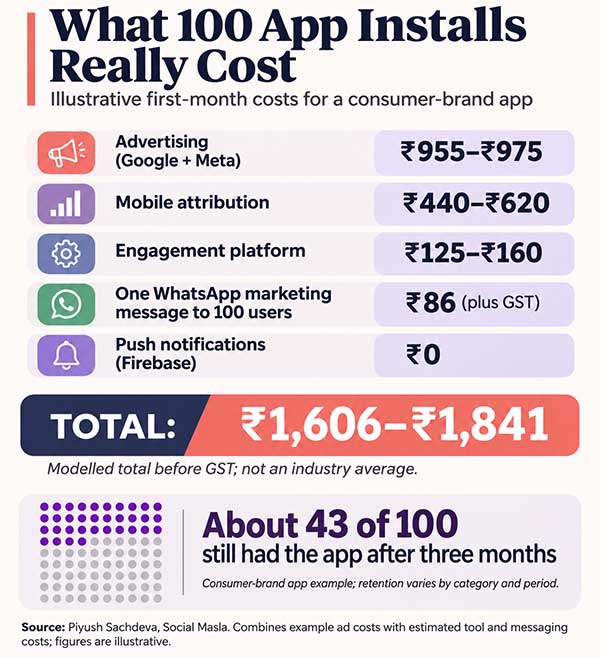
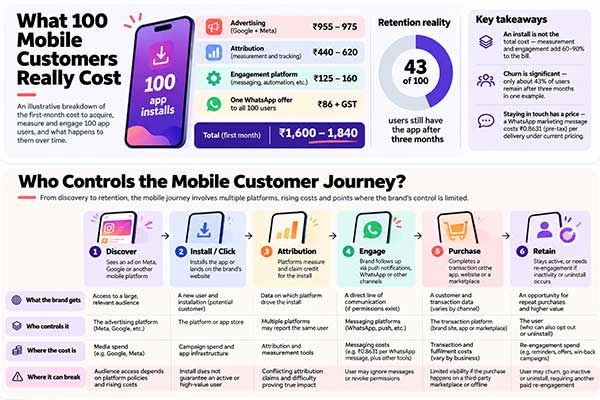
Piyush Sachdeva, Founder, Social Masla, estimates that acquiring 100 installations for a typical consumer application through Google and Meta could cost approximately ₹955–975 in advertising expenditure. However, his illustrative model puts the first-month cost of acquisition, attribution and engagement at approximately ₹1,600–1,840 per 100 installs, after accounting for measurement tools, engagement infrastructure and a WhatsApp marketing message.
The distinction matters because advertisers frequently assess campaigns through cost-per-install figures, even though installation alone says relatively little about subsequent commercial value.
Sachdeva's analysis also illustrates the problem of retention. In one consumer-brand application example, only about 43 of every 100 users still had the application three months after installing it.
Consequently, the effective cost of maintaining access to an acquired audience can be substantially higher than the original installation price suggests.
Attribution introduces another complication.
In one shopping-app campaign analysed by Sachdeva, 16 of every 100 installs reported by Meta involved users who had viewed an advertisement without clicking it. A consumer who sees an advertisement on Meta and subsequently clicks a Google advertisement may also be attributed to both platforms under their respective reporting systems.
Mobile measurement partners can help reconcile competing attribution claims, but even identifying which platform deserves credit does not necessarily establish whether an advertisement caused the installation.
That requires incrementality testing, such as comparing exposed audiences against a control group.
For brands purchasing mobile inventory across multiple platforms, the distinction between reported acquisition and genuinely incremental customers has direct implications for marketing efficiency.
Paying to stay in touch
The costs do not end when a consumer completes a purchase.
Push notifications offer a relatively inexpensive means of re-engagement, but they generally depend on the consumer retaining the application and permitting notifications. WhatsApp provides another route, although it introduces message-based charges and requires the appropriate customer permissions.
Under Meta's October 2026 India pricing, a delivered WhatsApp marketing message costs ₹0.8631 before taxes and additional provider charges. Sending one million such messages would therefore cost approximately ₹8.63 lakh in platform fees alone.
Ajay Varma, Co-Founder and Managing Partner, 0101.Today, points out that these recurring communication charges are only one component of the expenditure involved in maintaining customer engagement.
Mobile marketing operations may also require attribution, analytics, CRM, automation, personalisation and the technical infrastructure connecting them.
The commercial equation, however, is not simply one of accumulating costs.
Sachdeva describes an automated WhatsApp reminder system used in his own business when customers encounter failed course payments. Of 48 such cases, seven customers subsequently completed purchases, generating approximately ₹40,000 in sales against messaging charges of less than ₹25.
While the figures do not establish how many customers would have returned without the reminder, they demonstrate the potential value of timely, permission-based re-engagement.
The underlying question is whether brands can maintain sufficiently direct customer relationships to avoid repeatedly buying access to the same consumers through advertising.
Where the mobile journey breaks
The problem becomes particularly complicated when consumers move between brand-owned environments and third-party commerce platforms.
At Acer, approximately 80% of traffic to the company's direct-to-consumer website comes from mobile devices, compared with 20% from desktops.
Sooraj Balakrishnan, Head of Marketing, Acer Group, says the company has greater visibility into consumer behaviour and purchase decisions through its own website and exclusive retail stores.
"The dependencies are greater on third-party platforms, including e-commerce marketplaces and multi-branded retail channels, where access to customer data and the complete purchase journey is more limited," he explains.
Even when brands can observe initial customer interactions, the final transaction may take place somewhere they cannot fully track.
Acer has developed a practical means of narrowing this gap through product activation and warranty registration. When customers register purchased devices, the company gains additional information about the completed transaction, including where the product was bought.
This allows Acer to connect information from its marketing campaigns with subsequent purchases across external retail channels, although some gaps remain.
For hospitality brand Tribe Stays, the challenge lies in connecting mobile advertising enquiries with eventual bookings.
Aman Mehra, Co-Founder, CMO and CTO, Tribe Stays, says the company integrates Google and Meta campaigns, internal CRM systems, WhatsApp follow-ups and analytics through APIs.
Customer enquiries enter the company's CRM, while feedback on which enquiries result in bookings helps refine subsequent targeting.
The company is also testing voice AI to address a point of friction when consumers abandon digital interactions and contact the sales team by telephone.
The approach illustrates how businesses can bring disconnected stages of the mobile consumer journey into a more coordinated system, even when customer acquisition still depends on external advertising platforms.
These questions will be central to discussions at exchange4media's Screenage 2026, scheduled for December 1 in Mumbai. As marketers look to build more adaptive and connected customer experiences, the economics of acquisition, attribution and retention, alongside the question of who ultimately controls the customer relationship, are becoming increasingly important.
Who controls the relationship?
The experience of these brands highlights an important distinction between acquiring customer information and retaining the ability to use it.
Anil Pandit, Founder, Advantage Insights, argues that first-party relationships must be grounded in actual consumer interactions rather than the mere accumulation of customer records.
"First-party data is real when you have a login, a service call, or a loyalty program people actually use. It is not a line in a strategy deck," he says.
He also points to the growing significance of commerce platforms that simultaneously control consumer transactions and sell advertising access to those audiences.
For brands, this creates a difficult balance. Third-party platforms offer scale and access to consumer attention, while owned applications, customer databases and direct communication channels offer greater opportunities to build lasting relationships.
Neither approach guarantees independence.
A brand-owned app has limited value if consumers install it and subsequently abandon it. A customer database cannot ensure future engagement if consumers have not consented to communication or the business lacks an effective channel to reach them. And even successful re-engagement systems carry their own infrastructure and delivery costs.
The challenge for mobile marketers is therefore not simply to collect more first-party data or adopt more sophisticated technology. It is to determine which customer relationships are commercially sustainable, which interactions can genuinely be measured, and where external platforms remain indispensable.
For an industry moving from the mobile moment towards increasingly adaptive marketing, that may be the more consequential calculation.
The price of reaching a consumer can be measured in clicks, installs or impressions. The price of keeping that consumer is considerably harder to establish.
Read more news about Digital Media, Internet Advertising, Marketing News, Television Media, Radio Media
For more updates, be socially connected with us onInstagram, LinkedIn, Twitter, Facebook, YouTube & Google News