OTT on OOH: Why streaming players are moving outdoors
As OTT platforms compete for attention, OOH is emerging as more than a media buy, with launches designed to travel from the street to social
 by
by
Published: Sep 8, 2026 9:36 AM | 11 min read
 Follow Us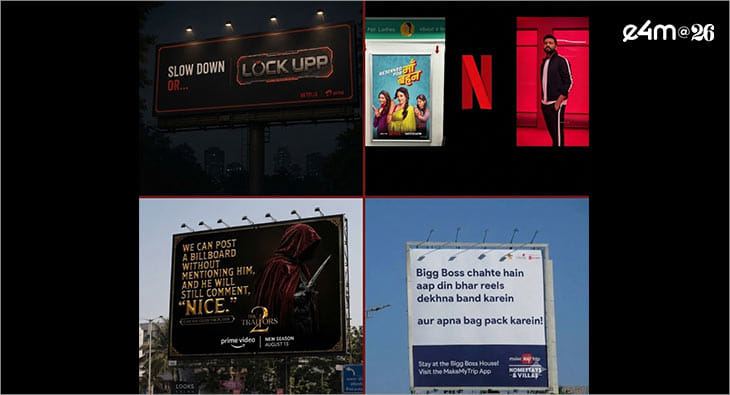

- OTT platforms are increasingly utilizing out-of-home (OOH) advertising, such as billboards, to enhance their marketing strategies, recognizing that digital campaigns alone cannot effectively reach all target audiences.
- Industry experts highlight that OOH advertising provides a physical presence that is unskippable and can generate significant earned media through social sharing and press coverage, thus amplifying the impact of campaigns.
- The annual OOH expenditure for active OTT players ranges from ₹25-30 crore, with a substantial portion allocated to marquee title launches, and successful installations can yield returns of 5 to 20 times their physical reach.
- Measurement of OOH's effectiveness is evolving, with platforms now analyzing various metrics, including search spikes and social media buzz, to better understand the correlation between OOH exposure and viewer engagement or subscriptions.
Something caught my eye this week…
An OTT platform, once again, turning to one of advertising’s oldest formats: the humble billboard (and this isn’t the first time!). Hocco’s Bullet Ice Cream × Mirzapur: The Movie collaboration took OOH quite literally, with a giant revolver, a moving mechanism and an installation designed to stop people in their tracks. It comes at a time when the OOH industry continues to grapple with the same question: how do you measure it better?
But perhaps a more interesting question is this: why do digital-first platforms keep coming back to something so physical? In a world of endless digital inventory, what does OOH offer OTT that a screen simply cannot?
Read more: The economics of competitive OOH
“OTT platforms use OOH for three key reasons to answer distribution, psychological and algorithmic challenges which digital alone cannot answer. A digital video is disposable and personalized whereas a large format billboard is kind of in your face and unavoidable staring at you with unflinching consternation,” Dipankar Sanyal, CEO, Platinum Communications added.
According to Yuvrraj Agarwaal, Chief Strategy Officer, Laqshya Media Group, “Let us be clear that this love between OTT and OOH is not new. OTT understood early that a digital campaign alone cannot reach the entire target group. The audience lives offline too. The success of titles like Sacred Games, Panchayat, Mirzapur, Heeramandi and Call Me Bae can be attributed, in part, to an impactful OOH presence that a phone screen could never have delivered on its own.”
The numbers behind the spectacle
Agarwaal puts the annual OOH spend of an active OTT player at around ₹25-30 crore or more, with platforms allocating roughly 20 to 30 per cent of their annual OOH budgets to marquee title launches.
The new billboard playbook. Read more here
He breaks down what a launch actually costs: “A city-level launch, one or two metros, a fortnight of high-streets, transit and a marquee digital screen, sits in the crore range. A national flagship launch, ten-plus cities with airports and metro networks layered in, runs materially higher. And the single biggest cost driver isn't the number of sites, it is the airport and premium digital inventory, which carries the steepest rates.”
Sanyal's numbers, drawn from the activation side of the business, land in a similar band: “OTT platforms normally spend 20 per cent to 30 per cent of the spends on OOH and activation for their flagship programmes. It can vary anywhere between Rs 2 cr to 10 crore. Across the metros mainly. The spends would be cast across airports, metro stations, malls and arterial routes.”
Where the conversation gets interesting is what that spend returns. Agarwaal cites an industry benchmark: “a well-executed installation can earn 5 to 20x its physical reach through user posts, influencer content and press coverage.”
“The smart platforms have stopped asking what a billboard costs. They ask what it returns after. When one paid impression on the street can throw off up to fifteen earned ones online, OOH stops being an expense line and becomes a content investment,” he added.
“If one spends 1 cr in paid media in OOH which of course should have its share of innovations and installation, it can get an additional 1–2 crs of earned media and PR,” Sanyal underscored.
What OOH brings to the OTT
The physical advantage has an economic implication. “I use a simple lens for this, the PAM model: Presence to Attention to Memory. A digital ad gives you presence. It struggles to convert presence into memory, because it is skippable and it disappears. OOH is unskippable, it is physical, and it plants the title in a city's shared conversation. That is how a launch becomes cultural memory instead of a notification people swipe away,” Agarwaal affirmed.
Agarwaal added, “For an OTT platform, the billboard is not the end of the campaign. It is the raw material for the campaign's second life on social media. The buy is what you pay for. The content is what you get back. So a campaign bought for its street audience is effectively delivering a multiple of that in earned digital impressions. The honest way to read the economics: the paid OOH line funds a far larger earned-media outcome. That earned layer is the reason OTT keeps coming back to the medium.”
For Sanyal, the physical scale of OOH is a psychological trigger. “The massiveness of the installation subconsciously registers the content of the billboard. The number of billboards gives a feeling of high budget and thereby increases the curiosity and desire to watch. The media itself is unskippable and demands attention unlike a digital video. OOH media creates awareness across diverse demographics simultaneously and creates conversation unlike digital where consumption is in silos.”
When the billboard becomes the content
The more interesting shift, however, is what happens once the audience encounters the OOH execution. “The buy is the simple part. A platform books billboards, transit, malls and airports to put a show or film in front of millions who are not on the app yet. That is reach,” Agarwaal said.
But, he added, “The content asset is where the real economics sit. A well-built OOH idea does not just get seen on the street. It gets photographed, posted, quoted and turned into news. The billboard becomes the ad, the social post and the press story at the same time. That is three media channels for the price of one.”
Recent OTT campaigns illustrate that approach. Agarwaal pointed to Prime Video's launch of The Traitors in May 2025, which rewrote famous lines from Mirzapur, Farzi and Paatal Lok on billboards; Panchayat turning streets into Phulera with oversized lauki and pressure-cooker installations; Heeramandi using a 1,000-drone show over Mumbai; and Netflix's Killer Soup billboard exchange involving Swiggy and Delhi Police.
“None of these were bought only to be seen on the road. They were built to travel,” Agarwaal affirmed.
Nipun Arora, Co-founder, OSMO, describes the same evolution from a different angle. “It is increasingly both, OOH is a media buy and also a content asset for OTT platforms. For OTT platforms, OOH is no longer just about buying media space. The strategy is increasingly built around reach, contextual relevance and attention.”
“Reach comes from using a mix of formats and locations to put the property in front of a large and relevant audience. This could include billboards, gantries, bus shelters, airports and other high visibility formats,” he added.
Arora says the content potential is what gives the medium another layer. “A strong execution can be photographed, shared and picked up by creators or entertainment pages, giving the campaign a second life on social media and adding to the overall buzz around the property.”
For Arijit Chakrabarti, Senior Vice President, WPP Media, the OTT-OOH relationship is ultimately about what each medium does best. “If the objective is narrow, highly targeted conversion, digital generally wins. The economics change when digital has already captured the easiest available reach and additional investment mainly adds frequency among people already exposed.” OOH, in that situation, can bring incremental reach, geographic dominance and physical visibility.
Which formats command the steepest rates
“Airports carry the highest sustained rates because the audience is captive, affluent and impossible to skip, and inventory is contracted long-term, so a late booker simply cannot get in,” said Agarwaal.
He noted that transit, the category airports sit within, is, per EY data, “a large and growing slice of OOH and is where a national title's most valuable eyeballs actually move.”
Second on his list are anamorphic 3D and premium digital formats, which are designed for a social second life. “Premium large-format screens are only about 2-3% of India's digital screen base, which is exactly why they price high. They are scarce, and they are the ones that get filmed.”
Third is programmatic and dynamic DOOH, which he backs with sector-wide figures. Per the FICCI-EY 2026 report, “OOH media grew 13 percent in 2025, and digital OOH now contributes about 18 percent of OOH revenues, up from just 7 percent in 2023, with the segment on track to reach ₹8,500 crore by 2028 and DOOH set to hit 25 percent of it,” he highlighted.
Agarwaal added that this runs on “roughly 2,25,000 active DOOH screens across India,” with CPMs ranging “broadly from about ₹100 to ₹1,200 per thousand impressions, with most campaigns landing in the ₹200 to ₹600 band and premium Mumbai metro screens at the top end.”
Summing up the hierarchy, Agarwaal said, “Airports and 3D screens are the expensive seats in OOH for a reason. They are the two formats a launch cannot fake and a phone cannot skip. Scarcity is the product.”
Arora largely echoes the hierarchy but adds an important caveat: price and effectiveness aren't the same thing. “Premium large format inventory across major metros and airport media are among the most sought after formats for OTT brands. However, the most expensive inventory is not necessarily the most effective. The choice of sites depends on the target audience, campaign objective, location and the kind of visibility the property needs.”
Measuring the unmeasurable
If there's one place the three sources diverge slightly, it's on how confidently OOH's impact can be tied to business outcomes.
Agarwaal is bullish that OOH has “grown up” on measurement. “Platforms now read four signals around a launch. First, search and trailer lift: a spike in title searches and trailer views in the cities and windows where the OOH is live, mapped against cities where it is not. Second, social buzz: hashtag volume, user-generated posts and the earned impressions the campaign throws off, which is the amplification we valued earlier. Third, streams and sign-ups: new installs, first streams and trial starts in the launch geographies. Fourth, geo and footfall data: mobile-location signals that tie exposure zones to app activity.”
“Measurement is moving to mobility and panel data across major cities, so a platform can start to answer the real question: not how many people passed the site, but how many who saw it went on to search, stream or subscribe. That shift, from counting to attribution, is what has made OOH defensible on an OTT plan otherwise built around click-level tracking,” he added.
Arora is more circumspect about direct attribution, even as he agrees the medium's role is now well understood. “There is no single attribution model that can directly say that a certain number of streams, trailer views or searches came specifically from OOH, particularly when multiple media channels are running together,” he said.
For Arora, that's not a weakness so much as a reflection of what the format is built to do. “The role of OOH is primarily to build awareness, recall and talkability at the top of the funnel, with other channels helping move audiences further down the consumer journey.”
As per Arora, OOH is also measured differently from digital. “We would not look at it as a choice between putting ₹1 crore into OOH or ₹1 crore into digital. The two mediums serve different roles and work best when they complement each other,” he said.
As streaming competition intensifies and every platform fights for the same finite pool of attention, the street, unskippable, unavoidable and endlessly photographable, may be one of the few places left where a launch can still feel like an event.
Read more news about Out of Home, Internet Advertising, Marketing, Digital Media, TV Media
For more updates, be socially connected with us onInstagram, LinkedIn, Twitter, Facebook, YouTube & Google News