Search Everywhere Optimization: How Google blurred the line between Search & Social
With Instagram, TikTok, X and YouTube performance being part of the Search Console, marketers say a reel is as searchable as a webpage, and it’s time to find out what that means for content & metrics
 by
by
Published: Jul 22, 2026 8:51 AM | 7 min read
 Follow Us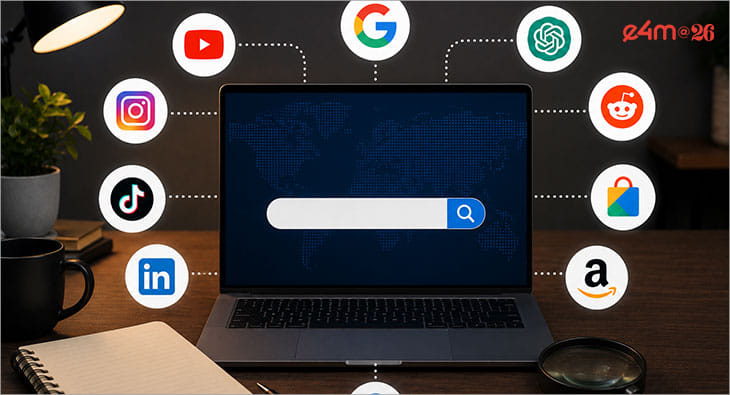

- Google has introduced a new feature in Search Console called platform properties, allowing creators and brands to track the performance of their content on social media platforms like Instagram, TikTok, X, and YouTube within Google Search and Discover, even without owning a website.
- This update shifts the measurement framework for marketers, suggesting that all branded content can now be viewed as a searchable asset, prompting closer collaboration between SEO, social media, and content teams.
- Experts argue that this development signifies a transition from traditional omnichannel marketing to a new discipline termed Search Everywhere Optimization, where discoverability becomes a key focus rather than just engagement.
- The introduction of platform properties also emphasizes the importance of measuring search impressions and clicks, providing a more intent-driven understanding of content effectiveness and encouraging brands to create discoverable content across multiple platforms.
There was a time when search meant a single sentence typed into a single box on a single website, and the answer that followed felt final. That idea, search as a destination rather than a behaviour, shaped two decades of marketing budgets, SEO teams and website architecture. But human curiosity was never really loyal to one address. People have always asked questions on Reddit threads, in comment sections, through a friend's Instagram story or a stranger's YouTube review, long before they typed anything into Google at all. What has changed is not the behaviour. What has changed is who is finally paying attention to it.
That shift became official this month when Google rolled out a new property type inside Search Console called platform properties, letting creators and brands see how their posts on Instagram, TikTok, X and YouTube perform inside Google Search and Discover, even without owning a website.
Read e4m report on Google expanding Search console
The feature, introduced through a Search Central blog post by Search Console product lead Moshe Samet, extends the Performance, Insights and Achievements reports that website owners have used for years to social and video content, tracking clicks, impressions, top queries and milestones such as crossing a new click threshold within 28 days. It builds on an earlier December 2025 experiment and follows June's launch of Search profiles for high follower creators, a related but separate feature that displays content rather than measuring it.
On the surface, this looks like a product update. Underneath, it raises a bigger question for every marketer, media planner and founder watching the space. If a reel, a tweet or a short can now be tracked the way a webpage is, does that mean every piece of branded content is, in effect, a searchable asset. And if so, is the industry quietly walking into a new discipline, one some are already calling Search Everywhere Optimization.
The Website Is No Longer the Only Front Door
For most of Search Console's history, visibility belonged to whoever owned a verified domain. Platform properties change that equation by handing the same analytics logic to accounts that may never build a website at all, formalising something practitioners say they have been observing for months. Vibhor Gulati, Founder of Defodio Digital, puts it plainly, "Google isn't changing consumer behaviour. It's changing the measurement framework to reflect the behaviour that's already there." He notes that a Reel or a creator collaboration is no longer only an engagement asset, it becomes content with measurable organic value, pushing SEO, social and content teams to work more closely than the siloed structures most organisations still run on.
How machine remembers reputation. Read e4m story here
Chirag Taneja, CEO and co-founder of GoKwik, connects this to a deeper trust shift already underway in how people search. With AI answers increasingly pulling from forums, reviews and social posts rather than brand websites alone, the credibility of a claim now often rests on lived customer experience rather than owned copy. As Taneja puts it, "SEO and social media teams working as mutually exclusive entities are a recipe for failure in the evolving times." The operational consequence is a push toward genuine community building and user generated content as core search strategy, not a campaign add-on.
From Omnichannel to a New Operating Model
The industry has spent a decade talking about omnichannel marketing, the idea of a consistent brand experience across touchpoints. Several experts argue Search Everywhere Optimization is a distinct evolution rather than a rebrand of that older idea.
Cheshta Aggarwal, Director of Marketing at Crimsoune Club, frames it as confirmation of a trend already underway, saying, "Consumers no longer distinguish between search and social." The shift moves marketing from an engagement-led model to a discoverability-led one, pressuring brands to stop treating SEO, social and influencer work as separate functions. She adds a caution that will resonate with anyone tracking the flood of AI-generated content online, noting that the real test is whether content offers original insight rather than sounding like everyone else.
Preetesh Chouhan, Co-founder and CTO of VibeTheory.AI, goes further, describing this as less an omnichannel exercise and more a new operating model for an AI-first discovery landscape, one where SEO, social, creator marketing and paid media need a unified view of intent and content performance rather than channel-by-channel judgement. His thought captures the competitive stakes well, "The brands that win won't be those producing the most content, but those building the most discoverable content ecosystem."
For category-specific brands, the shift is already visible in how content gets planned. Vibhor Rastogi, Founder of vegan skincare brand Oteria, says the brand has long treated discovery as a journey rather than a single platform event, where a consumer might encounter the brand on Instagram, search for the science behind an ingredient on Google, watch a creator explain a routine, and only then visit the website. He believes Google's move simply validates that approach, arguing, "Search presence is no longer limited to a website. Every credible piece of content contributes to how consumers discover and trust a brand."
Rewriting the Scorecard for Upper Funnel Content
Perhaps the sharpest business implication lies in measurement. Marketers have long leaned on likes, shares and views to judge whether content is working, particularly at the top of the funnel where discovery matters more than immediate conversion. Platform properties introduce a new, arguably more intent-driven signal: search impressions and search-driven clicks.
Gaurav Sehgal, VP Marketing at Medusa Beverages, sees this as validation rather than disruption for brands built on storytelling rather than product pages. In his words, "I'd call this less of a disruption and more of a validation of where consumer attention already is." For a beverage brand leaning on culture and community, being able to measure how that storytelling content surfaces in search closes a long-standing gap between creative work and discovery data.
Shagun Walia, from Avery Dennison's marketing communications team for South Asia and SSA, frames the shift in terms of trust rather than traffic alone, arguing that people move fluidly between platforms without registering the difference between search and social, "Discoverability today is no longer about one channel, but about the entire brand experience." Rastogi echoes the instinct from a category lens, pointing out that in a research-heavy purchase like skincare, a branded search or website visit often reflects deeper intent than a passive like, though no single metric tells the full story alone.
The consensus among these views is not that engagement metrics become irrelevant, but that they become one half of a fuller picture. Impressions signal that a platform, whether Google or an AI overview layered on top of it, considers a piece of content relevant enough to surface. Clicks confirm that a real person, mid-search, agreed.
A Positive Signal for a Fragmented Industry
What makes this development notable is less the feature itself and more the timing. It arrives as AI overviews, chat-based assistants and creator-led discovery are already reshaping how people research everything from skincare ingredients to beverage brands, often before they reach a brand's own website. Rather than resisting that fragmentation, Google's move gives marketers a way to measure it, turning what could have been a source of anxiety into a source of clarity.
For an industry that has long argued for closer collaboration between SEO, social, PR and paid media teams, this may be the clearest business case yet. The tools now exist to show, in hard numbers, that a well-made reel or a well-briefed creator video carries the same discovery value once reserved for an optimised webpage. Whether brands act on that proof by breaking down old departmental walls, or continue running search and social as parallel universes, may well decide who leads the next phase of digital discovery, and who simply gets left searching for relevance.
Read more news about Digital Media, Internet Advertising, Marketing News, Television Media, Radio Media
For more updates, be socially connected with us onInstagram, LinkedIn, Twitter, Facebook, YouTube & Google News