India’s marketers have reached everyone. They need to stop exhausting them: Dhruv Dhawan
Dhruv Dhawan, Vice President, Revenue at The Trade Desk, took the stage at the Pitch CMO Summit 2026 to discuss driving growth in an increasingly fragmented media environment
 by
by
Published: Jun 10, 2026 4:09 PM | 5 min read
 Follow Us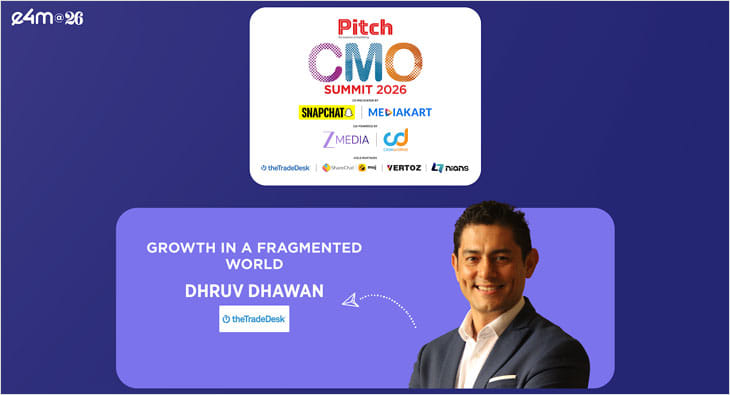

- India's advertising market is evolving, with a focus on capturing consumer attention amidst increasing ad fatigue, as highlighted by Dhruv Dhawan from The Trade Desk at the Pitch CMO Summit 2026.
- Consumers are exposed to approximately 1,000 ads daily, and 70% express fatigue from repetitive ads, indicating a need for better campaign planning that considers the interconnectedness of media consumption.
- Omnichannel strategies, which manage ad frequency across various platforms, have been shown to enhance brand impact and reduce consumer fatigue, with connected campaigns proving more effective than isolated ones.
- Connected TV (CTV) is emphasized as a key component of omnichannel marketing, offering significant engagement potential, and integrating retail data into campaigns can enhance performance by linking ad exposure to actual purchase behavior.
India’s advertising market is entering a new phase. The challenge is no longer just reaching consumers, but earning their attention without exhausting it.
That was the message from Dhruv Dhawan, Vice President, Revenue at The Trade Desk, who took the stage at the Pitch CMO Summit 2026 to discuss driving growth in an increasingly fragmented media environment.
Dhawan described a market of extraordinary scale and rising complexity. India now has more than a billion internet users moving across smartphones, feature phones, connected televisions and out-of-home screens throughout the day. For marketers, that creates more opportunities to reach people than ever before. But it also raises a more urgent question: how much advertising is too much?
According to Dhawan, consumers are now exposed to roughly 1,000 ads a day, while 7 in 10 say they are tired of seeing the same ad repeatedly. For him, this is not simply a creative issue. It is a structural one. Campaigns are still often planned with individual channels bought and measured in isolation, even though consumers do not experience media that way.
That disconnect matters. A consumer may move from CTV to mobile video, audio and outdoor in the same day, but many campaigns are still managed as separate buys. Without a connected view, brands can end up reaching the same person too often in one environment while missing more valuable moments elsewhere.
Dhawan pointed to omni-channel planning as a way to address that gap. By managing frequency across the full campaign, rather than platform by platform, marketers can reduce unnecessary repetition and make India’s scale work harder without adding to consumer fatigue.
Research conducted by The Trade Desk Intelligence and PA Consulting found that connected omnichannel campaigns were 1.5 times more persuasive and 2.2 times less fatiguing than disconnected campaigns — evidence that coordinating channels improves both brand impact and consumer experience.
Separately, a global analysis of campaigns run through The Trade Desk's AI-powered platform showed that when CTV is part of an omnichannel strategy, brands see 6.5 times more site visitation, 11 times more brand search activity, and 3.6 times more e-commerce shopping behaviour compared with single-channel campaigns, with cost per acquisition decreasing an average of 14 percent with each additional channel added.
He also cited work with IKEA in Australia to illustrate how channel sequencing changes outcomes. IKEA ran an omnichannel campaign across audio, display, broadcast video-on-demand and digital out-of-home. When consumers were exposed to audio and social together — versus social alone — conversions increased by 339 percent, while average time to convert decreased by 10 percent when two or more channels were used versus one. The point was not that one channel is better than another, but that the order, combination and frequency of exposure matter.
Connected TV took up a large part of the discussion. Dhawan described it as a cornerstone of the omni-channel model, rather than just another line on the media plan. In India, 72 percent of streaming subscribers are already on ad-supported tiers, and nearly three quarters of users say they have discovered new products and brands through CTV.
For marketers, that makes CTV especially powerful. It offers the storytelling depth of 30- and 60-second creative, while still allowing for more precise digital decisioning. But Dhawan was careful not to position CTV as a standalone solution. Overexposure on any one platform, he noted, is part of what creates fatigue in the first place.
“Think of 10x on one publisher. You need to actually spread it out,” he said.
That is where the role of frequency-controlled, cross-channel planning becomes more important. The objective is not simply to add more screens to a campaign, but to understand how each screen contributes to the consumer journey and when another impression is genuinely useful.
On measurement, Dhawan turned to the possibilities opening up when retail data is layered into CTV campaigns. He referenced work with Kellogg's in international markets as a case in point. By using purchase-based signals, Kellogg's was able to reach high-value shoppers within premium CTV environments and directly link ad exposure to real purchase behaviour — delivering a 187 percent uplift in sales and a 156 percent increase in conversions. Retail data, Dhawan argued, turns CTV from an upper-funnel awareness channel into a full-funnel performance engine.
In India, The Trade Desk is enabling similar closed-loop measurement by integrating retail-powered audiences from platforms such as Zepto, Swiggy and BigBasket — connecting media exposure with actual shopping behaviour so brands can understand not just who saw an ad, but whether it drove a purchase.
“It’s not just about measuring where you are showing your ad or the total completion rate, but also, is it driving business outcomes?” Dhawan said.
The message for marketers is hard to ignore. India’s scale is a major advantage, but scale alone is no longer a strategy. A reach-first playbook that ignores attention, fatigue and the connected nature of consumer behaviour is not just inefficient. It can actively weaken brand equity.
The next stage of advertising effectiveness will depend less on volume and more on intelligence. In Dhawan’s framing, the difference between a brand that resonates and one that irritates will increasingly come down to how well it plans across the open internet.
Read more news about Marketing News, Advertising News, PR and Corporate Communication News, Digital News, People Movement News
For more updates, be socially connected with us onInstagram, LinkedIn, Twitter, Facebook, YouTube & Google News