The economics of competitive OOH: Is it worth it?
Before competitive ads go viral on social media, they often begin with OOH. Industry experts break down the gamble, the costs and the potential payoff
 by
by
Published: Aug 31, 2026 9:13 AM | 13 min read
 Follow Us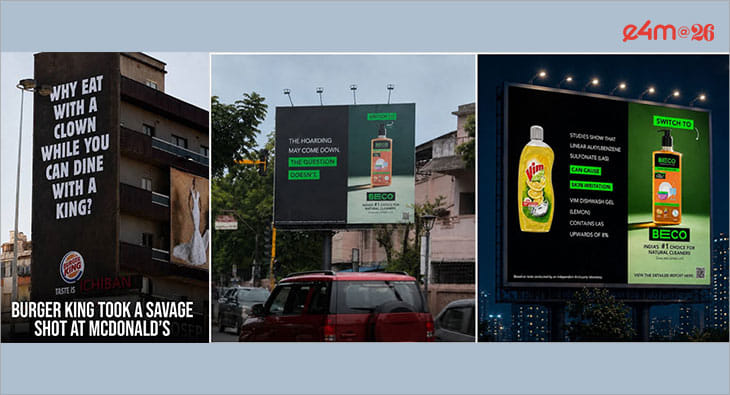

- Competitive advertising, including naming rivals in campaigns, serves as a strategy to gain attention and clarify product differences, with examples from brands like Pepsi, Coke, and Beco.
- Out-of-home (OOH) advertising amplifies this tactic by creating public confrontations that can generate significant social media buzz and earned media coverage, potentially increasing visibility without additional costs.
- While controversial campaigns can yield high engagement, they also risk legal challenges and unintended benefits for the competitor being named, as they may receive free advertising exposure.
- Measuring the success of competitive OOH advertising is complex, as it varies by brand objectives, with key metrics including earned media value, brand recall, and the ability to substantiate claims made in the advertisements.
Naming a competitor in advertising is rarely just about taking a swipe at another brand. Sometimes it is a shortcut to attention, sometimes a way to sharpen a product proposition, and increasingly, a calculated bet on the conversation that follows.
The tactic is hardly limited to challenger brands. From Pepsi and Coke trading blows to Rin taking on Tide, Sebamed calling out multiple brands and newer players such as Beco directly naming category leaders, competitive advertising has repeatedly put one brand at the centre of another’s communication.
And in OOH, that confrontation can become even more valuable once it spills beyond the billboard.
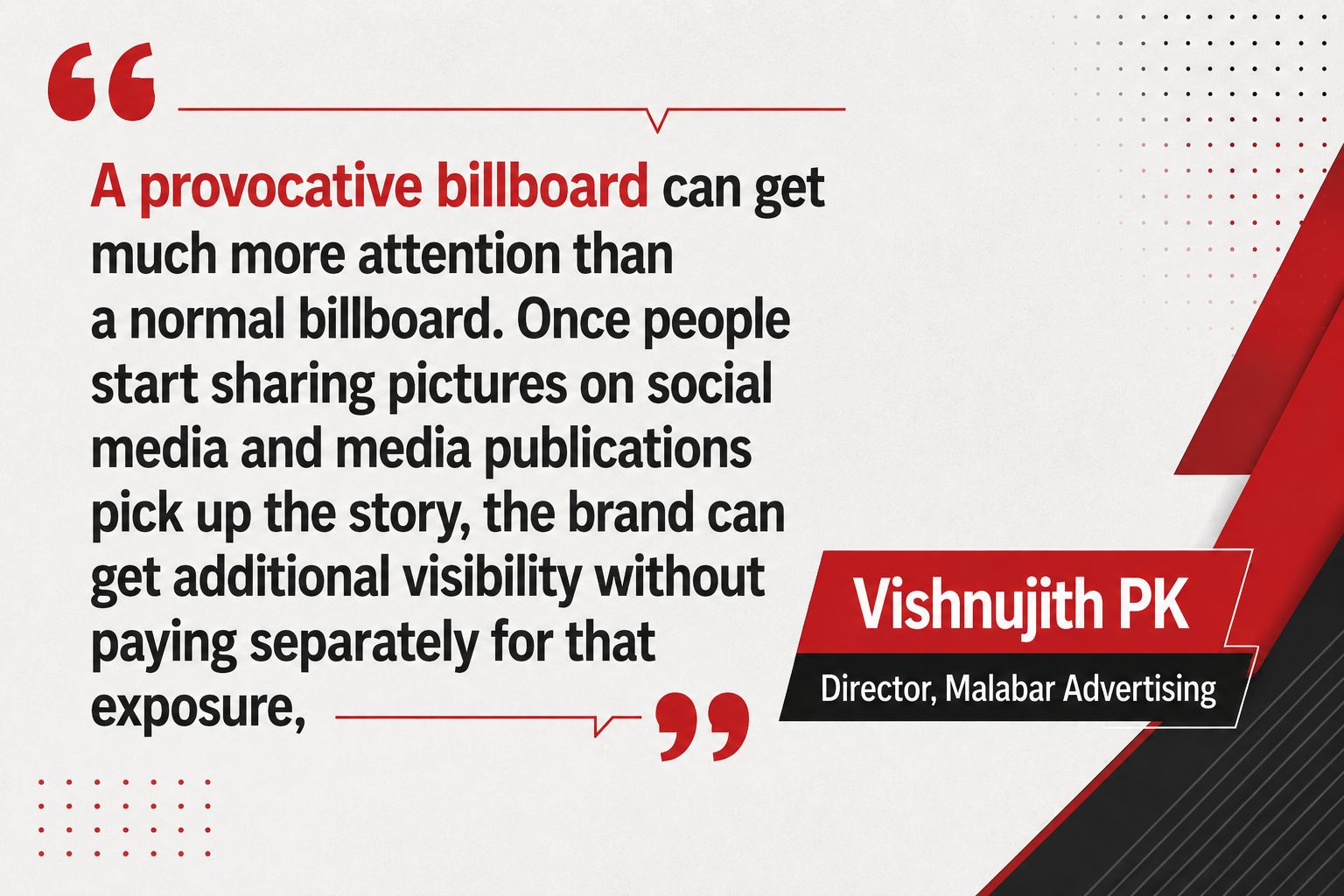
“A provocative billboard can get much more attention than a normal billboard. Once people start sharing pictures on social media and media publications pick up the story, the brand can get additional visibility without paying separately for that exposure,” said Vishnujith PK, Director, Malabar Advertising.
That creates the central question for marketers: when does putting a competitor on a billboard become worth the risk, cost and attention it generates?
When brands turn rivalry into ads
The strategic trigger can vary, but attention sits at the heart of it. “In my opinion, it usually happens when a brand wants to get immediate attention and create a talking point. If the competitor is already strong in that market, directly referring to them can make the communication more interesting, catchy and easier for people to understand. The main trigger is usually the need to stand out,” said Vishnujith.
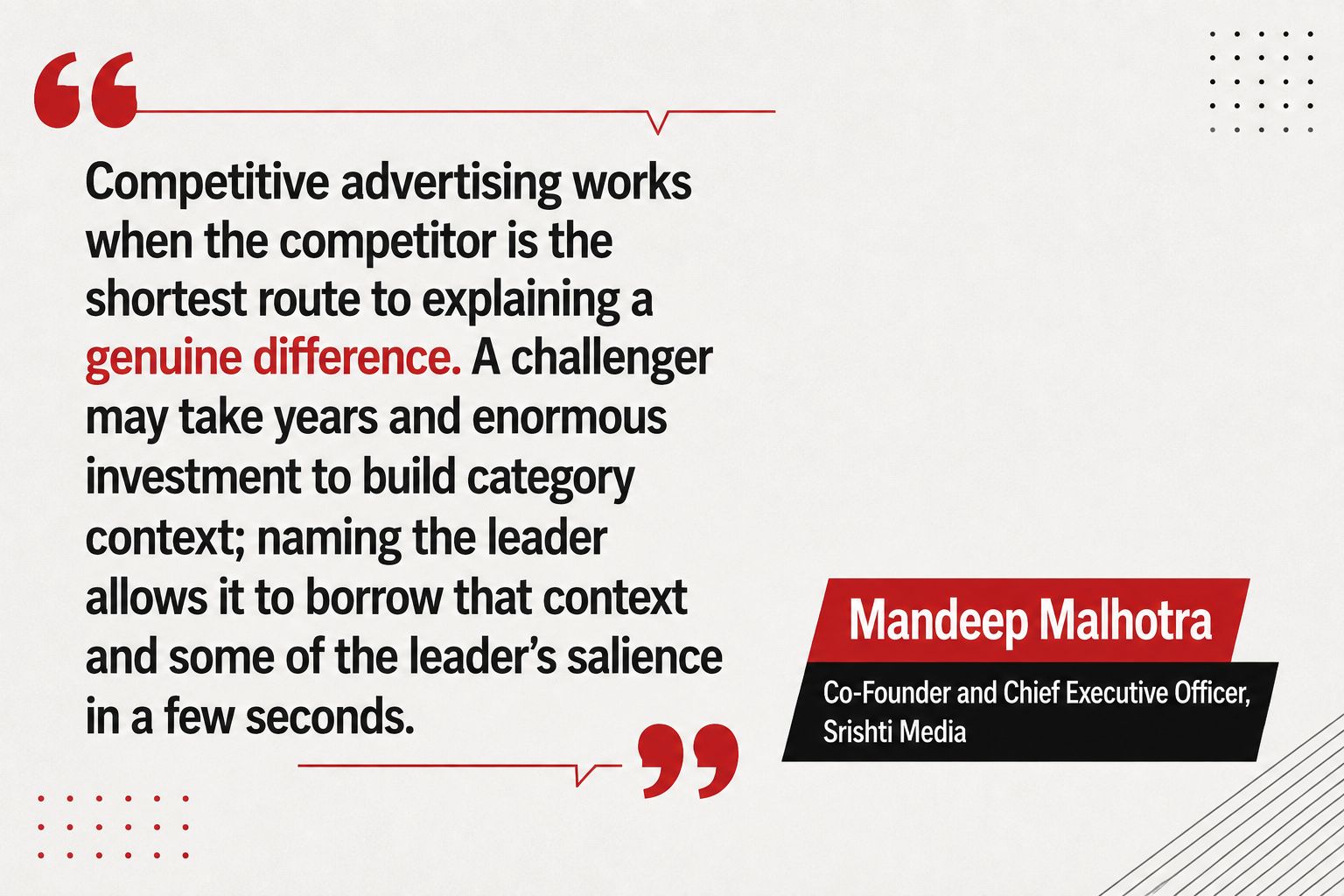
For Mandeep Malhotra, Co-Founder and Chief Executive Officer, Srishti Media, however, the competitor has to serve a larger communication purpose. “Competitive advertising works when the competitor is the shortest route to explaining a genuine difference. A challenger may take years and enormous investment to build category context; naming the leader allows it to borrow that context and some of the leader’s salience in a few seconds.”
That logic can work regardless of whether the brand doing the attacking is a challenger or an established player. The competitor provides context that would otherwise take several seconds, or several campaigns, to establish. There is also a simple creative test. “The sharpest comparative advertising dramatises a proposition; the weakest uses the competitor as a substitute for one,” Malhotra added.
Why OOH makes the fight bigger
A billboard gives competitive advertising a very different stage. The confrontation is public, physical and geographically visible.
“OOH is particularly attractive because it makes the confrontation public and physical. A billboard can convert a private market rivalry into street theatre,” said Malhotra.
But the physical site is only one part of the equation now. “Today, one must also recognise that the billboard is frequently only the first frame; the photograph or video of it travelling through social media is the real media plan,” he added.
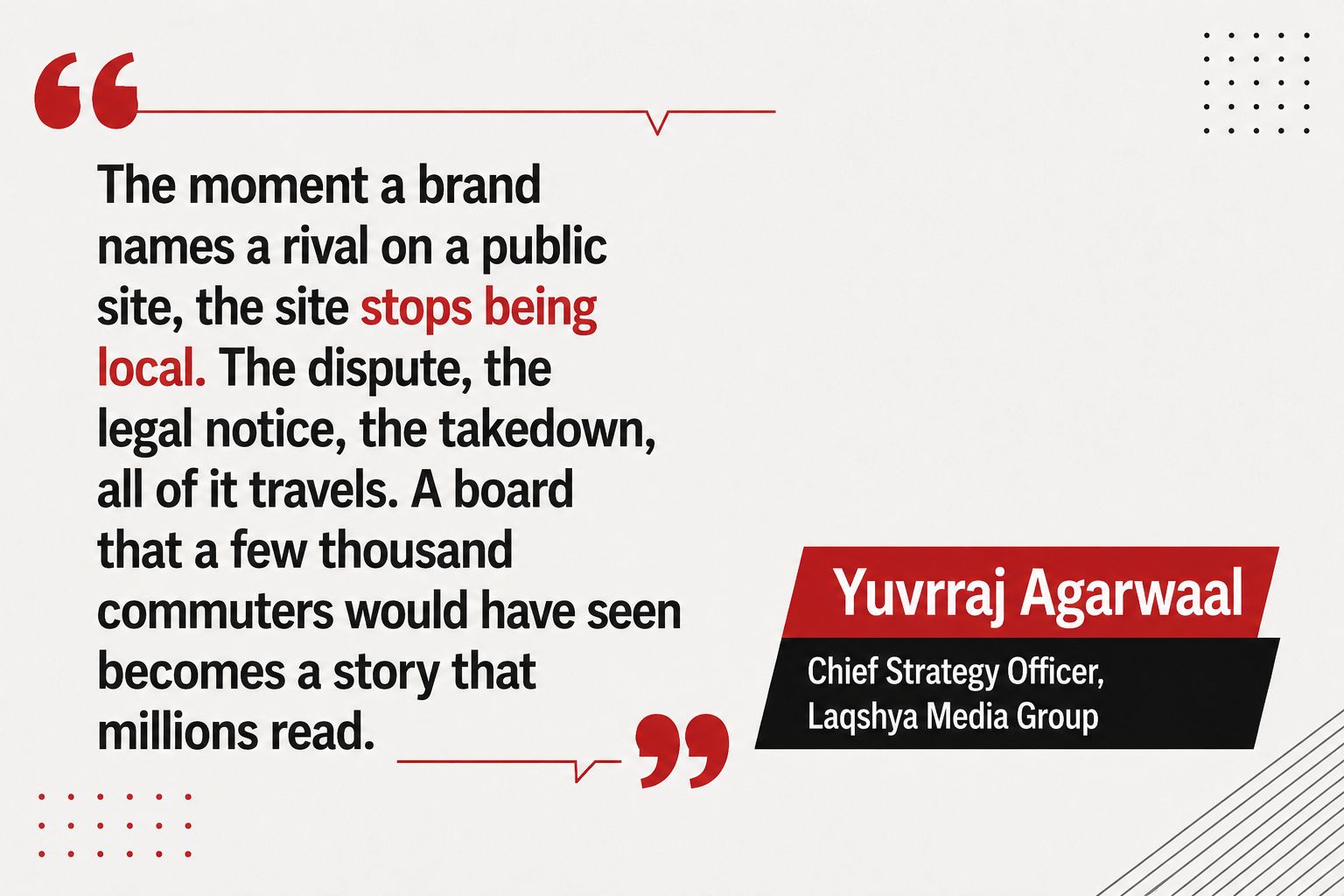
Yuvrraj Agarwaal, Chief Strategy Officer, Laqshya Media Group, sees the medium’s geographic limitation turning into an advantage once a competitive execution becomes controversial. “The moment a brand names a rival on a public site, the site stops being local. The dispute, the legal notice, the takedown, all of it travels. A board that a few thousand commuters would have seen becomes a story that millions read.”
That creates a second layer of value for the advertiser. The physical OOH buy is paid media, but the conversation around the creative can become earned distribution.
What happens to the campaign after the takedown
The Beco-HUL tussle offers a live example of how that second life can unfold. Beco’s campaign named Surf Excel Matic and Vim, after which HUL moved the Delhi High Court. Agarwaal argued that the resulting takedown did not necessarily end the campaign.
“Beco has shown this live. Its campaign named Surf Excel Matic and Vim, HUL moved the Delhi High Court, and Beco's own account is that its outdoor and digital partners were pressured to take the sites down, not by a court order and not by a regulator, but by the commercial weight of a much larger advertiser. Rather than withdraw, Beco re-papered the sites with new creatives built around the removal itself. One board read: ‘The hoarding may come down. The question doesn't.’ The takedown did not end the campaign. It became the campaign.”
The idea of the takedown becoming another piece of communication changes the way the media investment can be viewed.
But Vishnujith cautions against treating such outcomes as routine. “I would say it is not very common, but it does happen. Most brands and agencies are careful before putting such campaigns out because legal issues can be expensive and can also affect the brand image.”
For Malhotra, the distinction is between engineering for a response and simply being reckless. “A sophisticated challenger anticipates the response, substantiates every factual claim, prepares replacement creative and calculates whether the earned conversation can compensate for curtailed paid media.”
How much does picking a fight really cost?
But the cost is not limited to the initial media buy or a legal notice. “Break it into five lines,” said Vikas Nowal, CEO, Interspace Communications.
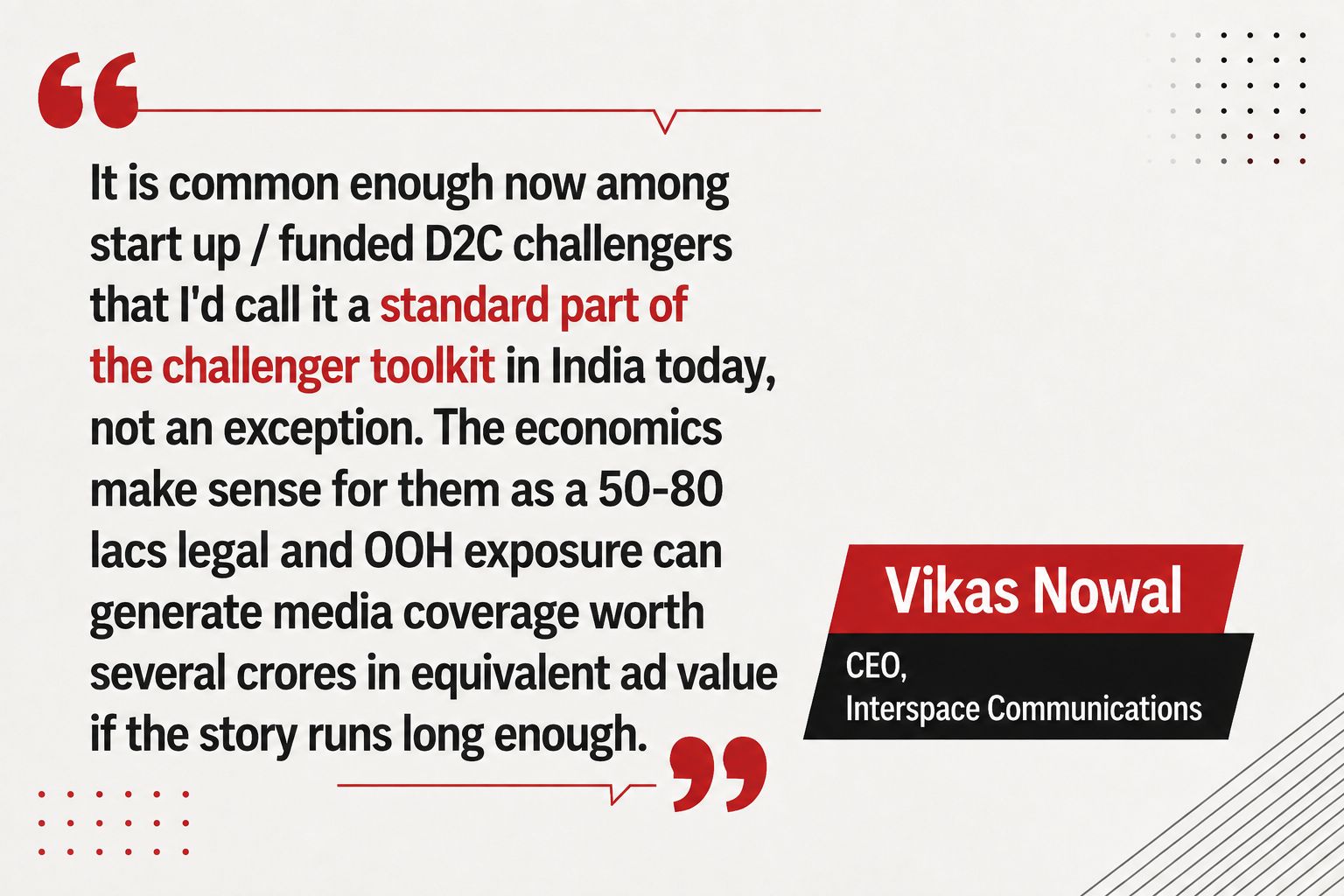
The upside of controversy comes with a very real cost structure. Nowal puts the potential exposure in stark terms: “It is common enough now among start up / funded D2C challengers that I'd call it a standard part of the challenger toolkit in India today, not an exception. The economics make sense for them as a 50-80 lacs legal and OOH exposure can generate media coverage worth several crores in equivalent ad value if the story runs long enough.”
“Replacement media, which is booking fresh inventory at short notice, usually at a premium since you've lost negotiating leverage; production, that is the reprinting flex/vinyl or re-rendering digital creative, sunk cost on the original; legal fees, running multiple hearings, this is not a one-time notice & response cost, it's weeks of senior counsel time which for a case like this runs into tens of lakhs easily, sometimes crossing a crore; agency & internal cost, wherein they spent on monitoring, drafting rebuttal creative & managing vendor relationships, which is real opportunity cost even if it doesn't show up as a separate invoice; lost media days, and that is the hardest to recover because unlike a paused digital campaign, every dark day on a physical site is reach that simply never happened.”
Malhotra offers another way to quantify the exposure, while stressing that his scenario is not an industry benchmark. “If a ₹40 lakh, 28-day static campaign is withdrawn after seven days, ₹30 lakh of planned media delivery is immediately at risk.”
For deliberately provocative campaigns, he recommended “a contingency of roughly 10–20% over the planned campaign cost”, while emphasising that this is prudent scenario planning rather than an audited industry average.
Who pays when the board comes down?
The answer, however, is not always as straightforward as assuming the advertiser takes the entire hit. “Normally the advertiser ultimately takes the cost, although it depends on the agreement between the brand, agency and media owner,” said Vishnujith. He pointed to the media already booked, production and installation costs, while noting that the eventual loss depends on how quickly the campaign is stopped and whether the media owner can resell the space.
Malhotra similarly said, “On who bears the cost when a campaign is withdrawn, the answer is contractual rather than universal.”
But Agarwaal presents a different outcome where the media owner or vendor itself pulls the campaign. “When the site comes down, the challenger simply does not pay for what did not run.
The vendor, having removed the campaign itself to protect a bigger advertiser, cannot bill the small brand.”
In that scenario, “the media owner, not the advertiser” can carry the immediate cost. The economics therefore depend not only on the legal dispute but also on who initiates the removal and what the commercial agreement between the parties says.
“Here the common assumption is wrong. The question is usually put as, who absorbs the media wastage, on the premise that the advertiser eats it. In the Indian vendor-pull, the advertiser does not. Two things decide it. OOH in India is almost never paid in advance; billing follows display and runs on credit. And when a vendor pulls a site, it is usually because it cannot afford to annoy a far larger advertiser. Put those together and the outcome is clear. When the site comes down, the challenger simply does not pay for what did not run. The vendor, having removed the campaign itself to protect a bigger account, cannot bill the small brand. If it is lucky it recovers the three or four days out of seven that the board was actually up. Often it recovers nothing at all. So the cost of a competitive takedown, in the vendor-pull case, is carried by the media owner, not the advertiser. It is small in absolute rupees precisely because nothing was prepaid. The party that never picked the fight pays for it,” Agarwaal pointed out.
Is controversy itself becoming a media buy?
There is growing evidence in these industry perspectives that some brands are willing to factor controversy into the communication strategy. Vishnujith believes “some brands do think this way” because a provocative billboard can generate substantially more attention than a conventional execution.
“Manufacturing controversy for earned coverage is now a deliberate tactic, led by D2C, not an accident. Beco is the current example, treating each turn in the dispute as fresh material. The cleaner, consensual version is Audi and BMW on Santa Monica Boulevard: your move, checkmate, your pawn is no match for our king. A chain of boards where both brands played along, nobody sued, and both won attention,” said Agarwaal.
But the objective does not necessarily have to be a legal fight. The underlying strategy is to create enough tension for the communication to travel beyond the paid media plan. That makes the controversy an amplification mechanism, rather than necessarily the original objective.
Caution: Your competitor gets a free ad too
There is, however, another side to competitive advertising: the brand being named gets attention as well.
“Comparative work almost always pays the named rival some rent, and this is the leak nobody prices in. Pepsi's vending-machine film is the sharpest illustration. The boy stacks two Coca-Cola cans to reach the Pepsi button, then walks off leaving the Cokes behind. Read it again. He bought two Cokes to reach one Pepsi. Rin versus Tide did the same in reverse, the attack handed P&G crores worth of free visibility for Tide Naturals. When you name a rival, part of your budget goes to advertising them,” Agarwaal pointed out.
That is the fundamental paradox of comparative advertising. The brand may be trying to pull attention away from a competitor while simultaneously reinforcing the competitor’s name in consumers’ minds.
The same problem can emerge in more aggressive comparisons. The audience may remember the brands involved, but not necessarily the specific product difference the advertiser wanted to communicate.
Malhotra's test is blunt: “If the consumer remembers the insult but cannot remember why the advertised brand is better, the campaign has generated entertainment not competitive advantage.” That makes attention alone an inadequate measure of success.
Buzz is not the same as ROI
There is no single benchmark for determining whether competitive OOH has worked. “I don't think there is a fixed ROI benchmark for competitive OOH. It depends on what the brand wants to achieve,” said Vishnujith.
For him, the measures can include how many people saw the campaign, whether people talked about it, whether it generated social media attention, whether it improved recall and whether it helped the brand take attention away from the competitor.
Nowal takes a broader view of the problem. “There’s no single clean benchmark because the objective shifts depending on who's running the campaign & conflating them is where most marketers get their measurement wrong.”
For a challenger, he said, the objective is “never reach efficiency rather it's earned media multiplier & category disruption.”
For an incumbent, meanwhile, “the objective should be containment & brand-safety, not competitive displacement,” he added.
Malhotra proposes four levels of measurement: media delivery, attention, brand effect and commercial effect. For challengers, earned media and share of search may be useful leading indicators, while established brands should put greater weight on consideration, preference and sales displacement. Advertising-equivalent value, he cautions, should not automatically be treated as ROI.
“There is no clean ROI benchmark for competitive OOH, and any figure offered as one should be treated with suspicion. The objective is rarely sales. It is earned media and salience, entry into the leader's consideration set, ownership of a single variable, and forcing the incumbent to respond, because a response validates the challenger. The honest measure is share of conversation and earned-media value against paid spend, not GRPs, reach or footfall,” said Agarwaal.
“And the cases that last are the ones that can be proved. Sebamed kept its Dove comparison because it was evidence-based. It lost the Rin comparison. Rin itself was restrained in 2010 partly on defective affidavits. HUL's argument against Beco is that naming an ingredient is not the same as proving the finished product harms anyone, a question now before the Delhi High Court. Competitive OOH manufactures attention a single billboard could never buy, and it plants memory by naming the leader. But it scales on what it can substantiate. The provocation gets you noticed. Only the proof lets you keep the claim,” Agarwaal added.
The claim has to survive the controversy
The bigger the claim, the greater the need for evidence. Agarwaal argued that the strongest comparative OOH executions rely on “a single, provable variable the eye can grasp in about three seconds.”
That could be pH, whiteness or a specific ingredient, but the claim has to remain demonstrable. Malhotra similarly said, “There must be a product truth beneath the provocation.”
The distinction becomes even more important where campaigns make claims around safety, performance or consumer risk, because the evidentiary burden can become considerably higher. The implication is that brands can deliberately choose confrontation, but cannot treat the resulting buzz as proof that the strategy worked.
So, who really wins the fight?
Competitive OOH can compress attention, comparison and brand positioning into a single execution. It can make a local billboard travel nationally, turn a legal dispute into another news cycle and give brands a way to enter conversations that conventional advertising may struggle to create.
But the same strategy can also hand the competitor free visibility, create legal and production costs, and leave consumers remembering the confrontation more clearly than the product. The challenge, therefore, is not simply getting people to notice the fight. It is giving them a reason to remember why the fight mattered.
As Agarwaal puts it: “Competitive OOH manufactures attention a single billboard could never buy, and it plants memory by naming the leader. But it scales on what it can substantiate. The provocation gets you noticed. Only the proof lets you keep the claim.”
Read more news about Out of Home, Internet Advertising, Marketing, Digital Media, TV Media
For more updates, be socially connected with us onInstagram, LinkedIn, Twitter, Facebook, YouTube & Google News