AI is making marketers faster. So why is the workload growing?
As automation accelerates content production and media planning, rising output expectations, quality checks & fragmented workflows are eating into the time AI was meant to save, say marketing execs
 by
by
Published: Oct 15, 2026 9:05 AM | 6 min read
 Follow Us

- Artificial intelligence (AI) is increasingly utilized in marketing for tasks such as copy generation, campaign variations, and consumer data analysis, but it raises questions about whether it enhances productivity or merely increases workloads.
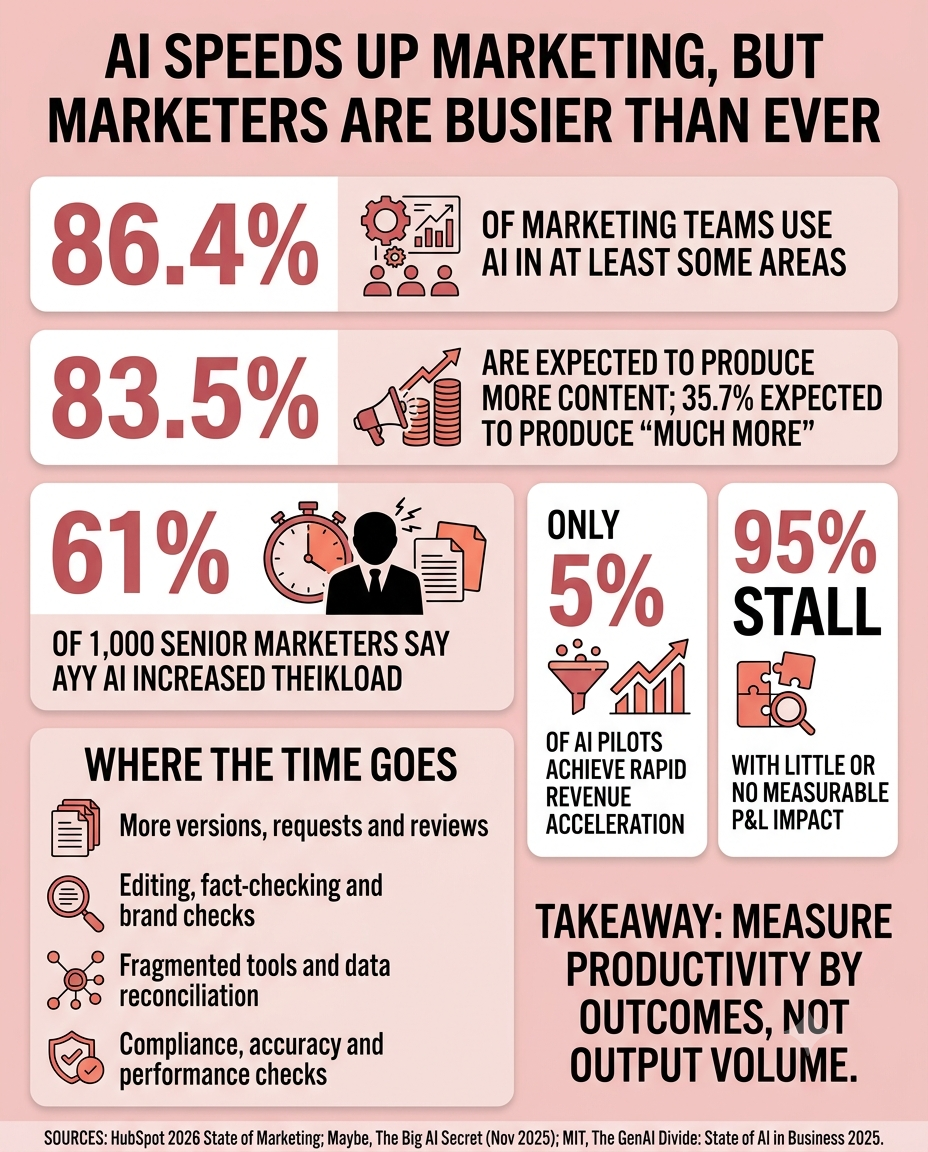
- Despite AI's ability to expedite processes, 83.5% of marketers report expectations to produce more content, with 35.7% feeling pressured to produce "much more," indicating a disconnect between efficiency gains and rising demands.
- Many marketing professionals, including 61% in a recent survey, feel that AI has increased their workloads due to the need for additional editing, fact-checking, and refinement of AI-generated content.
- Experts suggest that productivity should be measured by business outcomes rather than output volume, emphasizing the importance of making better decisions and reducing waste rather than simply producing more content.
Artificial intelligence is helping marketing teams generate copy, build campaign variations, analyse consumer data and accelerate media planning. But as adoption becomes routine, a more complicated question is emerging: are marketers becoming more productive, or simply being asked to do more?
AI is compressing timelines across marketing functions, allowing teams to complete in hours what once took days or even weeks. Yet these efficiency gains are not necessarily translating into lighter workloads. Instead, companies are raising output expectations, asking employees to take on more assignments, deliver faster and do more with the same resources.
The trend is not confined to India. HubSpot’s 2026 State of Marketing report, published earlier this year, found that 86.4% of marketing teams now use AI in at least some areas of their work. Content creation leads adoption, with 42.5% using AI extensively, followed by media creation (37.2%) and advertising automation (34.1%).
The AI content glut: Read more
Yet wider adoption has not eased the pressure to deliver. The report found that 83.5% of marketers are expected to produce more content, with 35.7% saying they are expected to produce “much more”. The findings point to a growing disconnect between AI’s promise of efficiency and the rising output expectations facing marketing teams.
A November 2025 study by AI platform Maybe, The Big AI Secret, found that 61% of the 1,000 senior marketing professionals surveyed said AI had increased their workloads. The findings suggest that the efficiency gains promised by AI are not necessarily translating into lighter workloads, as marketers contend with rising output demands and the effort required to review and refine AI-generated work.
Sooraj Balakrishnan, Head of Marketing at Acer, says the efficiency gains are often offset by rising demands on teams.
Read Taranjeet Singh's take on AI and the next generation
“AI has made parts of the marketing job easier, especially getting a first draft ready, doing initial research or adapting content for different platforms. But the time saved often gets absorbed by more versions, more requests and more reviews.”
“For a business like Acer, with multiple product categories and audiences, there is still a lot of judgement involved in getting the message right. Getting a draft in minutes is helpful, but what matters is how quickly we can turn it into something we are confident putting out,” he noted.
The distinction between automating individual tasks and improving an entire workflow is becoming critical. AI can produce a first draft quickly, but the time saved depends on how much human intervention is needed before the output is ready for use.
5 things that AI agents can do what marketers do manually
Marketing teams must still verify claims, protect brand voice, assess cultural context and ensure campaign assets meet legal and compliance requirements. In media planning, AI-generated recommendations also need to be checked against campaign objectives, audience quality, budget constraints and actual performance.
Tool fragmentation adds another layer of work. When platforms do not integrate, teams spend time transferring data, reconciling outputs and switching between applications. Individual tasks may become faster even as the overall workflow remains cumbersome.
A senior marketer from an FMCG major told e4m that the gains can be short-lived as the volume of work expands.
“For some teams, the efficiency gains are real but short-lived. Time saved on drafting is absorbed by editing, fact-checking and refining outputs. Campaigns that once required days can move faster, but the ability to produce more variations also creates more work for teams responsible for approvals, brand consistency and performance,” the executive said.
“The pressure is compounded by expectations from management. When AI is seen as a way to reduce execution time, teams can find themselves handling additional projects without corresponding increases in staffing or time for strategic thinking,” he added.
The Hidden Cost of Faster Execution
The pressure is not limited to marketing teams. An MIT report titled The GenAI Divide: State of AI in Business 2025 found that only 5% of AI pilot programmes achieve rapid revenue acceleration, while the vast majority ( 95%) stall, delivering little to no measurable impact on profit and loss (P&L).
The findings point to a broader challenge for businesses: translating AI experimentation into measurable commercial gains. For marketing leaders, the question is whether faster execution is improving campaign effectiveness or simply increasing the volume of work being produced.
Krishna Iyer, Executive Director, Marketing at TWBA/Lintas, believes AI has shifted rather than eliminating the effort involved in marketing.
“AI may not have reduced the marketer’s workload; it has simply traded the sweat of creation for the grind of curation. While drafting and data visualisation are faster within an organisation’s sandbox environment, humanising video remains an exhausting, iterative process. The time saved at the prompt is often swallowed by quality checks and polishing. Production costs may fall, but does the time to market actually shrink? Not necessarily.”
He adds, “CMOs treating AI as an ‘I-too-did-it’ post on social media does not elevate the craft of authentic filmmaking. Turning synthetic output into resonant storytelling still requires a substantial human effort.”
For Iyer, the distinction is between generating an output and producing work that connects with audiences. AI can accelerate the early stages of creation, but the judgement, refinement and creative direction required to make a campaign resonate can remain labour-intensive.
From Output Targets to Measurable Productivity
For marketing leaders, the implication is that productivity needs to be measured against business outcomes rather than content volume or turnaround time alone. Metrics should include execution costs, team capacity, quality of reach, media wastage, customer acquisition costs and incremental campaign outcomes, says Nikhil Kumar, who served as the Chief Growth and Marketing Officer (CGMO) for India & Emerging Markets at Affle.
“The real productivity dividend from AI is not producing more with less effort; it is making better decisions, reducing waste and creating more value from every marketing dollar,” Kumar says.
He explains, “AI has reduced the effort required to execute marketing, but it has also raised the bar on what teams are expected to deliver. The real question is whether we are using AI simply to produce more, or to make marketing more effective.”
Across programmatic advertising and adtech, Kumar says, AI’s potential extends well beyond content creation. It can help generate and personalise creative at scale, sharpen audience intelligence and optimise campaigns in real time.
“Two applications are particularly important: identifying invalid traffic and distinguishing genuine human engagement from bots and automated agents; and optimising ad delivery to reach audiences with fewer exposures, rather than repeatedly serving ads to the same people,” Kumar noted.
As internet users increasingly operate alongside multiple AI agents, the industry will also need to distinguish between an impression served to a human and an interaction with an agent acting on their behalf. This has direct implications for media efficiency and how campaign performance is measured, Kumar said.
He adds, “AI also introduces new responsibilities around validating outputs, maintaining brand consistency and ensuring accuracy. If the time saved is simply absorbed by higher output targets and more review cycles, teams may become busier without becoming more productive.”
Read more news about Marketing News, Advertising News, PR and Corporate Communication News, Digital News, People Movement News
For more updates, be socially connected with us onInstagram, LinkedIn, Twitter, Facebook, YouTube & Google News
