TV is not dead; Smart is not a defensive play: Tata Play MD & CEO Harit Nagpal on CTV bet
As Tata Play launches Smart to simplify connected TV viewing, Harit Nagpal discusses pricing, customer acquisition, DTH's future and why television distribution must evolve
 by
by
Published: Oct 15, 2026 9:13 AM | 8 min read
 Follow Us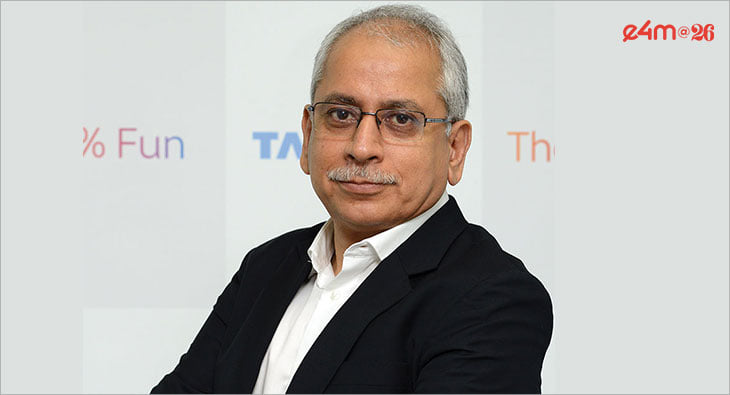

- Tata Play has launched Tata Play Smart, an internet-based aggregation platform that consolidates over 500 live television channels from various broadcaster apps into a single interface, aiming to enhance content accessibility for users with connected TVs.
- The platform is designed to simplify content discovery, allowing users to find desired programming across genres in fewer clicks, addressing the inconvenience of navigating multiple applications.
- Tata Play's MD and CEO, Harit Nagpal, emphasized that Smart is not a defensive strategy against declining DTH subscriptions but rather an opportunity to cater to diverse customer needs in a changing television market.
- The pricing model for Smart includes a base subscription of ₹199 per month for one language, with additional languages available for an extra fee, while the company plans to assess customer response and refine the offering after its launch.
Tata Play is betting on connected TVs with an internet-based aggregation platform Tata Play Smart that brings 500+ live television channels from multiple broadcaster apps onto a single interface. In an interview with exchange4media, Tata Play MD and CEO Harit Nagpal explains the thinking behind Smart, its pricing strategy, the coexistence of DTH and connected TV, and why the company is not yet putting a customer or revenue target on the new offering.
Edited excerpts:
Tata Play has launched Smart at a time when the television distribution market is undergoing a transition towards connected TVs and internet-based consumption. What is the proposition, and how does it fit into your existing Binge and DTH businesses?
We have always been in the business of aggregating content and making it easy for customers to access and consume it. That has been our underlying principle, irrespective of the screen, location or technology.
15 years ago, when broadband and OTT were not prevalent, there were customers who could not sit in front of their televisions at the time a programme was broadcast. They wanted to watch content at their convenience, so we introduced personal video recorders and digital video recorders.
When OTT emerged and customers had to move between multiple applications, we launched Binge. We aggregated 35 apps at the backend and made content discovery easier at the front end. That is what we know how to do. We do not produce content, nor are we broadcasters.
Smart follows the same philosophy. Our research indicates that there are households in large towns with connected TVs and high-speed broadband. Many of them also receive broadcaster apps bundled with their broadband plans, which give them access to live television. But customers still have to move from one app to another to find what they want to watch.
On DTH, you press the programme guide and can see what is playing across genres, whether it is drama, movies, children's programming or news in a particular language. We want to replicate that convenience on connected TVs.
Our objective is that a customer should be able to reach the content they want in three clicks and four seconds. If someone wants Hindi news, they should see the available Hindi news options on one page. If someone watches Tamil dramas, they should be able to find Tamil drama content across apps on a single page.
Smart aggregates live content from different apps under genres and brings it together through one interface. Instead of hopping between applications, customers can select what they want and start watching.
With the increasing cord-cutting and the shift towards connected TVs, is Tata Play Smart a defensive response to the possibility of customers moving away from DTH?
Is producing cars a defensive response to motorcycles? Are cycles defensive against scooters, or scooters against cars? Different products serve different segments of the market.
I have not watched live television for the past eight years, and I have said that openly at several forums. But am I representative of the entire country? No.
There are approximately 300 million households in India, and an estimated 100 million have yet to buy their first television. Another 40-45 million people have a television but cannot afford pay-TV services and therefore watch free-to-air content. A significant part of the country is still outside the pay-TV market.
So, when people say television is dead, I ask: how can it be dead when a large section of the population has not even entered the market?
Airplanes have been invented, but trains and buses continue to operate. Cars exist, yet people still use motorcycles and bicycles. Governments are building metro systems across cities despite the availability of cars. Different modes of transport coexist because they serve different needs and purchasing capacities.
Similarly, customers have different preferences, capabilities and budgets. As a service provider, I have to cater to all of them.
A customer who has moved to a smart TV, has broadband and wants to watch content through apps may be experiencing the inconvenience of navigating multiple applications. It is our job to solve that problem and build a business around the solution.
At the same time, I cannot ignore a household in a village that does not have access to broadband and can spend only ₹200 a month on television. Both markets can exist simultaneously. We do not see Smart as a defensive play.
Could Smart eventually cannibalise Tata Play's existing DTH subscriber base?
Nothing cannibalises nothing. If I offer customers an alternative that makes their lives easier, that is what I should be doing. And if there is cannibalisation, so be it, because it would have happened anyway.
Even today, we are acquiring more new DTH customers than Binge customers.
Smart is an opportunity we want to explore. It is not yet possible to predict whether it will attract half a million customers or five million. We believe there is a clear customer need, but we will understand the size of the market only after launching the product.
How are you approaching the economics of Tata Play Smart?
The advantage is that the business is not constrained by physical equipment. DTH requires a dish antenna, installation and a set-top box. With Smart, customers simply download the app from the Play Store on their television.
Whether one customer downloads it or one million customers do, we do not have to invest in a million boxes or worry about inventory shortages and excess stock.
We will advertise the product and see how customers respond. If they understand the proposition and like it, adoption will grow. If they do not, we will learn from that and make changes.
At this stage, Smart is a new concept being tested in the market. I do not think it is wise to put together a detailed business plan before we understand how customers respond to it.
More than 500 channels are available through the proposition. Does that mean customers will have access to the entire universe of channels carried by Tata Play?
The 500-plus figure refers to the total available offering, but we do not expect every customer to take everything. We already carry around 600 channels on our television platform, but an individual customer does not subscribe to all of them.
The proposition is about making the available content easier to discover and consume, rather than asking customers to navigate multiple apps independently.
How will the commercial arrangements with broadcasters work, particularly when the content is aggregated from their respective applications?
We have commercial arrangements with broadcasters. The terms vary from broadcaster to broadcaster. In some cases, the arrangements are similar, while in others they are different.
However, we have kept the customer-facing proposition simple. People generally watch content in one or two languages, and only occasionally in a third.
The first language costs ₹199 per month. That gives customers access to every genre, including drama, movies, children's programming, sports and news. An additional language costs ₹99 per month.
If a customer chooses two languages, the monthly subscription will be ₹298. If the customer wants only one language, the price is ₹199. A third language would cost another ₹99.
We believe most customers will choose two languages, such as Hindi and English, Tamil and Kannada, or English and Kannada. They can decide which languages they want without having to select individual channels.
Could Smart eventually become a platform through which broadcasters integrate e-commerce or other services, allowing viewers to move from watching content to shopping?
Broadcasters can explore those possibilities. But I do not have control over their content or the services they choose to integrate with it.
We are distributors. We provide the platform through which customers access content, and our responsibility is to make that experience convenient.
With Smart being a new category for Tata Play, when do you expect to have a clearer picture of its contribution to overall revenue and growth?
We will have to see how customers respond once the product is launched and advertised. We have advertising planned from the 15th, and the response will tell us whether customers understand the proposition and want to use it.
If the response is positive, more people will adopt it. If it is not, we will make changes and refine the product.
At this point, we do not know how many customers will sign up or how much revenue Smart will generate. It is a new concept, and we need to test it before setting out a business plan.
You have led Tata Play for more than 15 years, and your tenure is set to conclude in November this year. Have you begun planning your retirement or identifying a successor?
Have you heard the name of my successor yet? When the name is announced, you can talk to me about it. There is no succession plan in place yet.
Read more news about Television Media, Digital Media, Advertising India, Marketing News, PR and Corporate Communication News
For more updates, be socially connected with us onInstagram, LinkedIn, Twitter, Facebook YouTube & Google News
