AI can make 100 versions of an ad. Who checks version 63?
Under new ASCI rules, every consumer-facing AI-generated variant must stand on its own, even if master creative was compliant - a practical problem for brands producing adaptations from one campaign
 by
by
Published: Oct 12, 2026 9:09 AM | 7 min read
 Follow Us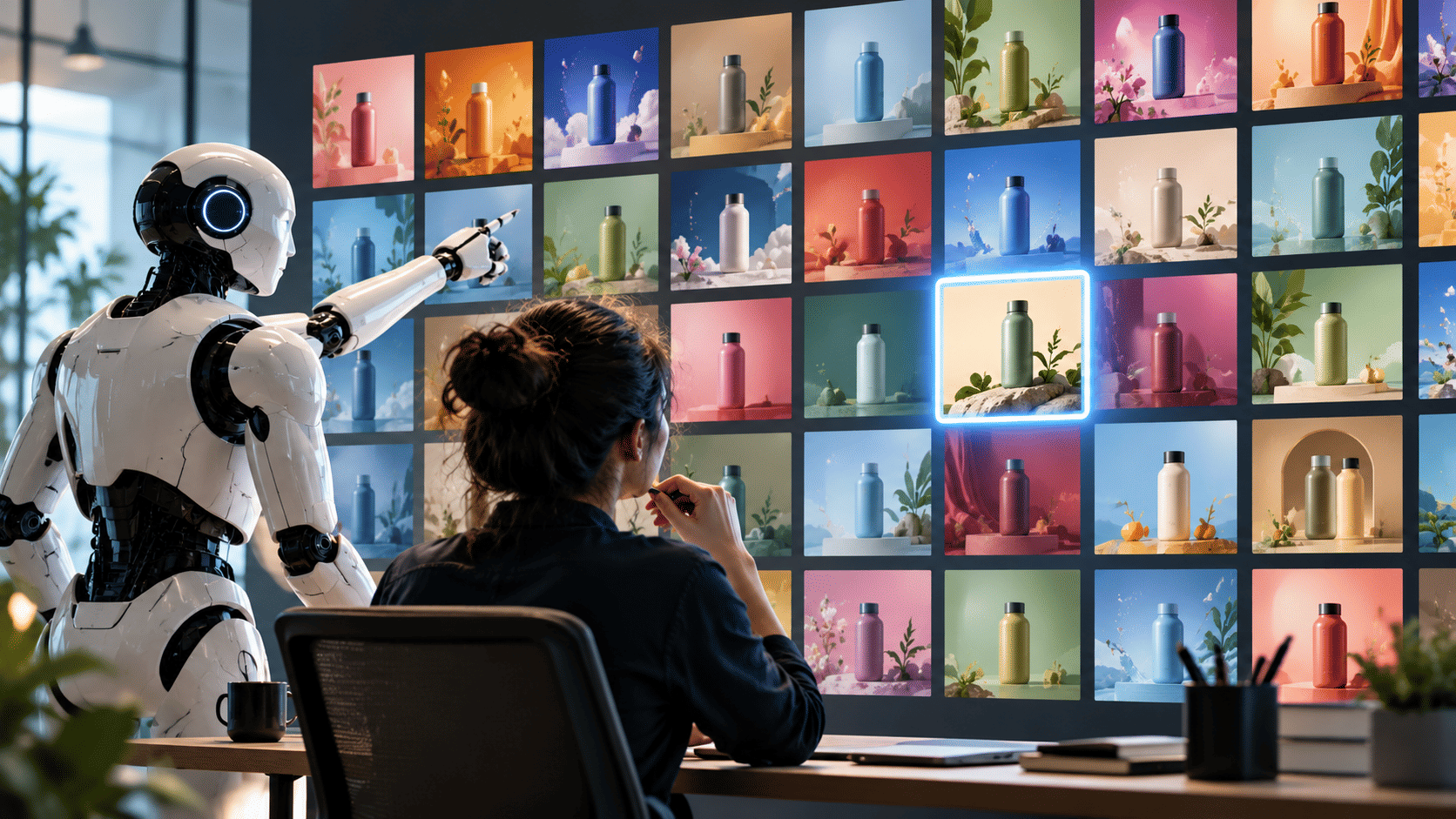

- The rise of generative AI in advertising has led to a significant increase in the production of ad variations, with companies like Google and Meta reporting millions of AI-generated assets, resulting in workflows where a single approved ad can generate numerous derivatives quickly.
- While the production of ads has become easier and faster, the challenge of ensuring compliance and accuracy in these variations has intensified, as many adaptations may not receive the same level of scrutiny as the original creative.
- Regulatory bodies, such as the Advertising Standards Council of India, have established guidelines for the responsible labeling of AI-generated content, emphasizing that each derivative must be assessed for compliance independently.
- Brands are adapting their approval processes to focus on overarching templates and rules rather than individual assets, with a shift towards automated checks for mechanical issues followed by human review for contextual accuracy.
The hero film has been approved, with its hero/ine doing their heroic thing with the hero product. Legal has checked the claim. The brand team has signed off on the product, offer and disclaimer.
Then the machine makes another 99 ads.
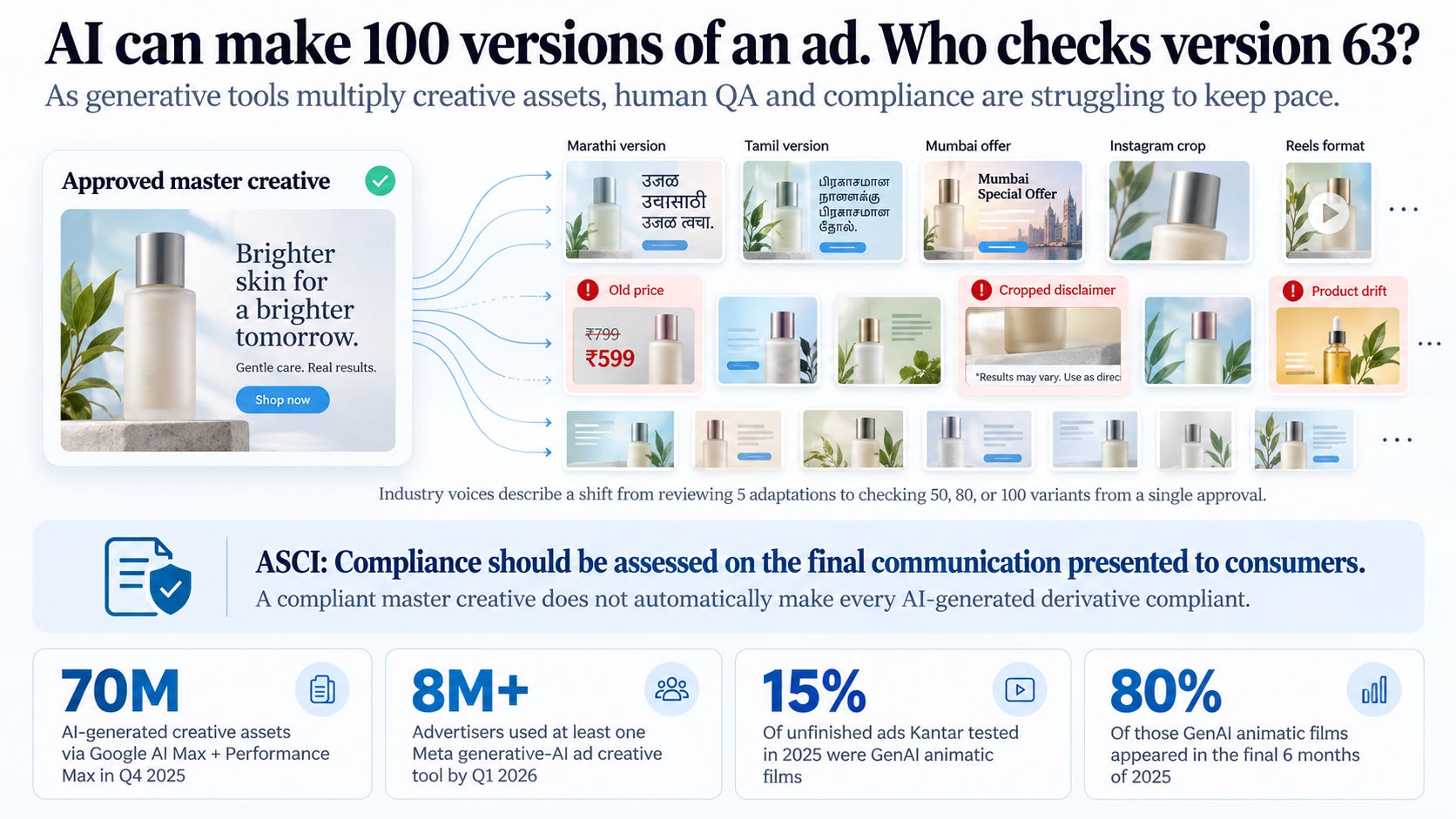
Version 12 is resized for Instagram. Version 28 is in Marathi. Version 47 carries a different offer for Kolkata. Version 63 is in Tamil, has last week's price and, somewhere between generation and resizing, has lost half its disclaimer.
Making version 63 is rapidly becoming unremarkable. Checking it is not.
Advertising has spent much of the past year confronting what happens when generative AI makes creative production cheaper, faster and almost infinitely variable. The machinery surrounding that production is now scaling just as quickly.
Can AI-generated ads turn attention into action? Read on
Putting the generative in AI
Google said Gemini-generated advertising assets tripled during 2025, with nearly 70 million assets generated through AI Max and Performance Max in Q4 alone. Since then, the machinery has expanded further. Hundreds of thousands of advertisers are already using AI Max globally; Google's Asset Studio can generate multiple creative themes and formats from a brief and brand guidelines; and multimodal video creation became generally available for Demand Gen in August. In September, Google expanded AI Brief and added reporting designed to show advertisers which creative assets its AI actually served during a Search journey.
Google at 28: Searching for answers
Meta is moving in the same direction. More than eight million advertisers were already using at least one of its generative-AI ad creative tools by Q1 2026, up from four million at the end of 2024. In July, Meta said its new Muse Image model would also become available to advertisers through Advantage+ creative.
And a new AI-native advertising surface has joined them. OpenAI's ChatGPT Ads, launched earlier this year, now counts tens of thousands of advertisers globally. On October 5, OpenAI introduced a more visual ad format and said ChatGPT reaches 1.2 billion people weekly. In India, Razorpay Engage is now helping brands including Tanishq, Tata Neu, Fastrack, Traya and Axis Max Life activate and measure campaigns on ChatGPT Ads.
The result is not merely more AI in advertising. It is more advertising per idea.
Across the agencies, technology companies and brands exchange4media spoke to, the numbers varied but the direction did not. Teams described workflows in which five adaptations become 20, or a single approved creative becomes 80 or 100 derivatives.
Play and pause
“Making versions has become easy. One approved ad can turn into a hundred versions before lunch. Checking them has barely changed,” says Shashidhar Sharma, co-founder and COO of AdNexa.ai.
Versioning itself is not new, he points out. Brands have long adapted one film across languages and screen sizes. The difference is that machines can now write new copy and create new imagery inside each version. “Often, nobody reads them all.”
Saket Dandotia, co-founder and CEO of Onetab.ai, puts the problem differently: “The bottleneck in creative production has moved from making to checking.”
Teams that once inspected a master film and a handful of adaptations can now face 80 or 100 derivatives without adding reviewers. By the sixtieth near-identical asset, he argues, review fatigue itself becomes a risk.
India is already seeing the production shift. Kantar says 15% of unfinished ads it tested in 2025 were GenAI-crafted animatic films, and 80% of those appeared in the final six months of the year. It described the acceleration as a workflow shift rather than experimentation.
The difficulty is that advertising regulation does not become proportionately more forgiving because production becomes easier.
On September 29, the Advertising Standards Council of India released its final guidelines for responsible labelling of synthetically generated content. The guidelines, which take effect three months after publication, require disclosure where synthetic content could materially affect consumer decisions, while excluding routine or immaterial editing. An AI label also cannot rescue advertising that is otherwise misleading.
More importantly for high-volume versioning, approval of the original creative does not automatically travel with everything derived from it.
“Compliance should be assessed based on the final communication presented to consumers,” says Manisha Kapoor, CEO and Secretary General of ASCI.
If an AI-generated derivative materially changes the product depiction, offer, claim or context, Kapoor says, it needs to be assessed on its own merits. “The fact that the original master creative was compliant would not automatically make every subsequent adaptation compliant.”
Read on: Who owns an AI ad’s copyright?
That creates an awkward collision between two realities of modern advertising.
New job description
Operationally, the incentive is to make more versions: one for every platform, language, geography, audience and offer. From the consumer's perspective, however, version 63 is still an advertisement. And what slips through is often less spectacular than the hallucinating AI ads that attract attention online.
Sharma points to city creatives carrying expired prices, fine print being cropped during resizing, technically correct translations that change meaning, two approved sentences being recombined into a claim nobody approved, or a product quietly acquiring a different pack, colour or feature.
For a physical-product brand, even apparently minor changes can alter what is being sold.
Dhruv Arya, founder of footwear brand WhiteMuds, says colour, finish, material and even the way a shoe is shown affect consumer perception.
“You can't just assume that because the original creative was approved, every version will automatically be right,” he says. If a campaign produces 20 variants instead of five, there are simply more opportunities for a wrong colour, changed product detail or incorrect offer to escape notice.
Language creates another layer of risk.
Dr Siddhant Sethi, AI Professional and Specialist at White Rivers Media, conversely, says automated checks can catch mechanical issues such as prices and spelling. Humans still have to determine whether localisation actually sounds right.
“People check whether it feels right for the audience, for example whether the Marathi reads like a Marathi speaker wrote it,” he says.
Kantar has seen similar problems in its testing, including regional adaptations losing nuance, lip-sync and timing mismatches, and visual inconsistencies across GenAI-created material.
What’s next
The emerging answer is therefore not necessarily to make humans manually approve 100 creatives in precisely the way they approved five.
It is to redesign approval around the system producing them.
Prasun Kumar, CMO of Magicbricks, says the real-estate brand increasingly approves the master creative, template and a rulebook defining what can and cannot change. Logos, brand colours, tone, claim language and RERA disclosures are locked; cities, price ranges, offers, imagery and local-language copy can flex within defined limits.
Outputs are still sample-checked, while anything involving a new claim, project launch or sensitive market returns to manual review. “In effect, the brand's role is shifting from approving individual assets to designing the system that produces them correctly,” Kumar says.
Legal approval is moving upstream too, with pre-cleared claims, disclaimer formats and permitted elements becoming the material from which AI is allowed to work. Automated systems can catch mismatched prices or missing disclosures before reviewers concentrate their attention on exceptions.
Sethi's formulation is simpler: AI check first, human check second. “If a wrong offer goes out under a client's name, they stop trusting us, and ‘the AI did it’ doesn't change that.”
That may be the less glamorous constraint on advertising's generative boom.
AI has dramatically lowered the cost and time required to make the hundredth creative. It has not created a hundredth pair of human eyes to inspect it.
And however cheaply version 63 was made, it remains the ad the consumer saw.
Read more news about Digital Media, Internet Advertising, Marketing News, Television Media, Radio Media
For more updates, be socially connected with us onInstagram, LinkedIn, Twitter, Facebook, YouTube & Google News