Programmatic’s next phase is about business impact, not media efficiency: Jai Lala, Zenith
At e4m Realtime Programmatic Conference 2026, Jai Lala, CEO, Zenith–The ROI Agency, said the biggest change in the industry has been the move away from media intelligence as an end in itself
 by
by
Published: Oct 5, 2026 9:21 AM | 5 min read
 Follow Us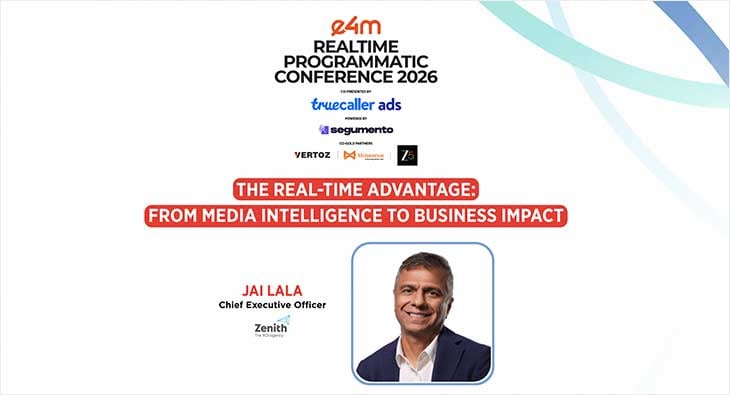

- At the e4m Realtime Programmatic Conference 2026, Jai Lala, CEO of Zenith, emphasized a shift in digital advertising from media intelligence to accountability for business outcomes in real time.
- Lala highlighted that marketers are now expected to demonstrate a clear link between advertising investments and commercial results, focusing on metrics like acquisition cost and ROI.
- The planning of campaigns is evolving towards continuous optimization based on live data, allowing brands to respond to real-time events and consumer behavior more effectively.
- Lala discussed the role of AI in enhancing marketing intelligence and facilitating human judgment, while also advocating for a unified approach to consumer measurement across fragmented media platforms.
At the e4m Realtime Programmatic Conference 2026, Jai Lala, CEO, Zenith–The ROI Agency, used his Spotlight Session to underline a fundamental shift taking place in digital advertising: programmatic is no longer just about making media buying smarter. It is increasingly about making marketing accountable to business outcomes in real time.
Speaking on ‘The Real-Time Advantage: From Media Intelligence to Business Impact’, Lala said the biggest change has been the move away from media intelligence as an end in itself. “Digital advertising programmatic was all about media intelligence,” he said. “But the shift which is happening is towards business impact.”
At the heart of that shift, according to Lala, is the changing mandate of the CMO. Brand awareness, creative quality and brand health continue to matter, but marketers are now expected to demonstrate a much clearer link between advertising investment and commercial results.
“Now it is all about acquisition cost, it is all about what ROI you're delivering, what is the business impact,” he said.
As commerce has moved online and the distance between marketing exposure and purchase has narrowed, marketing itself has become far more accountable. “Every funnel is accountable for that; every rupee spent has to lead towards growth,” Lala noted.
That accountability is also changing how campaigns are planned. The old model of making a media plan, running it for weeks and reviewing the data later is rapidly giving way to continuous optimisation based on live signals.
Search trends, content consumption, social conversations, commerce behaviour, weather and major cultural or sporting moments can all feed into campaign decisions in real time.
Using the IPL as an example, Lala explained that brands no longer need to think only in terms of buying inventory around an entire tournament or series. They can respond to individual moments as they happen.
“The moment a signal is received, a moment is happening, it's just at a click of a button, you release the creative,” he said. What once involved a long approval cycle can now be pre-planned, with messaging dynamically altered according to the event.
He cited Maggi and Nescafé as examples of weather-triggered communication. A rainfall signal can prompt “baarish wala Maggi” messaging in a particular geography, while Nescafé can shift between hot and cold coffee communication depending on temperature.
The larger implication, Lala said, is that advertisers are moving beyond conventional media-cost benchmarks. Clients increasingly want to know how many leads, sales or store visits a campaign delivered rather than simply whether impressions were bought cheaply. “It is no longer about looking at how cheaply we are buying, but it is more about what value you are trying to bring to the equation,” he said.
AI is central to enabling this transition, but Lala cautioned against viewing its role merely through the lens of speed and automation. “The real difference which AI is making is that it is making it towards intelligence,” he said.
AI can automate platform selection, budget allocation, optimisation, prediction, anomaly detection and reporting. Live dashboards can make campaign information instantly available instead of forcing teams to wait weeks for reporting. But Lala argued that automation should create more room for human judgment rather than replace it.
He described this through a three-layer framework: “Human Minus”, “Human Plus” and “Human X”.
Human Minus refers to repetitive work such as reporting, data collation and dashboarding that can largely be automated. Human Plus is where AI does the heavy analytical lifting and people apply interpretation and strategic judgment. Human X, he said, is the “sweet spot,” where human intelligence and AI combine to create something that may not otherwise have been possible.
Lala illustrated the idea with a Cathay Pacific campaign. Using AI, the airline could identify real-time consumer complaints about rival carriers (such as food or seat space) and serve contextual Cathay messaging near competitors’ boarding gates. “The money spent was very little, but the intelligence was extremely high,” he said.
This, for Lala, is also the answer to concerns over AI replacing people. “AI is going to make your jobs much easier. You will now have to think a lot more and come up with that intelligence to deliver that because AI alone cannot do that.”
At the same time, the media ecosystem itself is becoming increasingly fragmented across TV, connected TV, OTT, YouTube, social and other digital platforms. That makes it harder for advertisers to balance scale, relevance and speed without creating complexity.
Lala argued that brands therefore need a “one decision framework” in which consumers are viewed as a single audience rather than as separate “YouTube audiences” or “Meta audiences”.
“There has to be a common measurement and then it has to have a common learning loop,” he said.
That becomes especially important because the consumer journey is no longer linear. People may move directly from discovery to purchase, skip traditional consideration stages or interact with multiple channels in unpredictable sequences.
For Lala, this is why programmatic itself needs to be redefined. “Programmatic is no longer only about media buying. It is moving to a media decisioning,” he said.
The new model continuously connects audience signals, creative choice, media selection, commerce outcomes, measurement and learning. Personalisation, too, is moving from “one creative for many” towards one-to-one communication.
Ultimately, Lala said, the opportunity lies in shrinking the distance between consumer behaviour, data and brand action.
“We need to close the gap between what consumers are doing and what the data is telling us and what the brand does next,” he concluded. “This is the loop which all brands are trying to operate in, in a given dynamic environment.”
Read more news about Digital Media, Internet Advertising, Marketing News, Television Media, Radio Media
For more updates, be socially connected with us onInstagram, LinkedIn, Twitter, Facebook, YouTube & Google News
