AI can deliver scale, but human insight will build brand love: Marketing leaders
At e4m Pitch CMO Summit, industry leaders discussed why cultural intelligence, emotion and trust must remain central to AI-powered marketing
 by
by
Published: Sep 10, 2026 11:43 AM | 7 min read
 Follow Us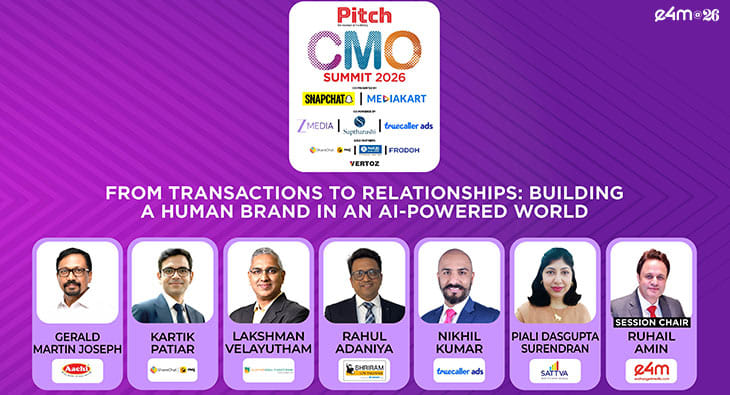

- A panel discussion at the e4m Pitch CMO Summit in Bengaluru highlighted the limitations of artificial intelligence (AI) in replicating human emotion, cultural understanding, and trust in marketing, despite its ability to analyze data and create content rapidly.
- Industry experts from various sectors, including food, social media, and insurance, agreed that while AI can enhance human capabilities, the essence of brand relationships relies on relevance, transparency, and understanding of consumer experiences.
- Speakers emphasized the importance of balancing AI efficiency with human cultural intelligence, noting that AI-generated insights must be validated through real-world experiences to avoid fragmentation of brand identity.
- The consensus was that AI should be used for tasks like data analysis and content generation, while human judgment remains crucial for fostering emotional connections and trust with consumers.
Artificial intelligence can help brands analyse data, personalise communication and create content at unprecedented speed, but it cannot independently replicate human emotion, cultural understanding or trust.
That was the broad consensus at the panel discussion, “From Transactions to Relationships: Building A Human Brand in an AI-Powered World,” held at the recent e4m Pitch CMO Summit in Bengaluru.
The session brought together Gerald Martin Joseph, Senior General Manager - Marketing, Aachi Masala Foods; Kartik Patiar, Senior Director - Clients, ShareChat; Nikhil Kumar, Sales Director, Truecaller; Piali Dasgupta Surendran, Vice President - Marketing, Sattva Group; and Rahul Adaniya, Head of Marketing, Shriram Life Insurance.
Moderated by Ruhail Amin, Senior Editor, BW Businessworld and exchange4media, the discussion examined whether AI can make marketing more human, where brands must draw the line on automation, and why human judgement could become more valuable as synthetic content proliferates.
Across food, social media, communication technology, insurance and real estate, the speakers agreed that AI worked best as an amplifier of human capability. The relationship itself still depended on relevance, transparency and a brand’s ability to understand lived experience.
Opening the conversation from the perspective of a traditional food brand, Gerald Martin Joseph said the category was shaped by three fundamentals: taste, distribution and availability. While AI could identify broad consumption patterns, it could not completely understand something as subjective and culturally nuanced as taste.
“AI can give you a general idea. It can tell you that people in Andhra Pradesh like spicy food, but it cannot tell you exactly how much spiciness they like. You have to take it with a pinch of salt - or masala,” said Gerald Martin Joseph.
Joseph explained that sambhar preferences could change across neighbouring markets. Consumers in Karnataka might prefer a ready-made spicy formulation, while those in Andhra Pradesh might want to control the spice themselves. AI insights therefore required on-ground validation.
Aachi Masala Foods uses AI for repetitive work, sales-data analysis and competitive comparisons. Joseph, however, cautioned that excessive personalisation could fragment a brand’s identity. The company differentiates between traditional consumers and a younger “two-minute” generation seeking instant products.
Joseph said Aachi Masala Foods recently used real models for two traditional masala advertisements and AI for two instant-product campaigns. “For a longer format and a traditional product, we prefer real-life models,” said Gerald Martin Joseph.
Bringing in the social-media perspective, Kartik Patiar said creators offered more than content. “Creators build authentic social relationships with their communities. They bring a human touch, create meaningful content and do it consistently,” said Patiar.
Patiar said ShareChat’s language-first and culture-first approach helped hyperlocal creators build communities. AI could expand their reach through multilingual adaptation and personalised messages, but cultural intelligence and emotional connection must originate with the creator.
“The right balance will be human cultural intelligence combined with AI efficiency. We see AI as a superpower that we can give to our creators,” said Patiar.
Patiar also explained ShareChat’s micro-drama offering, launched less than a year earlier, was generating around 950 million daily episodic views. With demand outpacing supply despite licensed and original shows, AI-generated content could supplement human-led production.
AI was also revealing emerging audience preferences. Patiar cited millionaire dramas and rags-to-riches narratives as distinct genres whose popularity was being identified through consumption data and then used to inform future content slates.
For marketers, Patiar argued, translation alone was insufficient. “Don’t translate; transcreate. Humour in one market can be very different from humour in another. A literal translation can have a disastrous outcome if it does not understand the cultural context,” said Patiar.
ShareChat combines language, content preferences, followed creators and participation in local festivals into a “cultural intelligence layer”. Patiar said marrying this “culturegraphy” with demographic data could improve effectiveness and brand affinity.
Nikhil Kumar said Truecaller viewed AI and human engagement as parallel engines rather than opposing forces. While most brands closely monitored return on investment and return on advertising spend, relatively few considered their “return on brand trust”.
“For us, the first reference point is trust and safety. AI comes second as a way of facilitating that trust,” said Kumar.
AI helps Truecaller organise communication signals and identify relevant audiences. Calling behaviour, SMS short codes and app-usage patterns could move advertisers from assumptive to more deterministic targeting, while frequency controls could prevent advertising fatigue.
Kumar also discussed Truecaller Pulse, which helps brands research consumer expectations before a campaign. “There is no point targeting someone who does not need the product. AI must help us find the relevant user,” said Kumar.
India remained a “warm economy” where people valued human conversation, Kumar observed. Truecaller’s role was to ensure a safe, identifiable person was behind a call. Kumar cited over 500 million users globally, including more than 300 million in India.
Rahul Adaniya recalled an AI-led life-insurance film about a claim being settled after a policyholder’s husband had died. Although the film conveyed the required information, it failed to create the intended emotional impact.
“It was communicating the message and serving the rational purpose, but it was not touching the heart,” said Adaniya.
The team consequently made a shoot-based film, distinguishing rational information from communication expected to build an emotional bridge.
Adaniya said AI could still help insurers analyse behaviour, create customer cohorts and personalise messages without appearing intrusive. As consumers increasingly used conversational AI to compare products, and journeys became easier to copy, trust would become the differentiator.
“Products can be copied and journeys can be copied, but trust takes time to build. It cannot be created only through rational communication; it has to be built through emotion,” said Rahul Adaniya.
For a recent Shriram Life Insurance campaign, Rahul Dravid was recorded for about 30 minutes against a green screen. Adaniya said the system learnt Rahul Dravid’s expressions, lip movements and speech, enabling multiple scripts and languages at around 30 per cent of traditional production costs.
Leo Burnett developed the campaign’s proposition and script. “The proposition came from a human problem and a human insight; AI helped us deliver it at scale and cost-effectively,” said Adaniya.
Adaniya said the experiment also taught the team to be patient: machine learning required time at the training stage, but once that learning was completed, adaptation and production became considerably faster.
Piali Dasgupta Surendran said AI could assist real-estate companies at the beginning of the customer journey but could not replace the physical and emotional experience of buying a home.
Sattva Group had recently launched its first fully AI-generated brand film. Surendran said it took approximately four months because fixing one element frequently disrupted another. Despite these AI hallucinations, the film reportedly saved close to 90 per cent of conventional production costs.
“AI is a scalable tool and is giving us significant production efficiency. But it is still synthetic. Great marketing is about human insights and human intelligence, and that is something AI cannot replace today,” said Surendran.
The limitation was clearer in real estate, a high-value decision where customers wanted to visit the site, see the model apartment, meet the sales team and involve their families. An AI-generated advertisement might initiate contact, but the journey quickly became human.
Surendran said AR and VR, widely used during the pandemic, now primarily served NRI buyers. Whether a virtual representation matched the completed property ultimately depended on the developer’s credibility and ability to honour its specifications.
“The brand experience starts when the person walks in for a site visit. Was the customer made comfortable? Were all the questions answered? Were you transparent enough to help the customer decide?” said Piali Surendran.
Surendran also said that 60 to 70 per cent of Sattva Group’s referrals came from existing residents. Piali Dasgupta Surendran also warned that using AI merely for volume risked creating an ecosystem where “AI is talking to AI” and substance disappears.
The panellists concluded that brands should use AI for speed, analysis and scale while reserving human judgement for culture, emotion and trust. As Gerald Martin Joseph observed, knowing where to use AI - and where not to - would become the premium human capability.
Read more news about Marketing News, Advertising News, PR and Corporate Communication News, Digital News, People Movement News
For more updates, be socially connected with us onInstagram, LinkedIn, Twitter, Facebook, YouTube & Google News