Data to Permission: Why Gowthaman Ragothaman says consent will reshape marketing
At the Pitch CMO Summit, Gowthaman Ragothaman said that as India moves towards stricter consent management, brands will increasingly need explicit permission to use personal data for marketing
 by
by
Published: Sep 3, 2026 4:08 PM | 5 min read
 Follow Us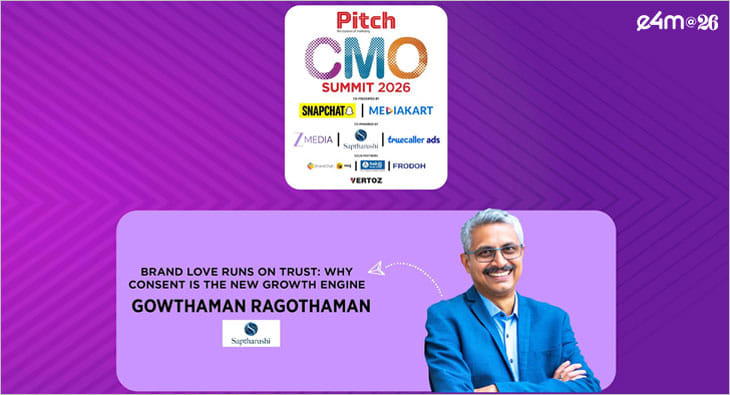

- Gowthaman Ragothaman, CEO of Saptharushi, emphasized at the Pitch CMO Summit that the future challenge for marketers will be obtaining permission to use consumer data, rather than merely accessing it.
- He identified a "permission wall" emerging alongside existing barriers like the "platform wall" and "signal wall," highlighting the need for explicit consumer consent as data protection regulations tighten in India.
- Ragothaman proposed that consent should be treated as a marketing opportunity rather than just a legal obligation, suggesting that brands must demonstrate ongoing value to maintain consumer engagement and consent.
- He predicted that new metrics, such as "withdrawal rates," will become important for marketers to track consumer consent, and urged a shift towards more explicit and transparent consent practices in marketing strategies.
For marketers accustomed to thinking about data as an asset to be accumulated, Gowthaman Ragothaman, Founding CEO, Saptharushi, offered a different proposition: the defining challenge ahead may not be access to data, but permission to use it.
Speaking at a Spotlight Session at the Pitch CMO Summit in Bengaluru on September 3 on the theme “Brand Love Runs on Trust: Why Consent Is the New Growth Engine,” Ragothaman argued that the relationship between brands and consumers is entering a new phase in which consent will become central not just to compliance, but to growth, engagement and brand affinity.
He began by highlighting a paradox confronting marketers today. There is more consumer data than ever before, but marketers are finding it progressively harder to reach audiences effectively.
“There is more and more and more data, there is less and less and less addressability of the data,” he said.
Consumers routinely share phone numbers, email addresses and digital behavioural signals, often without fully understanding how those details might subsequently be used. Yet despite this proliferation of information, Ragothaman noted, marketers continue to struggle with audience identification and reach.
“So there is a paradox of more and more data, less and less and less reach,” he said.
According to him, marketers already operate within two familiar barriers: the “platform wall”, created by large digital ecosystems that retain their own consumer data, and the “signal wall”, which makes it difficult for brands to identify and target consumers accurately. A third barrier, however, is now emerging.
“What is coming now, soon, is the permission wall,” Ragothaman said.
As India’s data protection regime moves towards stricter consent management, he argued, brands will increasingly need explicit permission before using personal information for marketing purposes. Consent, in this environment, can no longer remain a clause buried within lengthy terms and conditions.
Ragothaman captured the shift in a particularly striking phrase: “Consent is now an API.”
His point was that consent is becoming an operational layer of the marketing technology ecosystem. Companies for which first-party data and customer signals are critical will have to build systems capable of tracking, recording and transferring consent in a structured way.
He compared the emerging architecture to the infrastructure that made digital payments interoperable in India. “It’s like a UPI interface,” he said, suggesting that consent could similarly become a standardised protocol connecting consumers and enterprises.
For brands, however, Ragothaman believes the bigger question is how they choose to respond. Consent can be treated as a legal obligation (something to document, manage and audit) or it can be treated as a marketing challenge.
“Either you treat consent as a legal problem, tick the box and ensure that you’re maintaining a record of managing consent. Or you treat it as a marketing problem so that you grow the consent,” he said.
The latter approach, he argued, is where brand love becomes critical. Consumers who see continuing value in their relationship with a brand are more likely to remain engaged and continue allowing the brand to communicate with them.
“More consented consumers, better engagement and therefore better brand love. If the consumer doesn’t love your brand, very likely he will revoke the consent,” Ragothaman said.
This leads to what he sees as a fundamental change in marketing economics. “We don’t have a data problem. I think we’ll all end up having a permission problem,” he said. “If the consumer doesn’t give you permission, you can’t reach them anymore.”
That could have significant consequences for the size of addressable audiences. Ragothaman used an illustrative example of 100 million tracked cookies potentially shrinking to 20 million under a consent-led environment if brands fail to retain permission.
The answer, he suggested, is sustained consumer engagement. Instead of assuming access to audiences, brands will have to continually demonstrate value, relevance and reciprocity.
He also predicted that a new marketing metric would emerge alongside familiar measures such as opt-ins and refresh rates.
“Mark my words, by next year… we will be talking about withdrawal rates as well,” he said. “How many of your consumers have withdrawn from your consent? It’ll become as much important as the opt-ins and the refresh rates.”
Ragothaman also outlined Saptharushi’s approach to the problem. Its model, he explained, is built around keeping consented consumer data within the company that owns it. Rather than transferring data between businesses, queries travel through an interface while the underlying information stays in place.
“Data doesn’t move. You ask queries,” he explained.
Those queries, he said, are recorded in an immutable ledger, creating provenance and accountability while allowing organisations to collaborate and develop a richer understanding of consumers without moving the underlying data.
For marketers, Ragothaman’s final recommendation was clear: rethink the way consent is currently bundled into broad terms and conditions. Marketing consent, he argued, needs to become explicit, transparent and purpose-specific.
Ultimately, however, technology and compliance were only part of his message. His closing line distilled the larger challenge facing brands as consumer control over data increases: “Attention is what you buy. Affection is what you earn.”
In a permission-led marketing environment, that affection may become more than a brand metric. It could determine whether a consumer continues to let a brand into their life at all.
Read more news about Marketing News, Advertising News, PR and Corporate Communication News, Digital News, People Movement News
For more updates, be socially connected with us onInstagram, LinkedIn, Twitter, Facebook, YouTube & Google News