AI can scale execution, but human judgment will remain indispensable, say marketers
At exchange4media and Skylight MediaKart's roundtable, marketers explored AI and the future of advertising
 by
by
Published: Aug 12, 2026 1:05 PM | 5 min read
 Follow Us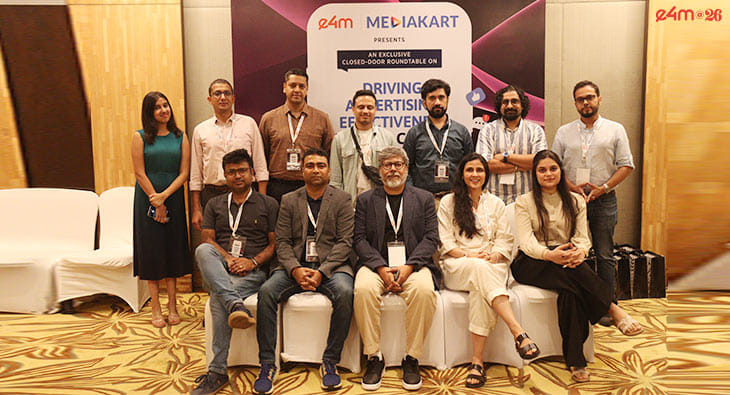

- A recent roundtable discussion on 'AI, Creativity and Context: The Future of Advertising' emphasized that while AI is transforming advertising execution, its greatest value lies in enhancing rather than replacing strategic thinking.
- Key themes included the importance of context, creativity, and consumer insight in capturing consumer attention amidst increasing digital clutter, with speakers advocating for innovation and meaningful communication.
- Marketers highlighted the shift from demographic targeting to understanding consumer intent through signals like search behavior and content consumption, underscoring the role of AI in delivering timely and relevant messaging.
- The conversation also addressed the balance between automation and human oversight, stressing that while AI can enhance efficiency and personalization, strategic decision-making still requires human judgment to avoid potential pitfalls.
Artificial intelligence is rapidly changing how brands create, personalise and optimise advertising, but marketers believe its biggest value lies in improving execution rather than replacing strategic thinking. As consumers become harder to engage amid fragmented media consumption and increasing digital clutter, context, creativity and consumer insight are emerging as key levers for brands seeking attention and business impact.
These themes took centre stage at exchange4media and Skylight MediaKart's roundtable on 'AI, Creativity and Context: The Future of Advertising', moderated by Shahad Anand, Business Head, Skylight MediaKart. The discussion brought together Raunak Rai, Digital Marketing Manager, KRBL India; Mohit Gupta, GM – Marketing Excellence, Bharti Airtel; Lakshay Katyal, India Marketing Lead – Premium and Flagship Phones, Motorola Mobility (a Lenovo Company); Vivek Shaw, Digital Head – North, Growth Cluster, WPP Media; Sajit Gopal, Head of Media, Domino's – Jubilant FoodWorks Ltd.; and Ratheesh MS, Vice President, Starcom.
Setting the tone, Anand highlighted the role of relevance in determining whether advertising is noticed or ignored. Drawing on examples ranging from parking signs to the ₹500 currency note and a personalised pen, he said consumers are more likely to respond when communication feels relevant to their immediate context.
"People pay attention when communication is meaningful, personalised, emotional and unexpected. Context creates relevance, while creativity creates emotion. Both are essential if brands want consumers to move from noticing an ad to acting on it," Anand said.
In telecom, meanwhile, innovation remains a critical tool for breaking through consumer inertia. Mohit Gupta, GM – Marketing Excellence, Bharti Airtel, said the category's basic proposition is already familiar to consumers, making meaningful innovation an important driver of attention.
"The biggest lever we have is innovation. Consumers are already familiar with the basic offering. What captures attention is introducing something genuinely new that solves a functional problem and improves their experience," Gupta said.
He added that communication ultimately needs to translate into a tangible consumer or business benefit, with the right contextual moment helping brands make that proposition more relevant.
For KRBL India, the challenge is balancing legacy with relevance among younger consumers. Raunak Rai, Digital Marketing Manager, KRBL India, said established brand messaging can be retained while the people and formats used to communicate it evolve.
"The brand message remains the same. It is the storytelling that changes. Amitabh Bachchan continues to drive the larger narrative, while newer faces help communicate the same proposition to Gen Z audiences," Rai said.
Rai pointed to the growing role of younger creators and stand-up comics in making established brand narratives more relatable to younger audiences, with humour and self-awareness increasingly becoming part of brand communication.
From an agency perspective, the shift is towards understanding consumer intent rather than relying primarily on demographic profiles. Vivek Shaw, Digital Head – North, Growth Cluster, WPP Media, said signals such as search behaviour, content consumption, commerce behaviour and even weather are becoming increasingly relevant to media planning.
"The industry has shifted from media transformation to business effectiveness. Context is becoming the key differentiator. Today, someone reading about energy-efficient air conditioners during a heatwave is far more valuable than someone who merely fits a demographic profile. AI helps us analyse these signals faster and deliver the right communication at the right moment," Shaw said.
However, as AI takes on more of the analytical and executional workload, marketers are also confronting a new challenge: ensuring that automation does not come at the cost of judgment.
This is particularly relevant as search evolves into AI-led discovery. Ratheesh MS, Vice President, Starcom, said brands now need to think beyond traditional SEO and optimise for AI-generated answers.
"Earlier we used to look at SEO. Now SEO has changed to Generative Engine Optimisation. People are not looking at Google rankings anymore; they are looking for answers," Ratheesh said.
He noted that if consumers increasingly ask AI platforms questions such as which is the best basmati rice in India, brands will need credible content, influencer validation and contextual placement to improve their chances of being recommended.
For Motorola Mobility, AI is also expanding the scope of contextual marketing beyond advertising into the wider consideration journey. Lakshay Katyal, India Marketing Lead – Premium and Flagship Phones, Motorola Mobility (a Lenovo Company), said AI is helping brands tailor communication across search, listings, CRM and other touchpoints based on what consumers are looking for.
"Consumers are researching products across multiple touchpoints before making a purchase. AI is helping us customise communication throughout that journey rather than simply targeting people with ads. Context is becoming much broader than advertising alone," Katyal said.
At the same time, he cautioned that automation cannot eliminate human oversight, particularly when brands are dealing with large volumes of online conversations where incorrect contextual decisions can quickly escalate.
For Domino's – Jubilant FoodWorks Ltd., AI's immediate value is visible in productivity and speed. Sajit Gopal, Head of Media, Domino's – Jubilant FoodWorks Ltd., said the technology is increasingly helping teams manage information and execution more efficiently, but that faster output also raises the risk of faster errors.
"AI makes execution much faster, but it also makes mistakes faster. It pushes brands to become clearer about their objectives, processes and measurement. Without strong human judgment, the speed that AI provides can quickly become a disadvantage," Gopal said.
The discussion pointed to a changing role for marketers. AI can accelerate execution, personalise communication and help analyse consumer signals at scale, but the strategic questions around what a brand should say, why it should say it and when it should say it continue to require human judgment.
The Skylight MediaKart roundtable highlighted how AI is becoming an increasingly important part of advertising, with brands and agencies exploring its potential across personalisation, contextual targeting, creative execution and consumer engagement. The discussion also highlighted the questions marketers are grappling with around relevance, human judgment and creativity. Through such conversations, Skylight MediaKart has been trying to raise awareness around emerging trends by bringing marketers and industry leaders together to exchange perspectives, learn from each other and drive innovation in digital advertising.
Read more news about Marketing News, Advertising News, PR and Corporate Communication News, Digital News, People Movement News
For more updates, be socially connected with us onInstagram, LinkedIn, Twitter, Facebook, YouTube & Google News