Marketers on how brands turn audience complexity into loyalty and impact
At the Pitch CMO Summit 2026, brand leaders explored how India's cultural diversity is reshaping marketing strategy and why the old book of rules no longer holds
 by
by
Published: Jun 10, 2026 3:08 PM | 11 min read
 Follow Us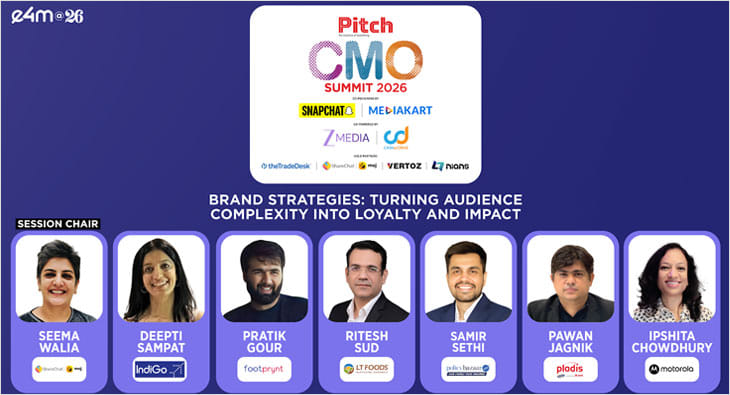

- At the Pitch CMO Summit, marketing professionals discussed the complexities of building brand loyalty in India's fragmented consumer landscape, emphasizing the need for culturally nuanced strategies that resonate with diverse regional identities.
- Panelists highlighted the importance of understanding local cultures and consumer behaviors, arguing that assumptions based on demographic data can lead to stereotyping and ineffective marketing.
- The shift from celebrity influencers to regional creators was noted as a key trend, with regional voices providing authenticity and a sense of belonging that appeals to consumers.
- The discussion concluded with varying perspectives on brand loyalty, acknowledging its elusive nature in a fast-paced market, while stressing the significance of meaningful consumer experiences in fostering long-term connections.
India's consumers have never been easy to pin down, but the speed at which they are fragmenting, across platforms, geographies, languages, and life stages, has made the marketer's job considerably harder. At the Pitch CMO Summit, a panel discussion titled "Brand Strategies: Turning Audience Complexity Into Loyalty and Impact," practitioners sat down to examine what it actually takes to build a brand in this environment.
The panel brought together Deepti Sampat, Vice President – Marketing and Digital at IndiGo; Ritesh Sud, Chief Marketing Officer – India and Far East at LT Foods; Pawan Jagnik, Head of Marketing at pladis India; Ipshita Chowdhury, Marketing Head at Motorola India; and Pratik Gour, Co-Founder of Footprynt. The session was moderated by Seema Walia, National Sales Head – Agency and Government at ShareChat and Moj.
The consumer journey, as Walia framed it at the outset, is not linear anymore. Before buying a mobile phone or even an edible, today's consumer visits ten platforms, compares prices, reads reviews, and then decides. The complexity is known. What's less understood is how brands are responding to it.
Walia's opening provocation cut to the heart of it. Are marketers oversimplifying the problem of culture versus language, personal versus relatable?
Chowdhury thought so. "The word culture itself gets misused. A fad or a moment in time is not culture. Culture is something deeply rooted in the fundamental socioeconomic histories of communities," she said.
Her concern was with the tendency to treat tier 2 as a single, undifferentiated cohort. "Tier 2 of the East is very different from tier 2 of the South. Their sensibilities, their purchasing powers and everything else is different. What is perhaps common is aspiration. That is the one thing India shares today. It is a young, aspirational country." But the point from which that aspiration begins, she argued, is rooted in culture, and that has to determine the language, the tone of voice, and what she called "the grammar of storytelling."
Sud gave a reality check on the topic. "The briefs are getting written in metro towns by teams from metro cities, and consumer research typically happens in Delhi or Mumbai. We are all guilty of it. I do not remember the last time we did research in rural India."
A 28-year-old in Gorakhpur and one in Delhi might both be on Instagram and buying in the same category, but what drives them is completely different. "It is important that they feel connected to the brand. That is the missing piece."
The conversation turned naturally to food, which is perhaps the most visceral expression of regional identity in India. Sud's brand carries Hyderabadi, Kolkata, and Lucknowi biryanis in its portfolio, each a cultural marker in its own right. "Biryani is not just a food item. It is a regional identity, an emotion," he said. "Asking someone from Kolkata to celebrate with Hyderabadi biryani is a bit like asking an RCB fan to cheer in a Delhi jersey."
What demographics tell you, he argued, is who the person is on paper. Culture tells you what they feel, what they love, what inspires them, and how they celebrate. "That is where you touch their hearts and those are the things that drive genuine purchase decisions."
On the risk of stereotyping, which is always a thin line in culturally nuanced advertising, Sud highlighted that the root cause was assumption. "Stereotyping happens when you assume. You impose a preconception onto a certain cohort of consumers."
The antidote is not more research reports but presence. "There is no better place to learn than being in the market, through food rituals, how communities celebrate festivals, through music. Punjabi music is very different from music in South India. These are the places where real cultural nuance lives."
Agreeing with Sud, Jagnik added that India's diversity is a commercial opportunity, not merely a creative challenge. "India is a land of many cultures, and that is an opportunity for brands. In the biscuit industry, a fifty to sixty thousand crore market, even if you target one state and get your tonality and your understanding of the consumer problem right, it is a real opportunity." He also pointed out that better access has made it easier for smaller brands to make a meaningful dent. Many cultures mean many entry points.
Gour took the discussion forward with something he had heard only the week before, from a podcast called Teen Taal. A speaker on the show made the observation that while we are living in 2026, a district in Jharkhand might effectively be living in 1996 or 2006. "The danger is assuming that because the internet is in everybody's hands, we are all consuming the same kind of content," Gour said. "What we consume sitting in this thirty square kilometre radius is completely different from what someone consumes 150 kilometres away."
According to him, every brand manager working in India is, by definition, equipped to work anywhere in the world, because they are navigating entirely different cultures at every level simultaneously.
He punctuated his arguments with examples. A former client, Emami, once moved away from his agency because, while he had four Bengali-speaking team members, two were from CR Park in Delhi and two from Mumbai. The client needed someone from Kolkata itself.
An OTT client promoting Bengali content had a similar requirement. The vice president of that division insisted the promotional material had to reflect the way the language is actually spoken, not a polished approximation of it. He drew the conclusion from these experiences that as communication trickles down to specific audiences, it must be truly rooted in their reality, not a metro team's best interpretation of it.
Sampat spoke to how this plays out at the level of lived experience. At IndiGo, serving regional food on flights is more than just a menu decision. It is a brand decision. "When you serve food from a passenger's particular region, there is a certain familiarity you are bringing to the consumer and an instant connection is built," she said. The in-flight experience, in that sense, is itself a form of storytelling, one that operates independently of, and in complement to, any advertising campaign.
From cultural nuance, the panel moved to the shift in how brands are choosing to communicate specifically, the move from celebrity influencers to regional creators.
Chowdhury offered a story from a market visit in Kolkata. She met a housewife who used her Motorola device to film cooking videos every day and had built a YouTube following of 35,000 people. "We do not realise, when we create campaigns, how empowering a device can be," she said. "That fine line between who audiences relate to, celebrities whom they look up to or the next-door person who has a good story to tell, is what is driving today's creator economy."
Regional creators bring a kind of authenticity that campaigns often cannot manufacture and brands need to leverage that fully.
Putting it more precisely, Sud added, "What celebrities can bring you is reach. What regional creators and influencers can bring you is belonging." At the end of it, he said, the consumer is seeking validation. They want to know if there are other people like them who trust this brand.
He also pushed back against the instinct to over-script creators. "Instead of writing scripts for them, let them absorb the brand's essence and express it in their own way. Otherwise, you see the same reels everywhere."
Gour recalled working with Asian Paints nearly six years ago, when micro-influencers were barely in fashion. The client insisted on finding painters across different parts of the country, craftspeople doing 45-minute YouTube videos in Hyderabadi slang or Tamil, showing how to use tools and where to find products locally. "That is when we realised that regional creators give you a sense of belonging. If Asian Paints is working with someone like me, someone I recognise, then I can see myself choosing to work with Asian Paints too." The connection is one that even a well-funded ad campaign might fail to create at the distributor's level.
The panel also addressed the rise of micro-drama and newer content formats. Sampat took the stage and shared, "It is our job as marketers to experiment. Audiences are becoming micro-audiences, and the strategy depends on where that cohort is and what the business objective is, whether you are promoting business class or reaching a first-time flyer in tier 2."
Sud, who admitted he got personally hooked on micro-drama six months before the session, noted that for FMCG and food products especially, the format allows brands to integrate far more naturally than a 30-second ad ever could. Jagnik's approach was budgetary. If your next set of consumers is watching micro-drama, you go there; if they are not, you do not.
On measurement, the panel found rough consensus on the fact that metrics matter, but the way they are applied can suffocate creativity. Gour acknowledged that engagement numbers do not lie and that CFOs will always demand accountability for spend. "But if everything gets reduced to numbers, marketing just becomes another function. There is a lot of creativity involved, and when we only look at numbers, that part gets defeated." His longer view is that if someone remembers a campaign five years from now, that is the real measure of whether it worked.
Jagnik's approach was to pre-align with the CEO and CFO before a campaign launches, setting a clear framework and checking against it every six months. "The ultimate measure is revenue. If you have defined what you are trying to achieve over the next two years and you are tracking it honestly, you should be able to take a call."
Chowdhury agreed, but resisted the idea that measurement and creativity are fundamentally at odds. "Creativity and accountability should work together, and they can. If our strategy is clear and we know where we want to go, we can get there creatively."
Offering the sharpest analogy for over-attribution, Sud said, "Pinning success to a single metric is like rewarding the waiter for a dish the chef spent three hours making. The consumer's moment of truth could have happened anywhere, be it a WhatsApp message from a neighbour or a creator's video. You have to look at the full picture."
The session closed on loyalty, which was perhaps the most contested concept in the room. Each panellist approached it differently.
Sampat saw it as sequential where experience came first, then consistency, then trust. In aviation, where product and price parity are real, the only true differentiator is how the journey feels. "I will come back and make an airline my preferred choice only if the experience is good. The delivery of the brand promise at every touchpoint is what the consumer will feel and that, over time, builds trust."
Offering a more behavioural reading, Gour argued that with attention spans shrinking, what ultimately matters is the first impression and the last. "The first impression, whether it is the first click on an ad or walking into a store, and the last impression, which is the product or service itself matter the most. If both work really well, the consumer tends to remain loyal for far longer than they otherwise would."
Jagnik's litmus test was to take a price increase and see who comes back. For a brand like McVitie's, where a pack costs ten rupees, loyalty is hard-won and easily lost. His prescription for building it was to pick one battle, own one space, and stay absolutely consistent across every touchpoint. "In our case, wherever digestive biscuits are available, we want McVitie's to be the name that comes to mind."
Being the most candid about the concept itself, Chowdhury shared, "Loyalty is elusive in today's world. It is something we all chase but is it really there?" In the age of quick commerce, she noted, consumers default to whoever solves the problem in the moment. But there are exceptions. A brand that delivered something a parent desperately needed for their child at midnight will be remembered long after. "Those small, meaningful experiences are perhaps what create loyalty. But it remains elusive."
It was a fitting note to close on. She was honest about how hard the thing actually is, even as every brand in the room keeps reaching for it.
Read more news about Marketing News, Advertising News, PR and Corporate Communication News, Digital News, People Movement News
For more updates, be socially connected with us onInstagram, LinkedIn, Twitter, Facebook, YouTube & Google News