Marketers say instinct still wins the breakthrough, even in the age of AI
At e4m TechManch 2026, brand heads discussed that while algorithms can optimise speed, efficiency & scale, breakthrough ideas, emotional resonance & brand memorability still depend on human intuition
 by
by
Published: Jul 27, 2026 8:22 AM | 12 min read
 Follow Us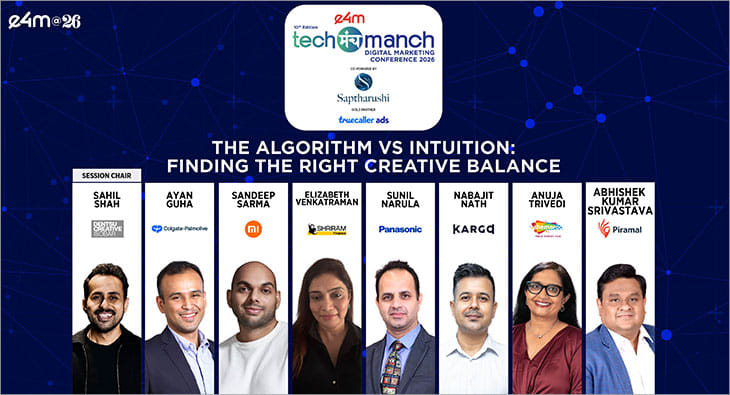

- At the e4m TechManch 2026 panel titled "The Algorithm vs Intuition: Finding the Right Creative Balance," brand leaders discussed the role of AI in marketing, emphasizing the need for a balance between algorithmic efficiency and human intuition in creative decision-making.
- Panelists highlighted significant changes brought by AI in their organizations, including improved talent density, efficiency, speed, and the shift of AI from an IT tool to a business enabler, while also noting the continued importance of human creativity in breakthrough campaigns.
- The conversation touched on the necessity of marketing to algorithms and shopping assistants, with panelists agreeing that while algorithms influence consumer choices, trust and engagement remain crucial for brand visibility and memorability.
- Concerns were raised about the potential for AI to produce more content without enhancing its memorability, with a consensus that while AI can assist in routine tasks, the creation of truly original and impactful ideas still relies heavily on human input and intuition.
At e4m TechManch 2026, brand leaders debated how far algorithms should be trusted with creative decisions, and where human judgement still cannot be automated.
The panel titled "The Algorithm vs Intuition: Finding the Right Creative Balance" was moderated by Sahil Shah, CEO, Dentsu Creative Isobar. It featured insights from Ayan Guha, Director – Marketing, Colgate-Palmolive; Sandeep Sarma, Associate Director – Marketing & PR, Xiaomi; Elizabeth Venkatraman, Executive Director & Head of Marketing, Shriram Finance; Sunil Narula, Senior Vice President, Marketing and Sales Strategy, PEWIN, Panasonic Life Solutions India; Nabajit Nath, Sales Director, Kargo; Anuja Trivedi, Chief Strategy & Marketing Officer, Shemaroo Entertainment; and Abhishek Kumar Srivastava, VP Marketing (CMO), Piramal Consumer.
Shah opened by declaring himself an unabashed AI enthusiast, convinced that the technology is only going to reshape marketing further from here. He asked each panellist to name the single biggest change AI had brought to their organisation.
For Guha, the answer was talent density. "There were A-class players and B-class players, and the gap between them ran along four vectors, like creativity, visualisation, and analytics," he said. "The gap has narrowed because of tools like Gemini and Claude. A-class players now have to try harder, and B-class players have caught up. It's become a virtuous cycle."
Sarma pointed to efficiency instead, noting that Xiaomi prides itself on being "probably the most efficient" player in its category, and that AI has let the organisation push that advantage further while freeing up time for creative work.
Venkatraman named speed as Shriram Finance's biggest shift. Work that once took 24 hours now returns in one, she said. "Decks look cleaner, and it's not costing us the hours it used to," she added, recalling that in earlier years large presentations were sometimes outsourced for formatting alone. They have seen that dependency completely disappear.
Narula agreed, adding that ideas which once took considerable time to develop can now be sketched out and refined far faster. Nath framed the change in terms of what it has reinforced rather than what it has replaced. For Kargo, AI has made the case for "memorable ads on clean inventory" even stronger. Trivedi described a mindset shift at Shemaroo, AI moving from an IT initiative to a business enabler, something the whole organisation now owns.
Srivastava answered the question by talking about an internal framework where work is assessed on how repeatable it is and how sensitive the underlying data is. "In pharma and healthcare, boundary conditions are tightly defined. You can't just say anything," he explained. "Anything highly repeatable and low-to-mid sensitivity is where AI is creeping in on a daily basis, performance creatives, analytics, even presentations. Three of my presentations this morning were AI-assisted." Where data sensitivity is high, human intervention still dominates, though he expects that to shift within a year.
From there, Shah turned to where AI sits in the consumer's own decision-making, pointing out that people arguably spend more time choosing a show to watch than a toothpaste to buy, and asking whether brands will eventually need to market to algorithms and shopping assistants rather than to people.
Srivastava's answer was that it's both. "What you see isn't decided by you, it's the algorithm deciding what you watch, what content, what communication reaches you," he said. "You can't say I'm going to ignore the algorithm and just build my brand my way because it won’t work." He suggested thinking of the algorithm as a shelf. Brands still need to be placed on it, but trust and engagement are what get a consumer to actually pick the product up once they're there. Being off the shelf altogether, means not being seen at all.
Trust came up again when Shah turned to BFSI, asking Venkatraman whether consumers respond differently once they know AI has had a hand in a campaign. She pointed to Shri Aarambh, a recent campaign for commercial vehicle loans aimed at truck drivers and fleet owners, which she said had been unusually well received within the industry.
The process, though, ran counter to how such campaigns are typically built. "The animation itself came from pure intuition and creativity, AI came in after that," she said. Rather than shooting the full campaign and treating it as finished, the team generated it in stages and tested each one with actual drivers at Transport Nagar. "In a way, we co-created it with our consumers," she said, describing roughly six or seven rounds of testing before the campaign was finalised, a use of AI to sharpen a human-led idea rather than the other way round.
Shah then asked Narula to speak to the scale at which Panasonic's electrical business operates, and where AI fits into it. Roughly 175,000 electricians and 200,000 retailers sit on the network, alongside 4,000 direct channel partners, with 45–50 million transactions taking place between retailers and electricians each year. On top of that, the company brands close to 42,000 outlets annually and runs around 10,000 meets reaching some 50,000 electricians and retailers. "In order to get the bang for the buck on every rupee we spend, all of that data needs to come together," Narula said, revealing that the organisation is currently building a unified data lake, with AI expected to sit on top of it. Once that's in place, he said, the real return on marketing spend will finally become visible, something spreadsheets alone were never going to deliver.
The conversation then moved to Colgate, with Shah pointing out that iconic brands are rarely built on optimisation but on creative leaps, and asking Guha when, in today's data-saturated environment, instinct still overrides evidence. His answer reached back two decades, to the "Kya aapke toothpaste mein namak hai" ("Does your toothpaste contain salt") campaign. "All the data pointed the other way. It was pure instinct," he said. "Twenty years later, it's a ₹60-crore-plus brand and market leader in the south." He argued that breakthrough thinking is where instinct takes over from data.
Next in the discussion, Sarma offered his view on whether Xiaomi's position at the intersection of technology, creators and community had made its marketing more effective. "Yes and no," he said. Data has sharpened targeting and made the organisation more efficient at identifying who to reach, but it hasn't replaced intuition, particularly when it comes to explaining what a device can actually do.
"Any data AI relies on is, by definition, old. You can't use it to define a campaign that's launching months or a year from now," he said, describing an internal tension where go-to-market teams point to data while others argue for instinct, with instinct, he added, "more often than not" winning the debate.
The tension between efficiency and memorability surfaced again when Nath was asked whether marketers have become so focused on efficiency that memorability has quietly been deprioritised. "We haven't undermined memorability, but digital is so good at efficiency that we over-index on it," he said, pointing to a reflexive fallback on performance metrics even for launches or teasers.
Kargo's response has been to partner globally with platforms including ChatGPT Ads and Amazon DSP as their exclusive creative partner, positioning the company to supply the memorability that pure performance media can't. He recalled pitching a major QSR brand on clicks and attribution data, only to be told the client already had the reach and the budget for that. "What he wanted was for someone watching football at midnight to look at his burger and salivate," Nath said. "He didn't want attribution. He wanted salivation."
Asked whether cheaper, faster AI-generated content makes emotional originality more valuable rather than less, Trivedi said, "AI will make a lot more content available, but what stays with a consumer is the story, not whether five different AI agents were used to make it." Shemaroo, now 60 years old, has lived through several technology shifts, from video cassettes to satellite television to digital and OTT, now AI, and in each case, she said, the audience for its content has only grown, while what makes a story memorable hasn't changed at all.
Srivastava pushed back, at least partially. He challenged the panel to recall the last ad they'd seen on Instagram or Meta. "Ninety per cent of these creatives are performance creatives. They're not putting the brand at the centre of what they're trying to say," he said, attributing this to quarterly pressure to demonstrate performance rather than brand-building. "Memorability has gone down. We still remember the best ads from ten years ago, five years ago." AI, in his view, is currently helping produce more content but not necessarily more memorable content, a gap the industry still needs to close.
Pressed on whether AI could eventually originate genuinely breakthrough creative thinking, rather than simply optimising what already exists, Srivastava was more optimistic about the trajectory than the present moment. "I have complete confidence there will be far more memorable work that AI helps us produce," he said, describing today's agentic AI use as concentrated in analytics and repeatable tasks, with human-AI collaboration on original ideas still the harder, slower work ahead. "It's a race we're running to get to a place where we're more memorable. I believe that day will come."
The discussion turned back to BFSI when Shah asked Venkatraman about the role of creativity within performance marketing in a category built on complex, hard-to-explain products.
"In financial services, comprehension comes before creativity," she said. "We're a regulated industry for good reason, you can mislead a customer far more easily in finance than you can with a face cream or a toothpaste, and any mis-selling creates a trust deficit."
Clarity is always the first checkpoint, with differentiation coming only once a product is properly understood, a sequencing that also shapes where AI is most useful for her team, largely in routine and performance-led tasks rather than in disruptive creative territory.
Shah then shifted the conversation towards brand movements, citing Colgate's oral health movement alongside Food Pharmer’s Label Padega India campaign as examples of creator-first efforts with real cultural traction, and asking whether such movements have become the most effective route into algorithmic discovery.
Algorithms serve engagement and conversation, answered Guha, which is why movements work as a vehicle, though he stopped short of calling it the only effective route. The bigger takeaway from Colgate's own movement was data. They collected five million first-party health data points directly from consumers, covering brushing habits, lifestyle factors and diet. It now feeds a regression-based risk model.
"If you tell me how often you brush, whether you have diabetes, whether you smoke, drink or eat non-vegetarian food, I can tell you your risk of cavities, sensitivity, gum problems, even yellowing," he said, describing it as both a marketing asset and a genuine responsibility that comes with being a category leader in oral care.
Asked about creator-led marketing and the transparency it demands, Sarma called it valuable because it solves a translation problem. Technical jargon needs to be broken down differently for different audiences, and creators are often better placed to do that than the brand itself. "We help the creator understand our technology properly, and in turn they help their audience understand it," he said, adding that Xiaomi deliberately avoids scripting what creators say, relying instead on full disclosure whenever a partnership exists. Creator feedback on what communities expect regularly feeds back into product decisions.
Trivedi returned to the panel for a question about whether AI can help create culture, or whether relying too heavily on the technology risks brands becoming polished but forgettable. "AI is a mirror to today's culture. I don't think it creates culture," she said. "Culture is lived, it's experienced, it's human-to-human, and it's about challenges. AI stands for sameness, for pattern."
Culture gets built when brands consciously stop deferring to what AI or an algorithm rewards in the short term.
When the conversation turned to serving a diverse audience, Narula explained that Panasonic's answer has been to run two distinct brands rather than one. Anchor, acquired roughly two decades ago, carries the trade relationship, electricians, retailers and dealers, largely a value-for-money proposition with strong legacy loyalty among an older customer base.
Panasonic itself is positioned towards architects, consultants and interior designers, built around technology and IoT credentials. AI, he said, doesn't sit with one brand over the other. "It's all about patterns, algorithms, and how large data sets can be used to help both brands grow."
Shah raised the prospect of Meta and Google eventually offering fully agentic, end-to-end creative and media engines, with a brand stating its objective directly to the platform and no agency in between, and asked how close that reality actually is. Venkatraman was sceptical of how soon, and how far. "For routine, performance-led work, I think that's very possible. But for a breakthrough idea, excellent work, I have my reservations. I don't know that AI has aesthetics, or taste, or a sense of how a brand should be represented." In her view, the marketer's intuition remains firmly part of the process.
The panel closed on a question of first principles, whether marketers in the AI era should optimise for attention or for attribution. Nath outrightly rejected the framing and said, "Attribution is what happened. Attention is why it happened. You optimise for both, it's a false choice." Kargo's partnership with Amazon DSP was built for this reason. The platform supplies the attribution, while Kargo brings the memorability that makes the attribution worth having in the first place.
Read more news about Marketing News, Advertising News, PR and Corporate Communication News, Digital News, People Movement News
For more updates, be socially connected with us onInstagram, LinkedIn, Twitter, Facebook, YouTube & Google News