Four Indias. One Budget. WIP Playbook
Rajiv Dubey, Vice President, Head of Media & Experiential, Dabur India, speaks with Shripad Kulkarni on Four media universes, a broken measurement system, and managing complexity to drive brand growth
 by
by
Published: May 19, 2026 8:31 AM | 6 min read
 Follow Us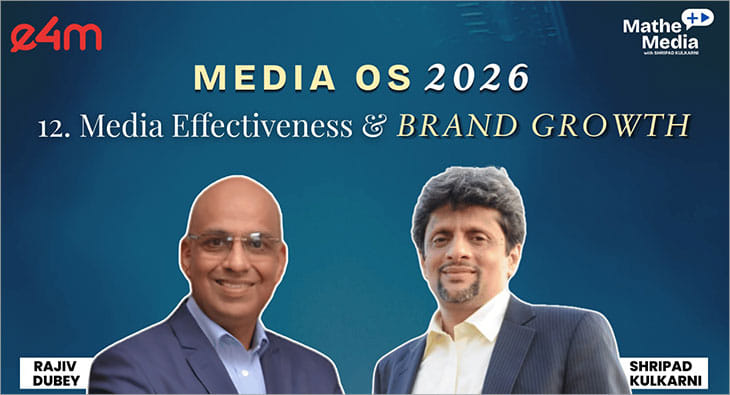

- Rajiv Dubey, Senior Vice President at Dabur, highlights the shift in media consumption from scheduled "Prime Time" to personalized viewing, necessitating a fundamental change in advertising strategies to focus on individual consumer behavior rather than traditional time slots.
- He identifies four distinct media ecosystems in India—digital video, broadcast TV, pay TV, and connected TV—each requiring tailored planning and budget allocation due to their unique audience profiles and engagement patterns.
- Dubey emphasizes the increased complexity in reaching audiences, noting that advertisers must now plan for significantly higher reach in online video compared to traditional TV, as audience fragmentation has intensified.
- He points out a critical gap in the industry: the lack of mid-level planners equipped to navigate this new landscape, suggesting that new training and development initiatives are necessary to create professionals who can integrate various media signals and data for effective advertising strategies.
Rajiv Dubey sits on the other side of the table from everyone else in the room. He is the client. The advertiser. The brand. While the agency heads, platform leaders, and broadcasters around him are each making a case for where the money should go, Rajiv is the one who actually has to decide — and then live with the outcome.
As Senior Vice President at Dabur — brands present in roughly 80 percent of Indian households, categories like oral care and hair oil north of 90 percent penetration — he has spent decades reading the media market from this side of the table. And what he is seeing now, he describes not with alarm but with the precision of someone who has learned to hold complexity without flinching.
From Prime Time to Personal Time
Rajiv's entry point is two letters. PT. For decades the most load-bearing abbreviation in media planning — Prime Time, the predictable gathering of audiences around a single screen on a broadcaster's schedule. He notes that the abbreviation has survived intact. The meaning has not.
“In good old days we used to call something called as PT, which used to be prime time. Now PT remains the same, but it’s become more of a personal time. So, I choose to watch or consume media as per my convenience in my own personal time.”
Scheduling power has moved — completely, irreversibly — from broadcaster to consumer. For an advertiser, this rewrites the brief at its foundation. You can no longer plan around a clock. You have to plan around a person.
Four Indias, One Budget
That person is present across four distinct media ecosystems — and Rajiv maps all with the bluntness of someone who has to actually allocate budget across them.
“You have the digital Video audience, which is around 600 million individuals. The Broadcast TV audience of about 700 odd million, which is broken down into 3. The free to air household, nowadays nobody talks about, which is about 50 million households in the country. There is a pay TV universe, which is about 100 million households in the country, which is declining, but still the largest. And then there is Connected TV – 65-75 million households, which overlaps with digital and broadcast. None of these can be ignored. So what happens is advertisers like us who is present in approximately 75 to 80 percent households all levels of funnels are very important. So, you have to look at all kinds of signals and then make a plan.”
And nested within the connected TV universe, a further layer: FAST TV, Free Ad Supported Television, with its own audience profile and planning logic. Four ecosystems — each with different signals, different behaviour, different economics. Behavioural data, purchase intent, content preferences, device type, transaction history, geographic markers. All of it flowing simultaneously. All of it requiring synthesis into a single coherent plan. This is not a refinement of old-model planning. It is a categorically different activity.
The Frequency Multiplier
One number Rajiv offers, reshapes the budget conversation entirely.
“Suppose for TV you are planning reach of 3+, for online video you have to probably look at a reach of 9+. So, it is becoming more complex for us you cannot ignore any of the medium you have to be present on large format and mass medium as well and as well as a target on a basis of precision and on the basis of behavioral signals etcetera.”
The reach demand has tripled. The audience has fragmented. The planning infrastructure has not kept pace. And each brand in the portfolio has a different task. The consumers for each are present everywhere. And segmented in a vey new way.
"And these new consumers are not only present on television only, they are present everywhere. If you go through the influencer route you talk to one audience, you go through the short video route you talk to a different set of audience. You go to a free to air household, pay TV universe, CTV, each is a distinct segment. eCom, Qcom can be one unifier.”
He grounds it in a specific brand problem: Dabur Honey, present in only 20 percent of Indian households. Growing that number can be done by marrying quick commerce signals with Meta data, targeting the unconverted, and converting fast.
“For a brand like Honey which is present only in 20 percent households, you want to increase the penetration of that category into much higher number of households. Here, ecommerce and quick commerce is giving you one solution. They are getting past behaviour, marrying with current in market signals and you can target those people and quickly convert signals into sales.”
A decade ago, this was science fiction. Today it is the baseline requirement for a mid-sized brand trying to grow in a fragmented market.
The Planner Who Doesn’t Exist Yet
The sharpest moment in Rajiv’s contribution is the quietest. Someone suggests a mid-level planner should be able to navigate the complexity he has laid out. His response is six words.
“So these planners do not exist right now. We have to create them.”
The platforms are live. The signals are flowing. The technology has arrived. The person who is supposed to synthesise all of it into a coherent plan does not yet exist in sufficient numbers. This is not a training gap. It is a generational one. The planners of the old world were built for GRPs and Prime Time. The new world requires someone who can move fluidly across four media universes, read behavioural signals, integrate commerce data, and present a unified measurement story to a CFO. No institution currently produces this person at scale. They will have to be created.
What Remains
Every default has broken simultaneously. Prime Time is gone. Rating-based planning is shaking. The 70-30 TV-to-digital split is history. The trained planner is scarce. A unified measurement framework does not yet exist.
This is not one disruption replacing another in an orderly sequence. It is a simultaneous dissolution — old certainties gone, new order not yet formed. What Rajiv is really describing is an industry in the middle of losing all its reference points at once.
What remains is a different kind of craft. Holding contradictions simultaneously — mass reach and precision targeting, brand building and performance conversion, linear and connected and FAST. Not choosing between them. Running all of them, at once, in service of a single brand goal.
"What should be the right mix — or is there a right mix at all which exists right now?"
Complexity is no longer the enemy of good planning. It is the planning. And the advertiser who thrives from here is the one willing to draw the map while walking terrain that nobody has charted yet.
Rajiv Dubey is a contributor to the Media OS 2026 Report, examining how Indian advertising is being rebuilt from the ground up. This piece has been curated by Shripad Kulkarni based on the conversation for the MatheMedia Podcast Series.
Read more news about Marketing News, Advertising News, PR and Corporate Communication News, Digital News, People Movement News
For more updates, be socially connected with us onInstagram, LinkedIn, Twitter, Facebook, YouTube & Google News
