AI slop is eroding brand trust: Channel Factory’s Kartik Mehta
At Pitch CMO summit 2026, Kartik Mehta, Chief Business Officer & Head of Asia Channel Factory, warned marketers against funding low-quality AI content
 by
by
Published: Jun 15, 2026 3:08 PM | 4 min read
 Follow Us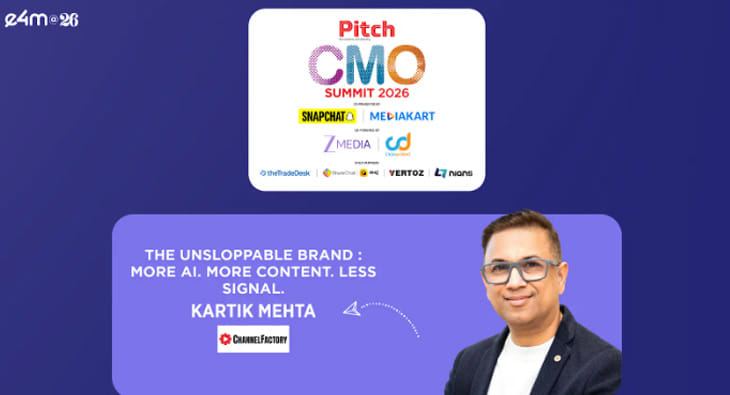

- Kartik Mehta, Chief Business Officer at Channel Factory, emphasized the need for marketers to prioritize the value of content over whether it is AI-generated, warning against the rise of "AI slop," or low-quality, monetization-focused content.
- Mehta noted that while poor-quality content has always existed, the speed and scale of AI-generated material have dramatically increased, leading to concerns about its impact on brand trust and perception.
- He advocated for a nuanced classification system for AI-generated content, identifying warning signs such as unusually high publishing volumes and repetitive content patterns to help brands avoid low-quality associations.
- Mehta urged advertisers to demand transparency from their agencies and media partners regarding ad placements, asserting that avoiding AI slop should be as fundamental as brand safety in the evolving advertising landscape.
As artificial intelligence floods social media platforms with an unprecedented volume of content, marketers need to stop focusing solely on whether content is AI-generated and start asking a more important question: does it add value to the brand?
That was the central message from Kartik Mehta, Chief Business Officer & Head of Asia Channel Factory, who cautioned advertisers about the growing threat of what he termed "AI slop" low-quality, mass-produced AI-generated content designed primarily for monetisation rather than meaningful audience engagement.
Speaking at the Pitch CMO summit 2026, Mehta argued that AI itself is not the problem. Instead, he pointed to the rapid proliferation of poor-quality content as the real concern for brands.
"AI is not the real enemy," Mehta said. "The real issue is what people call brain rot. If AI slop had only one key result area, it would be monetisation. Just make money. That's all. There's no value in it."
According to Mehta, low-quality content has always existed online. What has changed is the scale and speed at which AI tools can now generate such material.
"The kind of velocity at which low-quality content is now getting produced has shattered every threshold that existed before," he noted.
The executive highlighted the explosion of bizarre AI-generated videos across social platforms, from dancing cats and surreal fruit animations to mythological characters rendered in exaggerated forms, as examples of content increasingly populating users' feeds.
While industry bodies have begun addressing concerns around AI-generated media, particularly in areas such as voice cloning and disclosure requirements, Mehta believes the discussion must move beyond simply identifying whether content is AI-generated.
"It's not about asking, 'Is this AI-generated or not?'" he said. "The real question is: does this environment add value to your brand? Does it increase brand love? Does it create brand trust?"
For marketers, the consequences extend beyond traditional brand safety concerns. Mehta warned that advertising against AI slop can gradually damage brand perception while simultaneously contaminating the data used by increasingly automated advertising systems.
"Your dashboards may look great. Your views may look perfect. But what's happening to brand trust?" he asked. "Consumers aren't going to call you and say they saw your ad on a fruit-eating-fruit video. But it's eroding brand trust slowly but surely."
The problem, he argued, is amplified by AI-driven advertising ecosystems that rely on engagement signals to optimise campaigns. Poor-quality content attracting advertising dollars can influence both campaign performance metrics and future media-buying decisions.
To address the issue, Mehta called for a more nuanced classification system for AI-generated content. While current industry discussions often focus on broad categories, he revealed that Channel Factory has developed a framework that segments AI-generated content into five distinct risk levels using a combination of technological and behavioural signals.
Among the warning signs, he cited unusually high publishing volumes by creators.
"A good content team can produce two to four videos a day," he explained. "But when you suddenly see creators putting out 15 or 20 videos a day, that's a red flag."
He also pointed to recurring patterns in AI-generated content formats, including similar openings, structures and storytelling templates that can help identify content generated at scale.
Perhaps Mehta's strongest message was directed at advertisers themselves. He urged brands to demand greater transparency from agencies, platforms and media partners about where their advertisements are actually appearing.
"Demand transparency from anyone running your campaigns," he said. "Show me where my ad ran. That's the signal you need to feed back into your systems so that your ads don't end up next to AI slop again."
He added that any reluctance to provide such visibility should be viewed as a warning sign.
As the advertising industry becomes increasingly dependent on automation and AI-driven media buying, Mehta believes avoiding AI slop should become as fundamental as brand safety standards are today.
"Brand safety became table stakes as the industry matured," he said. "To me, avoiding AI slop should be table stakes as well. Brands simply cannot afford to fund content that is eroding trust."
His warning comes at a time when marketers are embracing generative AI across content creation, media planning and campaign optimisation. Yet Mehta's message suggests that while AI can be a powerful tool, advertisers must remain vigilant about the environments in which their brands appear and the long-term trust they may be sacrificing in pursuit of short-term metrics.
Read more news about Marketing News, Advertising News, PR and Corporate Communication News, Digital News, People Movement News
For more updates, be socially connected with us onInstagram, LinkedIn, Twitter, Facebook, YouTube & Google News