#e4mXplains: How AI interfaces are quietly becoming the next ad channels
The unit of value in digital advertising is shifting from interaction to outcome, from traffic to trust, and from optimisation to selection
 by
by
Published: Jan 24, 2026 8:41 AM | 7 min read
 Follow Us

Digital advertising has been organised around a simple unit of value: the click. Search advertising monetised intent by charging for it. Social media advertising monetised attention by interrupting it. Even performance marketing’s attribution models ultimately traced success back to whether a user clicked, landed, and converted.
That organising logic is now under quiet but accelerating pressure.
As AI interfaces like ChatGPT, Google’s AI-powered Search experiences, and Perplexity move from being answer engines to decision engines, the click is no longer guaranteed to exist at all.
Discovery, comparison, recommendation and even purchase are increasingly being compressed into a single interface, mediated by an AI system rather than a sequence of links. For advertisers and marketers, this is not just another surface to buy media on. It is a structural change in how demand itself is formed and fulfilled.
How India became Big AI’s favourite data mine
The scale at which this shift is happening is no longer trivial. By the end of 2025, ChatGPT was estimated to be serving well over 700 million WAU (Weekly Active Users) globally, with billions of prompts processed each week. A significant share of those prompts is already commercial in nature, ranging from product comparisons and travel planning to financial decisions and brand recommendations.
Perplexity, which positions itself explicitly as an answer-first search alternative, crossed an estimated 30 million monthly active users by mid-2025, with query volumes skewing heavily towards informational and decision-oriented use cases rather than casual chat. Average session lengths on conversational AI platforms are also materially higher than on traditional search, creating longer windows of intent expression rather than single-shot queries.
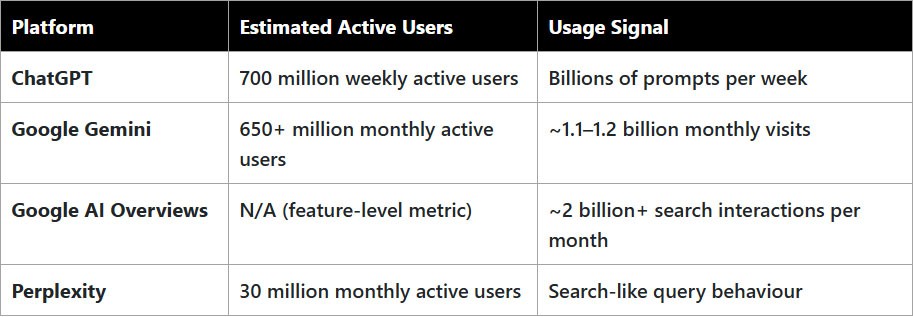
Google’s AI usage figures underline why this shift matters far beyond experimental chat interfaces. By late 2025, Google’s conversational AI ecosystem, now consolidated under the Gemini brand, was already operating at enormous scale. Independent analytics estimates put Gemini’s reach at over 650 million monthly active users globally, generating more than 1.1 billion visits per month across devices.
More importantly, Gemini is not a standalone destination in the way ChatGPT initially was. It is deeply embedded across Google Search, Assistant and Android, with AI Overviews reportedly appearing in over 2 billion search interactions every month. That means AI-mediated discovery is no longer a fringe behaviour but is being layered directly onto the world’s most heavily used information and intent platform.
For advertisers, this scale changes the conversation entirely. When AI becomes the default interface sitting in front of search, recommendations and product comparisons, advertising and commerce do not just gain a new channel. They gain a new decision-making layer.
e4m report card: AI in Indian marketing
At the same time, the economics of running frontier AI models have made one outcome inevitable. Training and operating large language models at scale costs billions of dollars annually in compute, infrastructure and talent. Subscriptions and enterprise licensing can offset some of that cost, but they cannot, on their own, monetise hundreds of millions of free users globally. Advertising remains the only proven mechanism for doing so at internet scale.
This is the context behind OpenAI’s recent articulation of its advertising approach for ChatGPT, where the company has made it clear earlier last week that ads will be introduced in a controlled, clearly labelled manner, separated from core responses, and governed by strict privacy commitments.
Open AI to test advertising in ChatGPT
The stated intent is to fund broader access while preserving trust, including assurances that conversational data will not be sold to advertisers and that ads will not influence model outputs. Similar moves are visible elsewhere.
Google is pushing towards agentic commerce through its Universal Commerce Protocol, designed to let AI systems handle discovery, comparison and checkout across merchants. Perplexity has begun embedding commerce and product actions directly into its interface.
Across the board, the direction of travel is the same: commerce and advertising are being pulled into the interface itself, rather than sitting one click away from it.
This is where the traditional logic of digital advertising starts to break down.
In an AI-mediated environment, users may never click through to a brand website. An AI system may summarise options, recommend a product, complete a booking or trigger a transaction without exposing the underlying funnel at all. The advertiser’s influence shifts from driving traffic to shaping outcomes. Visibility is no longer about ranking first on a results page or winning an auction for attention. It is about being selected by the model as the best answer to a user’s intent.
For marketers, this has two immediate consequences. First, the inputs that matter change. Structured product data, availability, pricing accuracy, fulfilment reliability, brand trust signals and relevance all become part of how AI systems evaluate options. Second, the outputs become harder to attribute using legacy models. If there is no click, no landing page and no session, last-click attribution becomes meaningless. Even multi-touch attribution struggles when the “touch” is a conversational exchange rather than a discrete interaction.
For India’s digital advertising ecosystem, this shift carries particular weight. By FY25, India’s digital advertising market had crossed the ₹50,000 crore mark as per per Crisil/Ipsos, with search and performance-driven formats accounting for well over half of all spends.
Mobile devices dominate consumption, contributing more than 90 percent of digital usage, and performance marketing has long been built on the ability to observe, track and optimise user behaviour at scale. That model is already under stress due to tighter data permissions, platform-level signal loss and regulatory scrutiny. AI-mediated discovery compounds that stress by removing the click as a dependable signal altogether.
Yet there is a paradox here. While AI interfaces may reduce observable signals, they also concentrate intent. A user asking an AI system to recommend a product or solve a problem is often closer to decision than a user scrolling a feed or typing a generic search query.
From a marketer’s perspective, this is high-quality intent, even if it is harder to instrument. The challenge is that confidence shifts from dashboards to trust. Brands may know less about how a decision was made, but they may trust the environment more if it is aligned with user needs and less dependent on opaque tracking.
This tension mirrors what marketers are already grappling with elsewhere. Trust in traditional performance dashboards has eroded as attribution models grow more complex and less transparent. Channels like Connected TV are gaining favour not because they offer perfect measurement, but because they promise less and feel more defensible. AI interfaces push this logic further. They force marketers to accept that influence may not always be measurable in familiar ways, and that performance may need to be evaluated through outcomes rather than pathways.
There are also competitive implications. As AI systems become the primary interface between users and information, platforms that control those systems gain enormous leverage. Decisions about which brands are recommended, which merchants are integrated, and which data sources are trusted effectively shape market access. This raises familiar questions about gatekeeping, neutrality and power, but in a form that is less visible than a search results page and harder to contest.
None of this will happen overnight. Clicks will not vanish tomorrow. Search ads, social ads and ecommerce marketplaces will continue to coexist with AI interfaces for years. But the direction is clear. The unit of value in digital advertising is shifting from interaction to outcome, from traffic to trust, and from optimisation to selection.
For marketers, the question is no longer whether AI will become an advertising surface. It is whether they are ready for a world where being chosen matters more than being clicked.
Read more news about Digital Media, Internet Advertising, Marketing News, Television Media, Radio Media
For more updates, be socially connected with us onInstagram, LinkedIn, Twitter, Facebook, YouTube & Google News
