When AI does the shopping, who sees the advertising?
For decades, advertising targeted people as decision-makers. With AI agents entering the purchase journey, marketers may now need to influence systems as much as consumers
 by
by
Published: Jun 10, 2026 9:10 AM | 7 min read
 Follow Us

- The rise of AI agents in consumer purchasing is shifting the advertising landscape, as these systems increasingly assist in product discovery, comparison, and decision-making, potentially complicating traditional marketing strategies.
- Google is leading the charge with its Universal Commerce Protocol, which aims to integrate AI interactions with transactions, laying the groundwork for AI-driven commerce.
- AI adoption in Indian marketing has surged, with a reported 73% year-on-year growth and a significant increase in budget allocation for AI tools, resulting in higher ROI for businesses using these technologies.
- Marketers are now required to appeal to both AI systems and human consumers, necessitating a dual approach that combines emotional branding with structured, data-driven information to ensure visibility and consideration in the AI-mediated purchasing process.
For decades, advertising has worked on a fairly simple assumption: the person seeing the message is also, eventually, the person making the decision. The medium changed from print to television to search to social to commerce platforms, but the basic premise held. Catch the consumer’s attention, shape preference, influence consideration, and hope the purchase follows.
AI agents could complicate that rather neatly.
As consumers begin using AI assistants and agents to discover products, compare features, shortlist options and eventually complete purchases, marketers may find themselves facing a strange new audience. Not just people, but the systems acting on their behalf.
Read On: AI is rewriting Indian marketing's OS. Is the industry ready?
This is no longer merely a futurist talking point. Google has already begun pushing infrastructure for agentic commerce through the Universal Commerce Protocol, an open standard designed to connect AI interactions with transactions. While widespread AI-driven purchasing remains some distance away, the foundations are being laid.
The broader AI shift is already underway. According to Cloud9Digital's 2026 AI marketing statistics, AI adoption in Indian marketing has grown 73% year-on-year, while roughly a quarter of marketing budgets are now being allocated to AI tools, up from 8% in 2024. The same report estimates that businesses using AI in marketing are reporting 3.5x higher ROI than those relying on traditional approaches.
That shift matters because AI agents do not behave like consumers. They do not get tired after comparing ten products. They do not respond to a celebrity endorsement. They do not develop an emotional attachment to a brand after seeing the same ad repeatedly. Instead, they evaluate information, compare options, and narrow choices based on signals that can be measured and verified.
If that sounds like a challenge for advertising, it is. But perhaps not in the way many expect.
Srinivasan Subramani, VP, Growth & AI, CleverTap, says one of the more interesting consequences of AI agents is that they “compress choice”. While mainstream use of personal AI shopping assistants remains early, platforms are already using AI extensively to filter, match and curate what consumers see.
“Tomorrow, consumers will increasingly rely on personal AI to do the exhaustive legwork of comparing reviews and features in seconds. But in both scenarios, the result is the same: marketing shifts from winning attention to winning consideration. If an agent, whether deployed by the platform today or the consumer tomorrow, narrows fifty products down to five before a human sees anything, the critical question becomes whether your brand was considered at all,” he says.
Read On: How commerce media is reshaping ad spends
That observation strikes at the heart of the issue.
Advertising has historically fought for visibility. The front page. The television break. The search result. The social feed. The marketplace banner. AI-mediated commerce introduces an invisible layer between discovery and purchase, one where products may be filtered, evaluated and ranked before a consumer consciously enters the buying process.
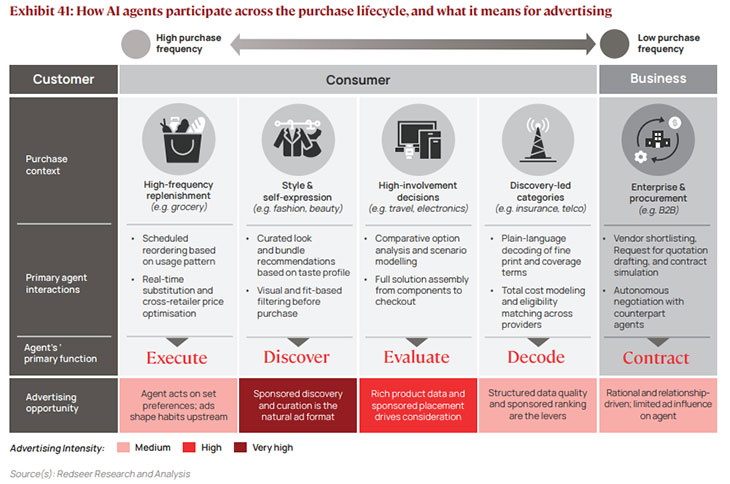
According to Mukesh Kumar, Associate Partner at Redseer Strategy Consultants, AI's role in the consumer journey is already becoming visible in certain categories. Discovery increasingly spans search, AI chat interfaces, commerce platforms and social media, while purchase decisions among informed buyers are already leaning more heavily on AI in categories such as travel, electronics, fashion and beauty.
(Photo Credits: Redseer)
Redseer's analysis suggests the impact will vary depending on the purchase context. In some cases, AI agents may simply automate replenishment. In others, they may act as recommendation engines, comparison tools or procurement assistants. The common thread is that the agent increasingly becomes part of the consideration process.
For marketers, that changes where influence happens.
Yaron Tomcin, CEO of Mobupps, believes brands will increasingly need to work for two audiences simultaneously. “AI may improve selection, but customers will still prioritize familiarity, credibility, and emotional connection. To be discoverable by AI systems and desirable to human consumers, companies should blend performance-driven marketing with long-term brand positioning,” he says.
That distinction is important because the rise of AI agents does not necessarily signal the death of branding. If anything, trusted brands may become more valuable.
When an AI system is asked to recommend a product, it needs signals. Reviews. Reputation. Product quality. Customer sentiment. Consistency of information. In many cases, strong brands already possess these advantages.
Sharat Kuttikat, Chief Creative Officer at Younion Brand Experiences, argues that brands must now operate on two tracks simultaneously. “Brands must now operate on two concurrent tracks: one that speaks to the human, with emotion, insight-influenced narratives and cultural resonance, and another that speaks to the machine, with structured information, consistent signals and trustworthy data. The brands that invest only in the former risk AI systems overlooking or misrepresenting them entirely,” he says.
The challenge is that these two objectives often sit in different parts of the organisation.
Brand teams focus on storytelling, emotional connection and distinctiveness. Data and digital teams focus on infrastructure, discoverability and performance. AI agents are forcing those worlds to converge.
The implications may be particularly significant in B2B and high-consideration categories, where discovery often precedes lengthy human-led sales processes.
Read On: Are brands building for LLM-mediated discovery?
Megha Agarwal, CMO at Table Space, says familiarity has traditionally been the moat in categories such as managed workspaces. Relationships, industry presence, publications and events helped brands stay top of mind among decision-makers.
That remains important, but there is now a parallel buying journey emerging. “A procurement lead at a GCC shortlisting managed office options in Hyderabad is increasingly starting with an AI search tool rather than just a broker call. What surfaces in that moment has nothing to do with how well-known your brand is. It has everything to do with how consistently and credibly your category signals appear across the web,” she says.
Her warning is particularly relevant for marketers who assume reputation alone guarantees visibility. “Reputation and discoverability by AI are not the same thing, and conflating them is where budgets quietly go wrong.”
That observation points to a broader shift underway.
Traditionally, advertising assets included creative campaigns, media plans and audience targeting. Increasingly, marketers may need to think of structured product information, reviews, expert coverage, ratings, pricing accuracy and third-party validation as advertising assets as well.
A brilliant campaign can create demand. But if an AI system cannot confidently interpret a product's value, specifications or credibility, that demand may never translate into recommendation.
Dipanjan Basu, Partner at Fireside Ventures, describes the shift as moving from “Share of Voice” to “Share of Model.”
“The new battleground is how AI models perceive and represent your brand. You're no longer optimizing for clicks, you're optimizing for citation probability inside an AI's reasoning chain,” he says.
That idea may sound abstract today. It could become increasingly tangible over the next few years.
Marketers already monitor search rankings, social engagement, share of voice and conversion rates. Tomorrow, they may be asking different questions. How often is our brand recommended by AI systems? Why are competitors appearing more frequently? Which signals influence recommendation engines? How visible are we inside AI-generated answers?
Some of the groundwork is already being laid. AI adoption across Indian marketing teams has accelerated rapidly over the past two years, with brands increasingly using AI for content creation, campaign optimisation, reporting and customer engagement.
Leslie C Morrison, VP Sales and Marketing at Tamara Leisure Experiences, says AI is already delivering impact across performance optimisation, media planning, measurement, creative production and customer journey optimisation. In hospitality, he says, AI is helping brands personalise communication, improve retention and anticipate guest preferences more effectively.
But the agentic commerce conversation goes beyond using AI as a productivity tool. It asks what happens when AI becomes part of the decision-making process itself.
Search engines became advertising platforms. Social networks became advertising platforms. Commerce marketplaces became advertising platforms. It is not difficult to imagine AI recommendation layers eventually following a similar path.
Google's own push into agentic commerce infrastructure suggests major platforms expect this behaviour to grow rather than remain niche. Meanwhile, industry observers increasingly describe retail media as evolving from keyword-led advertising towards AI-driven, intent-led product discovery.
For now, consumers remain cautious about handing over full purchasing authority to AI agents. Trust remains a constraint, particularly in high-value or high-risk categories. Yet the direction of travel is increasingly clear. The old advertising bargain was simple: buy attention, earn preference, drive purchase.
AI agents may not break that bargain entirely. They may simply insert a new negotiator between the brand and the buyer.
Read more news about Digital Media, Internet Advertising, Marketing News, Television Media, Radio Media
For more updates, be socially connected with us onInstagram, LinkedIn, Twitter, Facebook, YouTube & Google News