From ranking to representation: Are brands building for LLM-mediated discovery?
In part 2 of the LLM series, we explore why industry leaders believe the objective now is to influence the entire search experience, not just a results page & the need to think beyond a single query
 by
by
Published: Feb 27, 2026 9:11 AM | 7 min read
 Follow Us

The first phase of the AI search conversation focused on disruption. The second phase is about architecture. Large language models now sit between the user and the index. They do not simply retrieve links; they synthesise responses. They interpret multi-sentence prompts, infer layered intent, and generate consolidated answers that feel complete before a user encounters a traditional results page.
This mediation changes the competitive metric.
Which makes the structural shift of Search Advertising underway in search less a technical curiosity and more a strategic inflection point.
Read part 1 of this series: AI search after the hype
Preliminary figures from the Pitch Madison Advertising Report 2026 suggest India’s advertising market crossed approximately ₹1.55 lakh crore in 2025, with digital accounting for close to 60% of total spend under an expanded definition that now incorporates quick commerce and MSME digital investments. Early projections indicate the market could approach ₹1.74 lakh crore in 2026, with digital’s share rising further toward the mid-60% range.
Digital is no longer a challenger medium in India. It is the operating layer of the advertising economy. And within that layer, search remains one of the most commercially consequential environments.
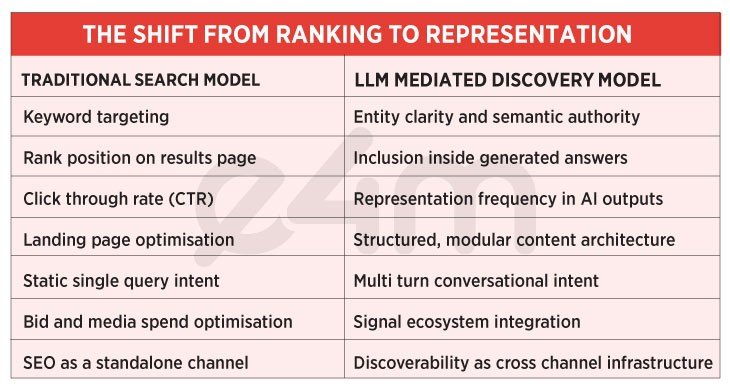
For two decades, discoverability in digital marketing revolved around rank. Position one meant visibility. Page two meant irrelevance. Entire ecosystems were optimised for incremental improvements in placement.
In an LLM-mediated environment, rank alone is insufficient.
If an AI system generates a summarised recommendation, comparison or answer block, the relevant variable is not where a brand ranks but whether it is represented inside that synthesis.
Signal architecture over keyword tactics
Large language models process language contextually rather than positionally. They parse meaning, relationships and entity associations across multiple sources before generating an answer. That shifts the optimisation burden from tactical keyword density to signal architecture.
Yaron Tomchin, CEO of Mobupps - a global mobile advertising solutions company - argues that brands must now “create content that search engines and LLM-led interfaces can interpret across multi-turn, conversational queries,” rather than focusing narrowly on ranking individual keywords. The objective, he suggests, is to influence the entire search experience, not just a results page.
Is AI search reshaping wellness advertising?
In practice, this means anticipating follow-up questions, structuring content in modular, fact-dense blocks, and ensuring that brand information is machine-legible through schema, clean HTML structures and consistent entity signals. It means thinking beyond a single query toward conversational pathways.
Multi-turn intent changes optimisation logic.
When a user asks an LLM for recommendations, then follows up with “why?” or “compare it with X,” the model draws from entities it already trusts. Brands that establish structured authority early in that exchange accumulate compounding visibility.
This is where first-party data, structured catalogues and coherent brand architectures begin to matter more than marginal bid adjustments.
This shift also has compounding implications for content strategy. As conversational queries increase in length and complexity, the data footprint of a brand becomes more important than individual landing pages. Tomchin’s emphasis on multi-turn interpretation reflects this structural reality.
When a model anticipates follow-up questions, it privileges entities that consistently appear across credible contexts. That consistency is built over time through structured publishing, authoritative backlinks, media mentions, and validated data points. In effect, discoverability becomes longitudinal. The brands that accumulate coherent signals across months and years gain disproportionate visibility in summarised outputs.
The economic consequences of this compounding dynamic become clearer when viewed against India’s accelerating digital investment landscape. With digital already commanding roughly 60% of total ad expenditure and projected to rise further, and with retail media expanding at over 30% annually, signal-rich ecosystems are multiplying.
As more ad budgets flow into structured commerce environments and performance layers, the informational web becomes relatively less central to monetisation. LLMs, drawing heavily from structured and validated datasets, naturally privilege those ecosystems. In such an environment, optimisation is no longer just tactical alignment with keywords; it is strategic alignment with structured signal economies.
Why video advertising in India no longer has formats only platforms
Commerce moves closer to conversation
If signal architecture determines inclusion, commerce environments increasingly determine signal density. The LLM shift is not confined to search engines alone; it extends into retailer platforms, apps and emerging conversational commerce interfaces where product information is already structured, validated and continuously updated. In such ecosystems, the raw material that feeds AI-generated recommendations is cleaner, richer and commercially closer to transaction.
Taranjeet Singh, Managing Director, APAC Venture Markets at Criteo, notes that “shopping discovery is expanding beyond traditional search engines into retailer platforms, apps, and LLM environments,” where structured catalogues, local inventory and real-time pricing provide the signals models rely on to surface credible recommendations.
This is strategically significant.
Retail media’s rapid growth in India is not just a budget reallocation story. It reflects the increasing value of structured commerce signals. Large language models trained to synthesise recommendations rely on high-confidence data inputs. Retail ecosystems, by design, provide structured, validated product data.
Optimising for LLM-mediated discovery therefore extends beyond Google. It requires feed accuracy, catalogue integrity, pricing transparency and cross-platform signal coherence.
Search does not vanish. It becomes one node within a broader conversational commerce ecosystem.
Inclusion becomes currency
One of the more under-examined implications of LLM mediation is the probabilistic nature of inclusion. Traditional search was deterministic in its visibility logic: if a page ranked in position one, it appeared in position one. In contrast, LLM-generated answers draw from multiple sources, weight them based on perceived authority and relevance, and synthesise output dynamically.
The same query can yield slightly different representations depending on context, phrasing, or follow-up prompts. This makes discoverability less about static optimisation and more about persistent signal strength. Brands are no longer competing only for placement; they are competing for interpretive trust inside the model’s training and retrieval layers.
Ravi Adhikari, Brand Lead at Chupps, frames the shift as a move from search engine optimisation to answer engine optimisation. “Shift from just SEO to AEO — Answer Engine Optimization. That means writing for how LLMs respond,” he says, arguing that structured FAQs, clear UVP-led content and pages built around real user questions are becoming central to discoverability.
The distinction is subtle but powerful. SEO optimised for index retrieval. AEO optimises for model interpretation. The former prioritised keyword alignment. The latter prioritises clarity, authority and structural legibility.
This is not cosmetic rewriting. It is architectural work.
The new KPI stack
If inclusion is currency, measurement must evolve accordingly.
Traditional search KPIs centred on rank, click-through rate and conversion rate. In an LLM-mediated environment, brands will increasingly need to track representation frequency within AI-generated responses, citation visibility, conversational share-of-voice and downstream assisted conversions linked to AI-origin queries.
This does not mean abandoning performance metrics. It means layering them.
PR, SEO, performance media and retail strategy can no longer operate in silos. Large language models do not recognise departmental boundaries. They ingest signals holistically.
Brands that build coherent authority across earned media, structured content and performance ecosystems will compound representation. Those treating channels as isolated optimisations risk fragmentation.
Increasingly, AI visibility is not just a marketing optimisation discussion; it is becoming a procurement and governance conversation inside CMO offices. As digital approaches two-thirds of total ad expenditure, boards and CFOs are asking how brands ensure structural discoverability in AI-mediated environments.
Investment decisions are beginning to extend beyond media buying toward data infrastructure, content architecture and retail signal integration. The question is no longer limited to “What are we spending on search?” but expanding to “Are we structurally visible inside the systems interpreting demand?” In that shift, AI readiness moves from a tactical line item to a strategic capability.
TL;DR
India’s advertising economy is expanding at scale. Digital dominates. Retail and mobile ecosystems deepen. Within that environment, large language models are reshaping how intent is interpreted and how exposure is allocated.
The competitive edge will accrue to brands that are structurally legible. That legibility is built through structured data, consistent entity signals, authoritative content, and cross-channel coherence. It is reinforced through commerce feeds and validated information ecosystems.
This is not a short-term optimisation cycle. It is infrastructure.
The early AI search debate focused on extinction. The current phase is quieter and more consequential. Discoverability is no longer purely positional; it is representational.
In a digital economy approaching two-thirds of total ad spend, inclusion inside the answer may prove structurally more valuable than occupying the top slot in a list.
Brands that adapt early will not simply rank well. They will be incorporated.
Read more news about Digital Media, Internet Advertising, Marketing News, Television Media, Radio Media
For more updates, be socially connected with us onInstagram, LinkedIn, Twitter, Facebook, YouTube & Google News