Great partnerships will always last: Amit Syngle, Asian Paints
At the launch of the PMAR 2026, Amit Syngle, MD and CEO of Asian Paints, addressed the evolving dynamics between advertisers, agencies and media owners in an era of constant disruption
 by
by
Published: Feb 26, 2026 4:54 PM | 10 min read
 Follow Us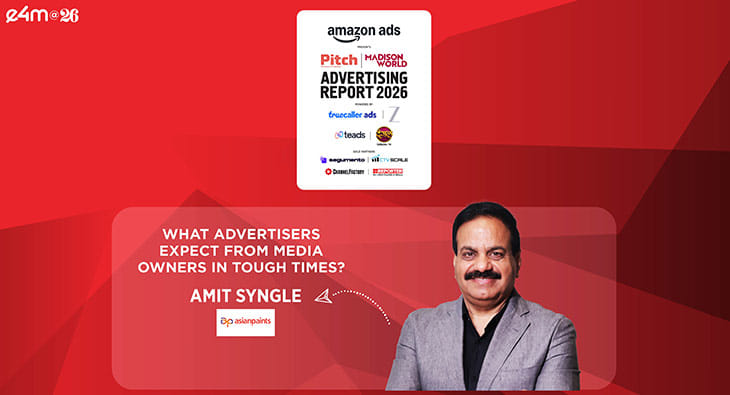

At the launch of the Pitch Madison Advertising Report (PMAR) 2026, Amit Syngle, MD and CEO of Asian Paints, delivered a candid and strategic address on resilience, relationships, and the evolving dynamics between advertisers, agencies and media owners in an era of constant disruption.
Opening his remarks by reflecting on the broader industry conversation, Syngle said, “It was quite exhilarating to hear Sam in terms of the trends, in terms of what’s really happening around. But sometimes I think we need to just keep those trends within us because some of us are trendsetters in terms of what we do, in terms of really seeing what changes we can bring to the industry.”
He underscored that the pace and nature of change today is fundamentally different. “I’m a firm believer of the fact that given what we see happening around, it’s a world of constant change, constant disruption. And this change is really very, very different in terms of what we are seeing,” he said. “It compels us to think very dynamically, to think on our feet, and really see how our strategies are far more aligned to the times.”
Advertising, he asserted, cannot be treated as discretionary. “At Asian Paints, one of the things we’ve truly believed is that advertising is not like an on-off button that you can decide to switch off whenever you want. It gives you fruits, whether in the short, medium or long term. If you are building a brand and your brand stands out, it is one of those triggers you need to keep on at it.”
Even as cyclicity plays out in business cycles, Syngle maintained that consistency in brand-building remains non-negotiable. “Times will change. Cyclicity will happen. But that’s the important thing in terms of what it brings in.”
Lessons from Covid: Prepared for the unexpected
Rewinding to the pandemic years, Syngle said Covid offered hard but necessary lessons. “COVID has really taught us a lot. The first part is that we should be prepared for the unexpected. In business parlance, that means the best today.”
He pointed to ambiguity as the defining feature of the present business climate. “Today, when we see ambiguity around us, decision-making in ambiguity is the skill which comes in. You could talk of algorithmic data patterns, but ambiguity management is a very big thing in terms of what we need to do.”
Emphasizing impermanence, he remarked, “Everything is transient. Even the worst is transient. Everything changes very fast. The cyclicity is very, very strong.” The only sustainable constant, he said, is relationships. “One thing which is sustainable is the whole parameter of relationships leading to partnerships.”
At Asian Paints, this philosophy is embedded into its distribution ecosystem. “When we reach out to almost 1.7 lakh retail points, we look at that relationship not only with that retailer, but also with the stakeholders across. That is very, very important for us to harness as we go forward.”
Empathy and certainty in uncertain times
Another key capability, Syngle noted, is empathy. “Unless we are putting ourselves in each other’s shoes and really thinking from that angle, it doesn’t give us dividends.”
He posed what he described as a critical leadership question. “How do you give certainty to an uncertain situation? That’s a skill very, very difficult to imbibe. But the moment, either as an agency or a media owner, you are able to say, ‘I can talk with certainty in an uncertain environment,’ it flips what you can offer and how the advertiser behaves with you.”
The Resilience Framework: A shared model
To structure his thoughts, Syngle introduced what he called a Resilience Framework that aligns advertisers, agencies and media owners.
“The first thing is very apparent, business-led thinking,” he said. “Unless you are able to put yourself in the shoes of the business, in terms of how business is thinking, it becomes very difficult.”
In a fragmented media landscape marked by micro-segmentation and AI-led disruption, this alignment becomes even more critical. “Now we are talking of AI sweeping everything, although I think the word is used very loosely. It is a lot of algorithms and data analytics. That is where putting yourself in that business seat really matters.”
He cited post-Covid workshops with Google as an example of collaborative, business-first engagement. “We had very interesting exercises with Google, fairly intense workshops. That was the time when the boom in digital was really happening. We got into creative and media discussions to decipher what we need to do and where we need to do it. That is more heartening than someone coming and saying, ‘Hey, I have three solutions for you, choose one.’”
Alliance over transaction
The second pillar, he said, is moving from transactions to alliances. “Sometimes there is an eagerness to sell a spot or a property. But in today’s world, that is changing. What matters is how you are partnering with the advertiser, how you are listening to the considerations the partner has.”
He illustrated this with Asian Paints’ Beautiful Home Painting Service, which he described as “the largest painting service in the world today.” “It spans across more than 1,000 cities in India,” he said, adding that it offers the company intimate consumer insights. “It gives us literally the understanding of consumer homes very, very intimately from the point of view of Har Ghar.”
Through alliances, the company moved beyond raw lead generation to business impact metrics. “From just generating raw leads, it looked at business impact. From just inventory considerations, it looked at reach and frequencies. It looked at parameters like share of search. Those parameters become very critical for us in seeing how we galvanize our monies in certain areas.”
Building long-term brand warmth
Returning to empathy, Syngle emphasized the importance of long-term brand tonality. “We need to think, are integrations giving us long-term impact? Are they giving us tonality and warmth of a very different nature? Is it a lasting proposition more than just an integration in that property?”
He cited the brand’s Wall of Legacy integration on Kaun Banega Crorepati as an example. “We felt the kind of salience, warmth and longevity it gave us was fabulous. You create a property with a media owner which is truly lasting. It gives you the confidence that here is a media owner thinking strategically and catering to the tonality of the brand.”
Clarity and adaptivity
Clarity, he said, is the backbone of collaboration. “Unless we are very clear that we have a shared vision, and unless all three, advertiser, agency, media owner, are aligned on the outcomes, it will never happen.”
Importantly, this clarity must be revisited. “It’s not that you invest once and it is done. You need to keep revisiting it. What was the objective set? With what clarity was it set? And how are we treading along?”
On adaptivity by design, Syngle stressed ongoing accountability. “We buy into a certain TVR and calculate a CPRP. But seldom do media owners or agencies look at mapping the objectives set at the beginning and see whether the value decided is coming in.”
He welcomed proactive monitoring. “Today someone is really monitoring that being with you in terms of fulfilling what you really set for. It is not that once you’ve kind of sold, you can’t help it in terms of what has really happened. I think a lot of media owners do that and it’s really a great thing, especially when times are a little bit tough, to create that relationship with such monitoring.”
Value beyond visibility
Syngle also spoke about visibility behind value, especially in high-clutter properties such as cricket. “When we look at cricket as a property, the clutter which you get is very, very difficult to really stand out from the point of view of what one is spending. You might get a lot of visibility but are you really standing out?”
He argued that advertisers and media owners must go beyond basic presence. “Are you aligning the impact? Are you aligning the network impact? Are there enough things coming in the form of vignettes and creatives which can possibly go beyond the value you have created? It is all about getting a whole lot of value by working with the brand and catering to the tonality of that cricket, bringing that thing very strongly in, and then seeing that the value is beyond what you are talking of.”
Responsible partnerships and innovation
The seventh pillar of his framework focused on responsibility and innovation. “When I say responsible, it’s about governance, ethics and integrity in how you work,” he said. “You need to align with the brand on what ethics it stands on and how you will work with the brand.”
At Asian Paints, he said, “we have a zero tolerance policy if something goes wrong. And we would really respect a media owner who stands for the kind of values you are speaking of.”
On innovation, Syngle stressed that brands must continuously reinvent engagement. He cited an example with Sun TV and Star Maa. “The top three leads in their leading shows were aligned to create a TV shade guide. It was phenomenal in terms of success. It reached millions of homes where people associated themselves with leading characters, bedroom, dining room and so on.”
He added, “It created something fantastic, from just innovation to something which really caught the fancy of people all across. It was a win-win, even in terms of the popularity of the shows.”
Endurance built on trust and intent
Concluding his address, Syngle spoke about endurance in partnerships. “Great partnerships will always last. We will have periods of disruption, change and slowdowns, but a great partnership would always last.”
He distilled relationships into two core elements. “When we look at relationships, there are two things which matter, trust and intent. These two are more important than volume and velocity.”
Ultimately, he said, the goal is to create a framework that compounds brand value. “It’s about making the brand stronger, looking at audience engagement and nurturing this partnership as we go ahead.”
Calling his approach “short and sweet,” Syngle added, “These are the golden rules we follow. I know they are not universal rules. But they are very strong from the point of view of any advertiser who would look at how to nurture in such a tough environment.”
With that, he concluded his session, leaving the audience at PMAR 2026 with a clear message that resilience is not reactive. It is a deliberate, values-driven and innovation-led framework for enduring brand partnerships.
Read more news about Marketing News, Advertising News, PR and Corporate Communication News, Digital News, People Movement News
For more updates, be socially connected with us onInstagram, LinkedIn, Twitter, Facebook, YouTube & Google News