PMAR 2026: Industry leaders on whether agencies serve clients or publishers
At the launch of the PMAR 2026, a panel of senior marketers delivered a blunt verdict on the agency ecosystem: ownership, transparency and business partnership matter more than scale or speed
 by
by
Published: Feb 26, 2026 12:29 PM | 4 min read
 Follow Us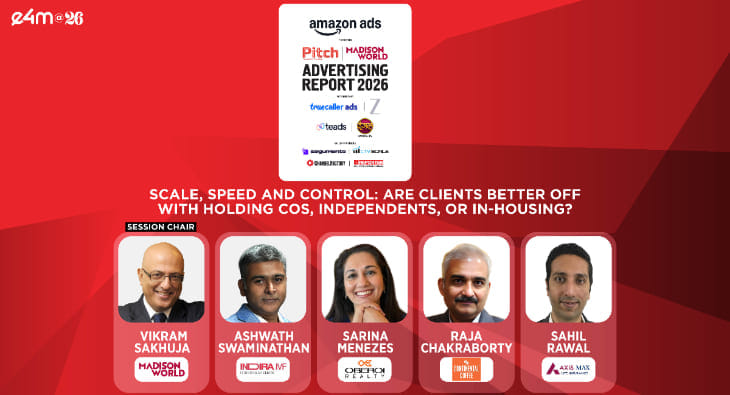

The question on the table was deceptively simple: in a world of holding companies, independent agencies and in-housing, who is best placed to manage modern marketing? The answer that emerged from a candid panel discussion at the Pitch Madison Advertising Report 2026 launch was far less tidy and considerably more challenging for agencies to hear.
The session, ‘Scale, Speed and Control: Are clients better off with holding cos, independents, or in-housing?’, was moderated by Vikram Sakhuja, Partner and Director at Madison Media, Madison World. The panel brought together senior marketers from MaxLife Insurance, Indira IVF, Continental Coffee and Oberoi Realty. Together, they painted a picture of an industry at an inflection point, where the traditional agency playbook is fraying at the edges, and clients are asking harder questions about value, alignment and trust.
The most pointed critique came from Raja Chakraborty, Chief Marketing Officer at Continental Coffee. "I don't think agencies today treat client's business as their business," he said. "Sometimes you do not know whether they're representing the client or they're representing the publishers." It was a charge that cut to the heart of a structural conflict that has been quietly growing as agencies deepen their relationships with digital platforms and trading desks.
Chakraborty called for a return to the rigour of an earlier era, when media agencies would "treat the client's business as their business" and do the hard analytical work of building models from data. "These learnings can only happen by trial and error," he added. "You can come up with a ready-made solution if, as an agency, you have got a learning curve and you can come back and say that through my pool of data, for your kind of brand, your kind of TG, this mix would work best."
The transparency argument was echoed powerfully by Sahil Rawal, VP – Marketing at MaxLife Insurance, who described it as non-negotiable in a heavily regulated sector. "Every penny that the customer is paying is pretty much tracked," he said, adding that his company demands "full transparency" from its agency partners.
Rawal also highlighted the challenge of unifying brand communication across the funnel; a problem he ultimately solved internally by restructuring his team. "We've changed structures internally. There is something called a one brand structure that we built internally that enables us to reorient the entire team, which is what I think is expected out of the independent ecosystem as well."
The conversation took an unexpected turn when Sarina Menezes, Senior Vice President & Head of Marketing at Oberoi Realty, pushed back on one of the industry's most prized selling points: speed. "I said to Sam, please don't give me anything in a rush. Please don't give me anything with speed. Please take your time and give me good work."
For a luxury brand where every creative output is an expression of an architecture-led, design-first philosophy, she said, quality and aesthetic integrity were the only currencies that mattered. What she looked for, she explained, was "an agency that has strong leadership. Because a strong leader drives their people to achieve the client's business objectives."
Ashwath Swaminathan, Chief Operating Officer at Indira IVF, offered perhaps the most expansive reframing of the discussion. Drawing on his background at Hindustan Unilever, he argued that even the FMCG world (long considered the gold standard for marketing discipline) is questioning its own assumptions. "There is no book today," he said. "The CPG world grew up on salience: build salience, the rest will take care of itself. That's getting rewritten."
For high-consideration categories like fertility treatment or life insurance, where consumer journeys are long and non-linear, he argued that agencies need to operate as "growth architects" rather than executional partners, building first-principles models rather than applying GRP-based templates. "We have to be constructing models that work for different industries based on the consumer journeys in those industries."
Sakhuja, reflecting on what the panel had surfaced, noted the irony that a discussion framed around scale, speed and control had kept returning to something altogether more human: "What came out resounding with the two of you is ownership, leadership, and understanding my business."
The message for agencies was consistent across the table. Clients are not primarily looking for the biggest buying pool, the fastest turnaround or the slickest integrated stack. They are looking for partners who care enough about their business to treat it as their own.
Read more news about Marketing News, Advertising News, PR and Corporate Communication News, Digital News, People Movement News
For more updates, be socially connected with us onInstagram, LinkedIn, Twitter, Facebook, YouTube & Google News
