Agencies must adapt to AI disruption without losing entrepreneurial energy: Ajit Varghese
At the launch of the Pitch Madison Advertising Report 2026, Ajit Varghese, Partner and Group CEO, Madison World, laid out a path to align agencies with growth, AI and full-funnel accountability
 by
by
Published: Feb 26, 2026 12:25 PM | 4 min read
 Follow Us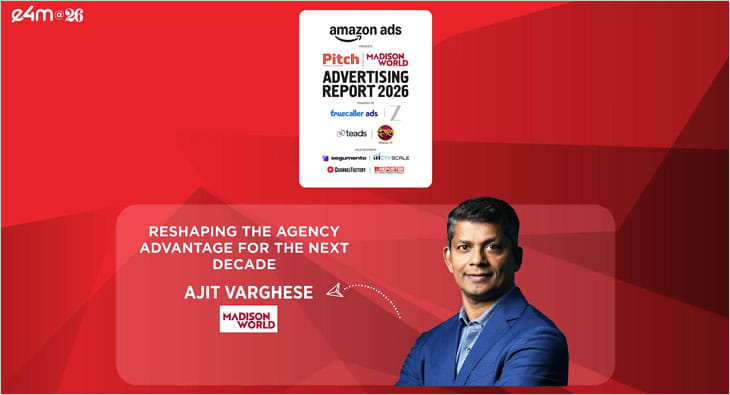

At a time when agencies are under pressure to prove their business impact, Ajit Varghese used the stage at the launch of the Pitch Madison Advertising Report 2026 to argue that the industry must fundamentally rethink its role. Speaking to a room of marketers and industry leaders, the Partner and Group CEO of Madison World said the traditional agency mandate is no longer enough in a market defined by growth accountability and AI-led disruption.
In a standalone session titled ‘Reshaping the Agency Advantage’ for the next decade, Varghese framed his return to Madison as a deliberate choice to drive that change. Having spent nearly eight years away from Indian agency life and then five years on the publisher side, he said the shift in perspective was stark.
The context, according to Varghese, is a market that now speaks the language of growth above all else. “If you look at every part of a business today, one of the biggest KPIs everybody is talking about is, ‘Am I contributing to growth?’ Every rupee being spent, every activity we do—is it contributing to growth?” he said. “It is time we put that at the centre of our being.”
The second force reshaping the agency landscape is artificial intelligence. “The transformation AI is bringing across every part of our journey, whether it is creative systems, workflows or consumer insights, is forcing us to pivot,” he noted. The challenge for agencies, he added, is to adapt to AI disruption without losing entrepreneurial energy.
Varghese simplified client expectations into four pillars, which he said have remained constant despite industry evolution. “Can you give me better consumer understanding? Can you create content or solutions that address their problem? Do you understand channels and platforms? And finally, can you drive action, whether it is clicks, engagement or sales?” he said.
While agencies have traditionally excelled in channel expertise, he argued that the value equation is shifting as publishers now offer full-funnel solutions and attribution capabilities. “Publishers have evolved radically in the last five or ten years. Does the agency have an intelligence layer of its own?” he asked.
To respond, Madison has identified a set of structural pivots. The first is a Growth Planning System, internally called GPS. “The single biggest pivot is making a media planner think business—think growth first and platforms later,” Varghese said. Instead of beginning with media choices, planners are encouraged to identify category unlocks and brand white spaces.
He acknowledged that cultural change across a 1,250-strong workforce is not easy. To institutionalise this shift, Madison is building an AI-powered assistant called mBrain. “This is a human-AI cognitive brain that accentuates our planners. It prompts us to think business and growth before we think platforms,” he explained.
Currently in beta testing, mBrain integrates Madison’s internal learning with large language models. The next step is developing a proprietary smaller language model to ensure that core intelligence remains within the organisation. “In a month and a half, we will launch the first version, where every planner can use it for client briefs and solutions,” he said.
On content, Varghese acknowledged the explosion of formats and the rise of AI-generated creatives. “When I ask a publisher what they can do, the answer is almost anything,” he said. Madison itself produced around 2,500 AI creatives last year, largely in performance and e-commerce.
However, he stressed that the agency’s role is not to compete with publishers but to integrate. “Each publisher can be an expert in their own ecosystem. The agency should play the horizontal. How do we integrate this into one solution that works for the client’s business?” he said, describing Madison’s ambition to act as a custodian of the content ecosystem.
The fourth shift involves deeper data and technology integration. “Let us not just talk about CPM. Let us talk about how it is contributing to growth,” he said, emphasising measurable return on ad spend and full-funnel accountability.
Finally, following the acquisition of Hiveminds in 2025, Madison is strengthening its performance and e-commerce muscle. “Today, we can talk branding, performance and e-commerce through the funnel rather than as different verticals,” he said, noting that many CMOs are consolidating these conversations under one leadership.
Varghese closed with a change in identity. “Twenty years back, we were proud to be called media planners. Going forward, I would love to be called a growth planner or a growth architect,” he said.
In an industry recalibrating around AI and accountability, his message was unambiguous. Agencies that fail to embed growth thinking into their DNA may find themselves edged out. Those that succeed could redefine their advantage for the next decade.
Read more news about Internet Advertising India, Marketing News, PR and Corporate Communication News, Digital Media News, Television Media News
For more updates, be socially connected with us onInstagram, LinkedIn, Twitter, Facebook YouTube & Google News