Forget Page One: The New Brand Battle Is to Become ChatGPT’s Answer
As AI assistants reshape online shopping, brands are shifting focus from Google rankings to AI recommendations, making trust, structured data and credibility critical for visibility.
 by
by
Published: Jul 29, 2026 10:26 AM | 8 min read
 Follow Us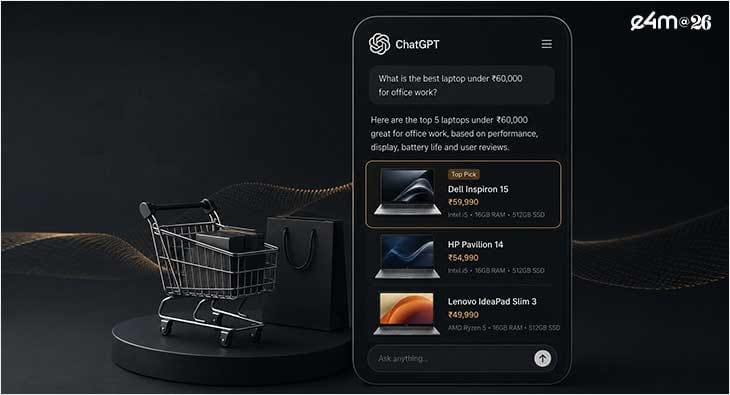

- Consumers are increasingly using artificial intelligence, such as ChatGPT, to seek product recommendations, shifting the focus for marketers from traditional search engine optimization to ensuring credibility for AI systems to recommend their products.
- A Pew Research Center study indicates that AI-generated summaries significantly affect user behavior, with users less likely to click on conventional search results when AI summaries are present.
- In India, a significant majority of online shoppers using AI tools report faster decision-making and increased confidence, with many open to allowing AI to make purchases on their behalf.
- Brands must adapt by providing accurate, structured product information and building credibility through third-party reviews and transparent content, as AI systems prioritize relevant and trustworthy data in their recommendations.
This story was originally published on MartechAI.com.
Consumers are beginning to ask artificial intelligence what to buy instead of searching through pages of links. For marketers, the challenge is no longer only to rank on Google, but to become credible enough for an AI system to recommend.
For more than two decades, digital discovery followed a predictable pattern. A consumer typed keywords into Google, opened several websites and gradually reached a decision. Brands built a large marketing industry around influencing that journey through search engine optimisation, paid keywords and product pages.
That journey is now being compressed into a conversation.
A shopper looking for a laptop can ask ChatGPT for five models under ₹60,000, specify that the device is meant for office work, remove brands they do not trust and request a final recommendation. The assistant can compare specifications, prices, reviews and trade-offs without requiring the user to visit ten different pages.
The change alters the role of the platform. Traditional search engines largely helped people locate information. Generative AI systems increasingly attempt to interpret it, compare alternatives and produce a usable answer.
For brands, the prize is shifting from appearing prominently on a results page to entering the AI-generated shortlist.
From blue links to a single answer
The early evidence suggests that AI-generated answers are already changing user behaviour.
A Pew Research Center analysis of 68,879 Google searches conducted by 900 US adults found that 18 per cent of searches in March 2025 produced an AI summary. When one appeared, users clicked a conventional result in only 8 per cent of visits, compared with 15 per cent when no summary was present. Users clicked a source cited within the summary in just 1 per cent of visits.
The implication is uncomfortable for publishers and brands. Their information may help create the answer even when the consumer never visits their website.
The users who do click through from an AI assistant, however, may arrive with stronger intent. Adobe Analytics found that traffic from generative AI services to US retail websites rose 693.4 per cent year-on-year during the November and December 2025 holiday season. AI-referred visitors converted 31 per cent better than other traffic sources, while revenue per visit was 254 per cent higher on a year-to-date basis.
India could become an important market for this transition. A Google and Ipsos study of 1,073 online shoppers in India who used Google AI Overviews or AI Mode for shopping found that 84 per cent believed the tools helped them decide faster and 87 per cent felt more confident. Google also reported that 86 per cent of Indian shoppers using Search were open to trying a new brand or product.
The next step may go beyond advice. A Google and Kantar survey of 4,598 active internet users in India found that 45 per cent of surveyed shoppers were comfortable allowing AI to purchase products on their behalf, provided they were notified before the final purchase.
The studies use different methodologies, but together they point towards a broader change: AI is moving closer to the point at which products are evaluated and shortlisted.
“Consumers are no longer searching; they are asking, and brands need to show up with the right answers at the right moment,” Abhirup Datta, CEO of Performance Practice, Media Solutions at dentsu India and CEO of Sokrati India, has said.
What ChatGPT actually evaluates
There is no publicly disclosed formula that allows a company to secure the top position in a ChatGPT recommendation. The system also does not use one fixed ranking mechanism for every shopping question.
OpenAI says ChatGPT selects products when it considers them relevant to the user’s intent. The answer can be shaped by the wording of the query, the conversation context and, where enabled, memory or custom instructions. Shopping research can use merchant product data, publicly available product information and other retail sources.
A request for “the best laptop” can therefore produce a different answer from one seeking a lightweight laptop under ₹60,000 for a travelling journalist. Budget, intended use and exclusions all change the task.
ChatGPT can compare information such as price, features and reviews, but product selection should not be confused with merchant selection. When several sellers offer the same product, OpenAI says merchants may be ranked using factors such as availability, price, quality and whether the seller is the manufacturer or primary retailer.
Organic product results are selected independently and are not advertisements or influenced by OpenAI partnerships. Advertising, where shown, is separate.
OpenAI has also expanded its Agentic Commerce Protocol to support product discovery through merchant feeds and promotions. Target, Sephora, Nordstrom, Lowe’s, Best Buy, The Home Depot and Wayfair are among the retailers integrated for discovery, while Shopify merchant data is connected through Shopify Catalog.
These integrations improve the completeness and freshness of available information. They do not guarantee a recommendation.
Generative AI also does not behave like a stable league table. A BrightEdge analysis of tens of thousands of identical prompts found that ChatGPT, Google AI Overviews and Google AI Mode produced different brand recommendations for 61.9 per cent of queries. All three returned the same brands in only 17 per cent of cases.
A brand can therefore appear prominently on one platform and be absent from another. Results can also change with prompt wording, location, availability and the sources retrieved.
Devajit Roy of LinkedIn has described the shift in blunt terms: “SEO would be a thing of the past, but GEO is going to be the thing of the future.”
SEO is unlikely to disappear. AI systems still depend on the open web, product pages and structured information. It is becoming the foundation for a wider discipline described as Generative Engine Optimisation, Answer Engine Optimisation or AI search visibility.
How brands can compete without gaming the system
The first requirement is accurate and structured information.
A consumer electronics company should not bury processor details, storage, warranty, battery capacity and weight inside promotional copy. Product specifications, variants, availability, returns and pricing should be consistent across the brand website, retailers, marketplaces and product feeds. Schema markup and machine-readable data can reduce ambiguity, although neither guarantees inclusion.
The second requirement is content built around real consumer decisions rather than isolated keywords.
A user may not ask for “running shoes”. The request could be for running shoes under ₹8,000 for a beginner with flat feet who mostly runs on roads. A brand hoping to appear needs content that clearly connects its products with budget, use case, experience level and limitations.
This creates a role for buying guides, comparison pages, FAQs and transparent explanations of product limitations. In India, brands must also consider questions asked in English, Hindi, Hinglish and regional languages.
The third requirement is credibility beyond the company’s own website.
AI systems can retrieve information from retailer pages, reviews, media coverage and other public sources. A brand’s claim that it offers the “best” product is weak evidence on its own. Consistent information, credible reviews and authoritative third-party references create a stronger digital footprint.
“Brand trust becomes a data asset,” Dipanjan Basu, Partner at Fireside Ventures, has said. He argues that brands will increasingly compete through machine-readable signals such as review authenticity, return rates, sustainability credentials and other forms of verifiable credibility.
Public relations, customer service and reputation management are therefore becoming part of AI visibility. Repeated complaints about fulfilment, misleading claims or poor after-sales service may give recommendation systems conflicting evidence.
Some brands in India have already begun treating AI visibility as a measurable channel. ASICS India started evaluating AI search and GEO initiatives in early 2025. Moneycontrol has also reported that Jio BlackRock and Birkenstock India worked with specialist firms to improve visibility across AI search platforms. Performance claims in this young sector are often reported by the companies or agencies involved and may not be independently audited.
That caution matters. No agency can credibly promise a permanent number-one ranking across ChatGPT, Gemini, Perplexity and Google’s AI surfaces. The systems use different sources and may produce different answers to slightly different prompts.
Brands should measure visibility through repeated testing rather than one screenshot. They can track how often they appear across high-intent questions, which competitors are mentioned, what information is inaccurate and whether the brand is presented positively or negatively.
The objective should not be to manipulate a chatbot. It should be to identify weaknesses in the public information surrounding the brand and correct them.
AI recommendations can still be wrong, and OpenAI advises shoppers to verify final prices, stock and shipping on the merchant’s website. Consumers may also use AI only to narrow their choices before watching reviews or visiting stores.
Brand building therefore remains essential. An algorithm may place a product in the consideration set, but it cannot automatically create heritage, emotional attachment or long-term loyalty.
Avirup Mukhopadhyay, Head of Marketing at Victorinox India, has captured that tension: “Being found matters less than being chosen.”
The next phase of marketing will require both. Ecommerce teams must maintain accurate feeds, content teams must answer complex questions, PR teams must build independent authority and customer teams must protect the review signals that influence trust.
The companies that succeed will not have uncovered a secret ChatGPT algorithm. They will have made themselves easy to understand, consistently represented and credible enough to recommend.
In the old internet, the winner appeared at the top of the page.
In the new one, the winner may simply become the answer.
Disclaimer: All data points and statistics are attributed to published research studies and verified market research. All quotes are either sourced directly or attributed to public statements.
Read more news about Marketing News, Advertising News, PR and Corporate Communication News, Digital News, People Movement News
For more updates, be socially connected with us onInstagram, LinkedIn, Twitter, Facebook, YouTube & Google News