Who regulates live TV on Big Tech? FAST players flag gap in TRAI’s ALTD plan
ICFC has welcomed TRAI’s efforts to establish a regulatory framework for the evolving ALTD ecosystem, while indicating that some recommendations merit further consideration
 by
Published: Oct 27, 2026 9:08 AM | 6 min read
 Follow Us


- The Telecom Regulatory Authority of India (TRAI) has proposed a framework for Application-Based Linear Television Distribution (ALTD) services, raising concerns among stakeholders in the Free Ad-Supported Streaming Television (FAST) and connected TV sectors regarding the exclusion of live streams on social media and the high registration costs for internet-native channels.
- Industry executives argue that the proposed framework could create a regulatory gap for live television-style channels on major platforms, which would not be subject to the same compliance and registration requirements as dedicated internet television services, potentially leading to an uneven competitive landscape.
- The proposed registration framework includes a ₹10,000 processing fee and an annual ₹1 lakh fee per channel, which could pose significant financial burdens on emerging digital-first channels still developing their advertising and monetization models.
- While TRAI's recommendations aim to establish regulatory clarity and consumer protection, industry stakeholders are advocating for a more balanced approach that considers the commercial realities of digital-first channels and seeks clarity on the treatment of livestreaming services on social media platforms.
The Telecom Regulatory Authority of India’s (TRAI) proposed framework for Application-Based Linear Television Distribution (ALTD) services has triggered concerns among Free Ad-Supported Streaming Television (FAST) and connected TV industry stakeholders over the exclusion of live streams on social media platforms and the cost of registering internet-native television channels.
The recommendations, released on October 26, seek to bring internet-based applications that aggregate and distribute scheduled television channels under a formal authorisation regime.
However, industry executives argue that the proposed framework could leave a regulatory gap for television-style live channels operating on major technology platforms, while imposing additional compliance costs on digital-first channels that are still developing sustainable advertising and monetisation models.
The two concerns highlight the challenge of establishing regulatory parity across television distribution platforms without discouraging emerging digital services.
TRAI drops sports signal-sharing mandate for internet TV, cites alternatives such as WAVES
TRAI okays bringing ALTD viewership into TV ratings, allows apps to publish audience data
From channel feeds to Ad revenue: How TRAI’s internet TV rules could affect broadcasters
Big Tech’s livestreaming exemption raises level-playing-field concerns
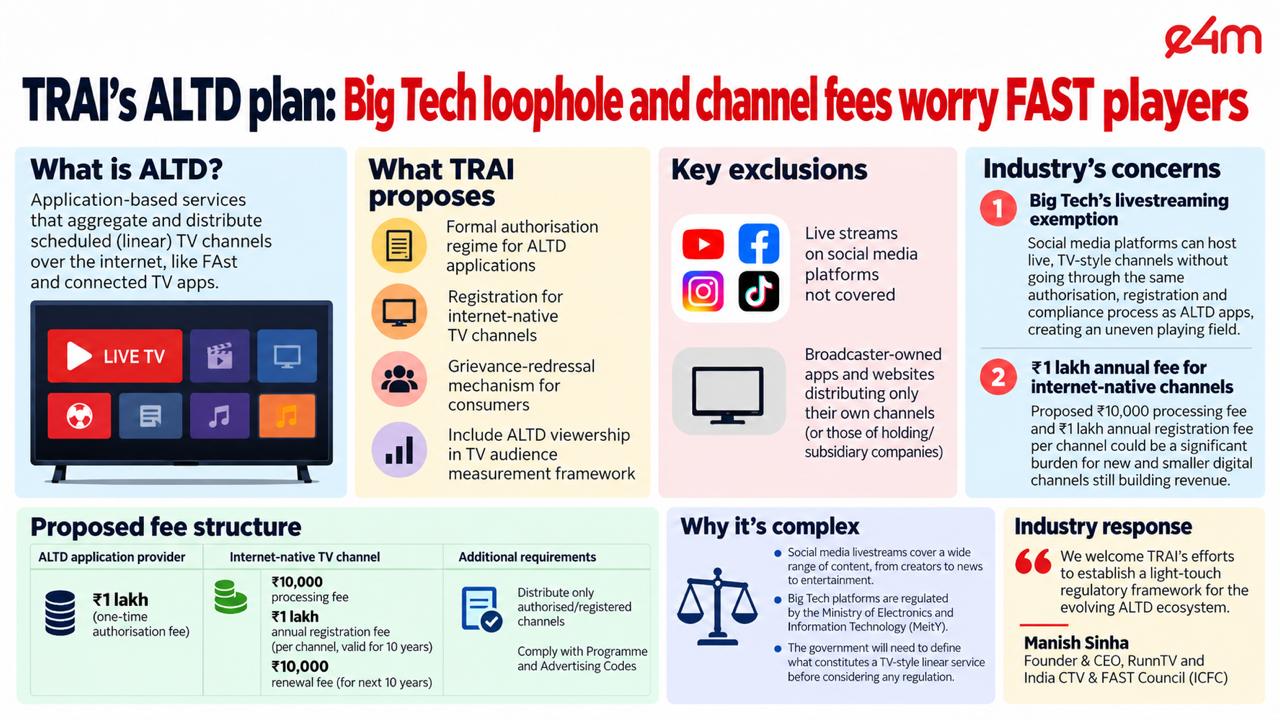
TRAI has explicitly excluded live streams on social media intermediaries from the proposed ALTD framework, alongside broadcaster-owned applications and websites that distribute only their own channels or those of their holding or subsidiary companies.
Industry executives contend that the exclusion warrants closer scrutiny because large technology and social media platforms can host live channels and reach substantial audiences without being subject to the same proposed authorisation, channel registration and grievance-redressal requirements applicable to ALTD services.
“Live channels operating on Big Tech platforms have an unfair advantage. They can reach audiences through livestreaming without going through the registration and compliance processes that a dedicated internet television platform may have to follow. Regulators need to examine this gap; otherwise, platforms could continue carrying television-style channels without comparable oversight,” an industry executive said.
The concern is particularly relevant as connected television platforms and internet-based distribution services expand beyond conventional cable and direct-to-home networks. FAST services offer scheduled programming over the internet, often supported by advertising, and compete for viewers and advertising budgets with established television distribution models.
Industry executives argue that regulatory obligations should be examined based on the service being offered, rather than determined solely by the technology platform through which audiences access it. They say a dedicated application aggregating linear channels could face a different compliance burden from a social media platform carrying similar live programming, potentially affecting competition and investment decisions.
“An application that aggregates scheduled television channels could be required to obtain authorisation, ensure that its channels are registered and provide a formal grievance-redressal mechanism. If comparable live television-style services can operate on social media platforms outside this framework, it creates an uneven playing field for companies investing in the FAST ecosystem,” a second industry executive said.
The issue, however, is not straightforward. Social media livestreams encompass a wide range of content, including individual creator broadcasts, news events, entertainment streams and other user-generated programming. Bringing all such activity under a television distribution regime could significantly widen the scope of regulation. Moreover, Big Tech platforms are regulated under the Ministry of Electronics and Information Technology.
The government would therefore need to define what constitutes a television-style linear service and assess whether specific categories of livestreaming warrant obligations comparable to those proposed for ALTD providers. The objective would be to address genuine regulatory disparities without extending broadcasting requirements indiscriminately to all online video.
₹1 lakh annual fee raises concerns for internet-native channels
The second concern relates to the proposed registration costs for internet-native linear television channels, particularly those that are yet to establish a stable revenue base.
TRAI has recommended a separate registration framework for channels created exclusively for ALTD services. The proposed structure includes a processing fee of ₹10,000 and an annual registration fee of ₹1 lakh per channel, with registration valid for 10 years and a renewal fee of ₹10,000 for a further 10-year period.
While the proposed authorisation fee for ALTD application providers is a one-time ₹1 lakh, the recurring channel-level fee could become a significant expense for operators launching multiple internet-native channels.
Unlike established broadcasters, which have developed advertising relationships and distribution arrangements over several years, digital-first channels are still working to build audiences, secure advertiser commitments and establish viable monetisation models. Revenue visibility can be particularly uncertain for niche and regional channels that require time to achieve sufficient scale.
Industry stakeholders fear that recurring registration expenses could discourage smaller operators from launching new channels or force platforms to limit the number of offerings they carry.
The cost becomes more relevant for businesses operating several channels under one umbrella. Although the proposed framework does not impose a recurring authorisation fee on the ALTD application provider itself, each internet-native channel would have a separate annual registration cost.
The proposed authorisation framework also requires application providers to distribute only channels holding the requisite government permission, authorisation or registration. Internet-native channels would need to comply with the applicable Programme and Advertising Codes.
The industry’s concern is therefore not simply the initial cost of entering the market, but the cumulative financial and compliance obligations that could arise before channels begin generating meaningful revenue.
ICFC welcomes light-touch framework
Manish Sinha, founder and CEO of RunnTV and the India CTV & FAST Council (ICFC), welcomed TRAI’s efforts to establish a regulatory framework for the evolving ALTD ecosystem, while indicating that some recommendations merit further consideration.
“We welcome TRAI’s efforts to establish a light-touch regulatory framework for the evolving ALTD ecosystem. The recommendations reflect a balanced approach that takes into account the current realities and future potential of the industry, while aiming to encourage wider industry participation and protect user interests. While there are a few recommendations that merit further consideration, this is certainly a positive start. We will study the recommendations in greater detail in consultation with industry colleagues and share our considered response.”
TRAI’s recommendations also propose a Master ALTD App Repository to help television manufacturers and operating system providers verify authorised applications, along with consumer grievance-redressal requirements and the integration of ALTD viewership into the television audience measurement framework.
The recommendations are intended to establish regulatory clarity for internet-based linear television distribution while improving accountability and consumer protection. They are proposals, with the final framework to be considered by the Ministry of Information and Broadcasting.
For the FAST and connected TV ecosystem, the eventual rules will need to balance these objectives with the commercial realities of digital-first channels. Industry stakeholders are likely to seek greater clarity on the treatment of livestreaming services on social media platforms and a proportionate registration structure that does not make experimentation economically difficult for emerging players.
Read more news about Television Media, Digital Media, Advertising India, Marketing News, PR and Corporate Communication News
For more updates, be socially connected with us onInstagram, LinkedIn, Twitter, Facebook YouTube & Google News