When IPOs become campaigns: The ethics of selling investment hype
As IPOs find their way into creator feeds, the growing overlap between influencer marketing and financial communication raises questions about transparency, intent and accountability
 by
Published: Oct 27, 2026 8:50 AM | 9 min read
 Follow Us


- The Jio Platforms IPO has gained significant attention on social media, particularly Instagram, where various creators discuss its details and prospects, blending financial information with entertainment content.
- With a subscription rate of 22.19 times and over 13.8 million applications, the IPO's popularity raises concerns about the potential for investment hype versus genuine financial awareness among audiences.
- The distinction between educational content and promotional messaging is critical, as influencers may unintentionally blur the lines, leading to potential regulatory and reputational risks.
- Regulatory bodies like SEBI emphasize the need for transparency in influencer communications regarding IPOs, highlighting the importance of clear disclosures and the responsibility of both creators and issuers in ensuring accurate information is shared.
If you have even a passing interest in finance, chances are you have come across a Jio IPO Reel on Instagram. It could be a financial creator explaining the offering, a podcast clip discussing its prospects, a fun Reel built around the listing, or even a lifestyle influencer bringing up the IPO in a conversation that has little to do with financial analysis.
https://www.instagram.com/reels/Dei2pDAzGAZ/
Scroll through Instagram, and the frequency of such content is difficult to miss. The Jio Platforms IPO has travelled beyond financial newsrooms and brokerage platforms into the feeds of creators across niches, turning a major market event into a social media talking point.
https://www.instagram.com/reel/DeuQiEYq2xd/?utm_source=ig_web_copy_link&srtk=MzRlODBiNWFlZA==
With a ₹30,213-crore offering, subscriptions of 22.19 times the shares on offer and more than 13.8 million applications, the scale of interest in Jio is undeniable. But as IPO conversations move into the creator economy, a question emerges: when does financial awareness become investment hype, and who is responsible for drawing the line?
https://www.instagram.com/reel/DeuQaU2zUH6/?rpxt=MWJ3dHJ5b2pka2p3
The question is not whether creators should discuss IPOs. Their content can make financial information accessible to audiences who might otherwise find offer documents and market terminology intimidating. The concern is whether audiences can distinguish independent commentary from promotional messaging, particularly when the content comes from personalities they follow for entertainment, lifestyle or business insights rather than investment expertise.
And this is not the first time an IPO has generated substantial buzz on Instagram. The public offerings of ESDS Software Solution and Tempsens Instruments (India) Limited this year also saw considerable social media activity, bringing IPO-related conversations to audiences beyond traditional financial platforms.
The latest wave of Jio-related content, however, puts the question of creator responsibility back in focus. Are influencers being approached to generate buzz around public issues, or are they independently discussing offerings because their audiences are interested? And if a commercial arrangement exists, how clearly is that relationship communicated?
How IPOs Are Entering the Creator Economy
The creators discussing Jio's IPO span different formats and audience segments. Content featuring personalities such as Prakhar Gupta, founder and host of The Prakhar Gupta Xperience, Viraj Seth, Co-Founder and CEO of Monk Entertainment, Actress and content creator Sahiba Bali, Bigg Boss contestant and travel creator Tanya Mittal sits alongside posts from lifestyle and beauty creators such as Shani Dhariwal, Diksha Pawar and Radhi Arora.
https://www.instagram.com/reel/DetOMAkhcOO/?obrf=MTh3d243ZDN6end3NQ==
Their content provides a window into how an IPO can become part of a much wider social media conversation. Financial explainers, podcast discussions and entertainment-led formats can all bring an offering into the public consciousness, although their objectives and approaches may differ.
The presence of such content does not, by itself, establish a coordinated campaign or a commercial relationship with the issuer. Some creators may be responding to a trending subject, while others may be producing content as part of a paid engagement. Establishing which is the case requires examining the individual posts and the arrangements behind them.
Several creators making Reels around the IPO were approached for this story to understand how they navigate IPO-related content, what a typical brief from a company planning an IPO looks like, and the responsibility they bear when discussing investment opportunities with their audiences. While some said their content was limited to creating buzz through “fun reels” around the IPO, others maintained that they could only inform audiences about an upcoming public issue and could not discuss its pros and cons or offer forecasts, citing their lack of SEBI registration.
https://www.instagram.com/reel/DevzZseI1FT/?mdxt=bjI3ZnZmemR4MTB4
That difference is significant. Explaining that an IPO is opening for subscription is not the same as recommending that audiences apply. Discussing a company's business is different from suggesting that its shares will deliver listing gains. Yet, when these messages are delivered through short-form content, the distinctions can become less apparent to viewers.
The fine print of marketing an IPO through creators
Yasin Hamidani, Director, Media Care Brand Solutions, believes IPO-related influencer engagements require tighter controls than conventional brand collaborations. “From an influencer-marketing perspective, an IPO brief should be far more controlled than a normal brand collaboration. The focus would typically be on explaining the company, its business model, sector, IPO dates, issue structure and where investors can access official information. Deliverables may include Reels, YouTube explainers or social posts, but every factual claim needs to remain aligned with the offer document and go through compliance and merchant-banker approvals. This is not a category where creators should be given complete creative freedom.”
The question is what happens when the messaging moves beyond explaining the issue and towards generating excitement about its investment potential. “This is precisely where the line needs to be very clear. A creator should not be promising listing gains, predicting returns or positioning an IPO as a must-buy,” Hamidani added.
https://www.instagram.com/reels/DerJdewvfqw/
“Education should remain education. Once a paid creator starts recommending subscription, forecasting listing gains or manufacturing urgency, the communication has moved from explaining an IPO to influencing an investment decision and that is where both regulatory and reputational risk increases significantly,” Hamidani added.
Views, virality and the investment decision
Sanjay Laul, Founder at MSM Unify, pointed to the shift in how investors discover public offerings. “IPO discovery has moved from the newspaper ad and the broker's research note to the reel, the Telegram channel and the hourly grey market premium tracker. The scale of this shift is no longer anecdotal. According to SEBI’s Annual Report for FY26, 62 per cent of retail investors have been affected by financial influencers online.”
Laul said investors should examine the substance of the content rather than relying on its popularity. “An investor can start by looking at the foundation of the content. Reliable analysis is built upon the red herring prospectus - risks, percentage of issue being offered for sale versus coming directly from IPO, use of funds, comparison with competitors. On the other hand, promotional content sticks to subscription numbers, GMP and urgency. A second test is identity. As of May 1, 2026, entities regulated by SEBI along with their respective representatives must display their registered names and registration numbers on social media platforms as well as in the introductory segments of posts and videos related to investments.”
The concern is particularly relevant to first-time investors, for whom a popular creator's confident delivery may carry more weight than the underlying financial information.
“In a country like ours, how many retail investors actually conduct a detailed due diligence exercise before applying for an IPO. For many, the decision may be influenced by what they see on social media, hear from peers or infer from market sentiment. They may not even know the details of certain ratios. When a familiar influencer presents a confident view, it can create a perception of credibility without necessarily offering the depth of analysis needed to make an informed investment decision,” said Amol Mohandas, Media and marketing strategist.
The accountability gap in IPO marketing
The growing overlap between financial communication and creator marketing also raises questions about the reach of existing safeguards.
“SEBI norms restrict regulated entities from associating with unregistered finfluencers who give recommendations or make return claims. Giving advice about securities without SEBI registration is not permitted. SEBI has raised concerns in the past too that finfluencers were promoting IPOs instead of objectively informing investors of merits and risks,” said Manisha Kapoor, CEO & Secretary General, ASCI.
“Any influencer content must avoid return claims, price targets and listing-gain talk. Educational content about the process, such as how to read a draft red herring prospectus, is permitted,” she added.
Kapoor said the advertising code also applies to influencer communication. “The ASCI Code requires advertising to be honest, truthful and not misleading, irrespective of the platform or format used. It also requires financial influencers to be registered or have licences of the with appropriate statutory authorities, or the necessary qualifications. Influencer promotions around IPOs must be assessed in this context.”
https://www.instagram.com/reels/De9EIjwIXIt/
“Advertisers and influencers must ensure that none of their communication misleads consumers or violates SEBI norms or the ASCI Code,” Kapoor reiterated.
The more difficult question concerns accountability when content is commissioned through multiple parties. If an issuer, intermediary or agency pays creators to publish IPO-related content, the nature of the arrangement, the claims being made and the disclosures provided become central to assessing the communication.
Mohandas said the responsibility cannot rest on creators alone. “The distinction between independent analysis and paid IPO promotion therefore becomes critical. Commercial relationships, sponsorships and referral incentives must be transparently disclosed, and promotional claims should not create unrealistic expectations of listing-day returns.”
“The primary responsibility should lie with issuers, merchant bankers and brokers who commission, facilitate or distribute such campaigns. They need to ensure that the communication is accurate, balanced and does not mislead investors. Influencers, in turn, must recognise that audience reach is not a substitute for investment expertise.”
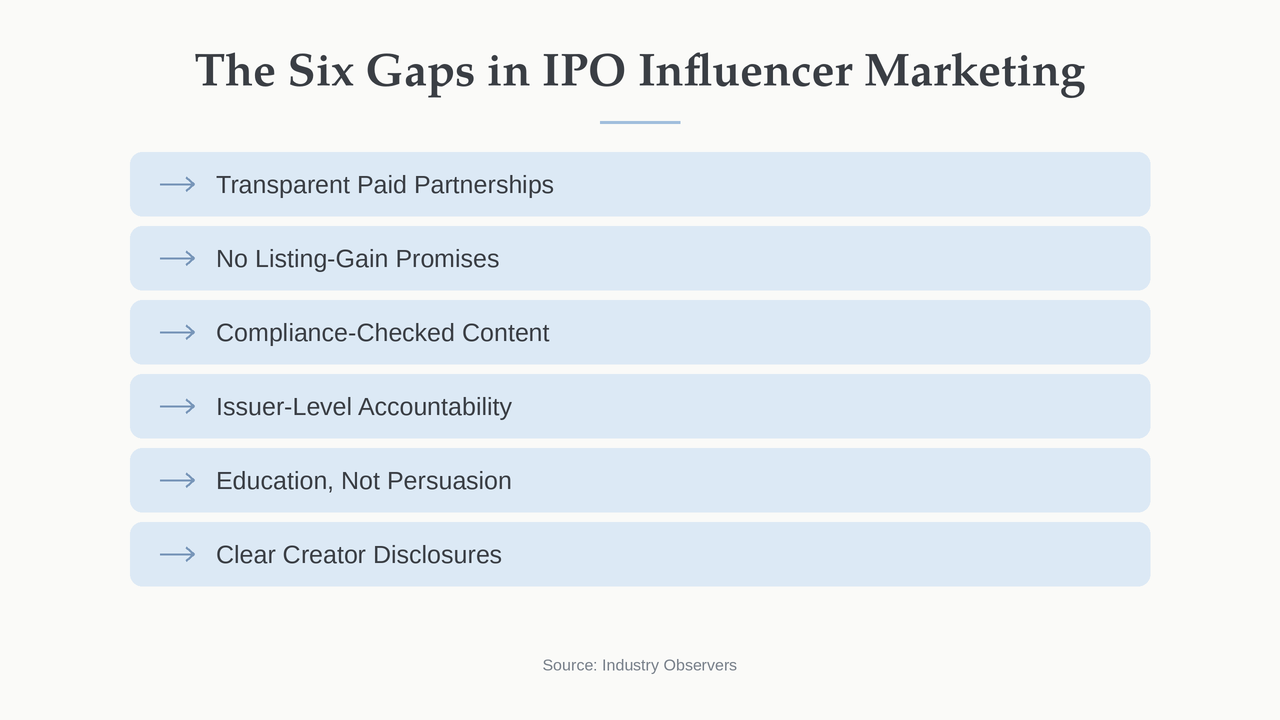
Organic buzz or paid promotion? The question remains
The popularity of IPO-related content raises a wider question about how financial information is packaged and consumed in the creator economy because commercial promotion can be difficult for audiences to distinguish from independent commentary when both appear in similar formats. Establishing whether creators were asked to generate buzz around the Jio IPO, or whether they independently joined a conversation that was already gaining traction, requires evidence of briefs, payments, disclosures and commissioning arrangements. The content alone cannot answer that question.
What is clear is that the responsibility extends beyond the person appearing on screen. Agencies and commissioning parties need to consider the accuracy and transparency of the messages they distribute, while creators need to recognise the difference between attracting attention and influencing an investment decision.
As Mohandas put it: “India’s regulatory framework addresses several aspects of misleading market communication and unregistered financial advice, but accountability across a rapidly evolving digital ecosystem remains a challenge. It is important to draw a clear line between education and persuasion, than to simply discourage financial content creators.”
For investors navigating an IPO through a stream of Reels, clips and commentary, that distinction may be the most important one of all. A crowded feed can signal public interest, but it cannot substitute for due diligence. And when an investment opportunity becomes a social media conversation, transparency about who is speaking, why they are speaking and what they stand to gain matters as much as the message itself.
Read more news about Digital Media, Internet Advertising, Marketing News, Television Media, Radio Media
For more updates, be socially connected with us onInstagram, LinkedIn, Twitter, Facebook, YouTube & Google News