The ad after the ad: Are brands now designing for the conversation?
As ads enter ChatGPT, Gemini, and Copilot, Indian creative leaders say the brief must plan for what a brand says after the ad ends
 by
by
Published: Sep 29, 2026 9:18 AM | 8 min read
 Follow Us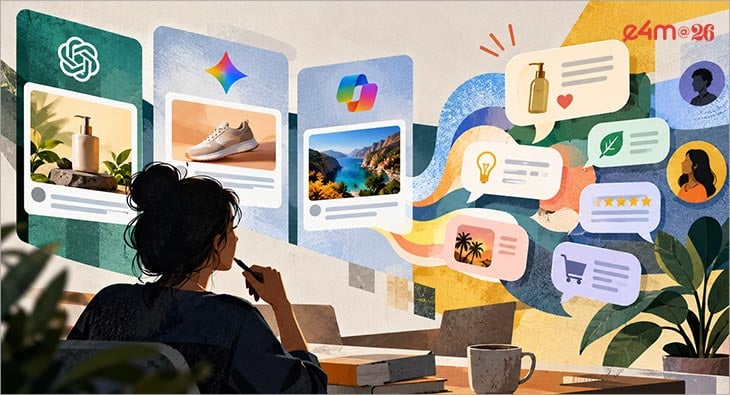

- OpenAI, Google, and Microsoft are integrating paid placements and sponsored answers into conversational AI platforms, shifting the advertising landscape from traditional formats to interactive dialogues with consumers.
- Agencies are adapting to this change by redefining creative briefs to focus on ongoing conversations rather than just initial impressions, emphasizing the importance of dynamic engagement in brand loyalty.
- The Indian advertising market is experiencing significant growth in digital spending, particularly in conversational commerce, with projections indicating a substantial increase in both local and global markets.
- Experts highlight the need for brands to navigate the unpredictability of consumer interactions in real-time, balancing scripted responses with the flexibility to engage meaningfully, as the conversation after the ad becomes central to marketing strategies.
The ad used to end when the film cut to black or the banner stopped loading. That boundary is dissolving fast. OpenAI began testing paid placements inside ChatGPT in February 2026, running static sponsored links at the bottom of AI-generated responses for its free and low-cost tiers, while Google has started experimenting with sponsored answers inside Gemini conversations. Microsoft's Copilot has reported click-through rates far higher than traditional search advertising, and Perplexity has been running its own version of the format for over a year.
For an industry used to designing hooks, headlines and fifteen-second cutdowns, this changes the basic unit of creative work. The ad is no longer the final artefact a consumer sees. It is the opening line of a conversation the brand may then be asked to continue, in real time, without a script.
When the brief doesn't end at the ad
The shift is already showing up in briefs, if only tentatively. According to Aalap Desai, CCO and Co-founder of tgthr, the Mumbai-headquartered full-funnel creative agency he founded in 2023 after heading Dentsu Creative's India and West operations, clients are beginning to ask for the conversation, but not yet for the risk that a genuine conversation carries.
“Conversations are unpredictable. We do receive briefs that ask for them, and it's always good for the campaign to be discussed after the launch, but you can only plan it to a certain extent. You can put in cues and hope that people pick it up. Putting in controversial points intentionally is a brief I'm yet to receive in India,” he said.
That gap, between wanting the conversation and being willing to engineer its edges, is where the industry's discomfort really sits. It is also, on The Glassbox's reading, where the job description itself is being rewritten. Vishal Nicholas, Chief Creative Officer at The Glassbox, the Komerz-owned brand and marketing consultancy whose client roster spans McDonald's, Tata Motors and Star Health, frames it as a structural change rather than an incremental one.
“The traditional brief ends at the first impression; the modern brief begins there. We aren't just designing an impression or a brand hook anymore; we are creating a dynamic dialogue tree. The 'after-ad' is where true engagement, conversations and loyalty actually happen,” he said.
Now put money behind the mood. India's ad market crossed ₹1,55,105 crore in 2025 under the Pitch Madison Advertising Report's expanded AdEx definition, up 12% over the previous year, with Digital already accounting for 60% of all spending. By 2026, that expanded AdEx is projected to touch ₹1,74,605 crore, pushing Digital's share closer to 64%. Two lines inside that number matter for this story. Quick commerce advertising jumped 202%, from ₹1,325 crore to ₹4,000 crore in a single year, and MSME digital spending grew 21% to ₹35,814 crore, both categories that live almost entirely inside chat-first, recommendation-driven interfaces rather than traditional display.
Globally, the picture is still starker. Conversational commerce spend is estimated to have jumped from $41 billion in 2021 to $290 billion in 2025, nearly sevenfold in four years, and shoppers who use an AI assistant during a purchase are said to convert at more than four times the rate of those who don't. ChatGPT alone is now reported to field over 50 million shopping-related queries a day. India's conversational AI market, valued at $361.3 million in 2023, is projected to grow to $1.85 billion by 2030, at a compound rate of over 26%, and homegrown platforms are moving to meet it.
Meesho launched Vaani, billed as India's first Gen-AI-powered conversational voice shopping assistant, in March 2026, built explicitly for the next 500 million users who describe what they want rather than typing it into a search bar, while Flipkart has paired its GenAI assistant Flippi with a Sarvam AI-built voice bot on WhatsApp for its wholesale buyers. Every one of these numbers, Indian and global, is pointing at the same underlying fact. The conversation is no longer a footnote to the media plan. It is fast becoming the media plan, always-on in a way a thirty-second tentpole film never had to be.
Teaching the brand to answer back
If the conversation is now inventory, the obvious next problem is tone. A television commercial can be storyboarded frame by frame; a chat cannot be, because the consumer holds half the script. That is forcing agencies to think less like copywriters and more like people training a new employee.
Nicholas describes the shift as one from writing lines to writing boundaries. “I think it requires moving from rigid scripts or fixed responses to behavioural guardrails. You define the brand's core values, vocabulary, and emotional boundaries, allowing the AI to contextualise responses natively. It's about training the system and helping it learn rather than typical mechanical answers,” he said.
Desai's answer to the same problem is almost the opposite instinct, and it is worth sitting with. Rather than engineering the system, he wants the human kept firmly in charge of it. “I look at AI as a tool for human expression. The human translates everything. AI is a tool for expression of what has already been set. If we have human intelligence taking care of the mandates, the tool doesn't matter,” he said. Read together, the two views describe two ends of the same rope rather than a disagreement. Guardrails decide what the system is allowed to say, and insight-led human judgement decides what the brand actually means by it.
Where this gets tested is not really inside a chatbot at all, but in the far more chaotic version of “the conversation after the ad” that Indian brands already know well: social media. Sneha Iype, Founder-Partner and Executive Producer of Nirvana Films, the Mumbai production house she co-founded in 2001 and which is best known for creating Vodafone's Zoozoo campaign, argues that most brands never actually get a dialogue with their audience at all. “As a brand, you can always operate in a safe zone. There is no reason to take any risks strategically unless there is an interest or ideology behind the idea that the brand hopes to bring to the viewers' minds and start a conversation of some kind around it in relation to what the brand stands for,” she said.
2025 offered a clean illustration of what happens when a brand does take that risk, whether intentionally or not. When jewellery brand GIVA's Raksha Bandhan campaign featuring actor Kriti Sanon drew criticism over its styling and its interpretation of the festival, the backlash escalated within days into a full-blown cultural and political argument, pulling in actor and BJP MP Kangana Ranaut's public criticism on one side and Congress leader Rahul Gandhi's commentary on the other, before GIVA withdrew the film altogether, saying it had “inadvertently” hurt sentiments.
The episode is close to a textbook case of Iype's point. “Given the social media construct, however, it's never a dialogue. It's usually only a monologue. But yes, brands never go seeking negative publicity. It's unpredictable, and if that happens, the team needs to know how much damage control to do or sometimes even to just sit back and watch while the world in all likelihood would move on to the next sensational thing,” she said.
The line that keeps the conversation alive
For all the risk it carries, none of the three agree that the after-ad can be skipped, or even treated as a secondary line item under the main campaign. Desai's reading is that it always was the more important half of the equation, AI or no AI. “It has and will always be important because it is a reflection of how interesting your campaign has been. No brand is created in one shot. You notice the brand because of something interesting, but it's the next one that keeps you interested,” he said.
Nicholas takes that logic to its harshest conclusion, arguing that the industry's habit of treating a launch as the finish line is now a genuine liability. “It will, in fact, become more important. The initial campaign is merely the invitation; it's the equivalent of a first glance, but the ensuing conversation is the actual relationship. If a brand cannot sustain a compelling, intelligent dialogue after capturing attention, the initial creative investment is ultimately wasted. So a creative idea in its inception itself has to include thinking for the ensuing conversations,” he said.
Iype's closing thought is a reminder that accountability for that conversation does not sit with the algorithm, however well it has been trained. “In the meantime some heads could roll at the corporate end if the leaders aren't aligned to take that calculated risk,” she said.
As sponsored answers move from pilot to platform default across ChatGPT, Gemini and Copilot, and as Indian brands increasingly get discovered through voice bots and GenAI assistants rather than search bars, the industry's oldest creative question, what happens after the ad, has stopped being a nice-to-have addendum to the brief. It is quickly becoming the brief itself. The agencies that treat the first line as the whole job may still win the pitch. The ones that plan for the second, third, and fourth lines are the ones likely to keep both the client and the consumer in the room.
Read more news about Internet Advertising India, Marketing News, PR and Corporate Communication News, Digital Media News, Television Media News
For more updates, be socially connected with us onInstagram, LinkedIn, Twitter, Facebook YouTube & Google News
